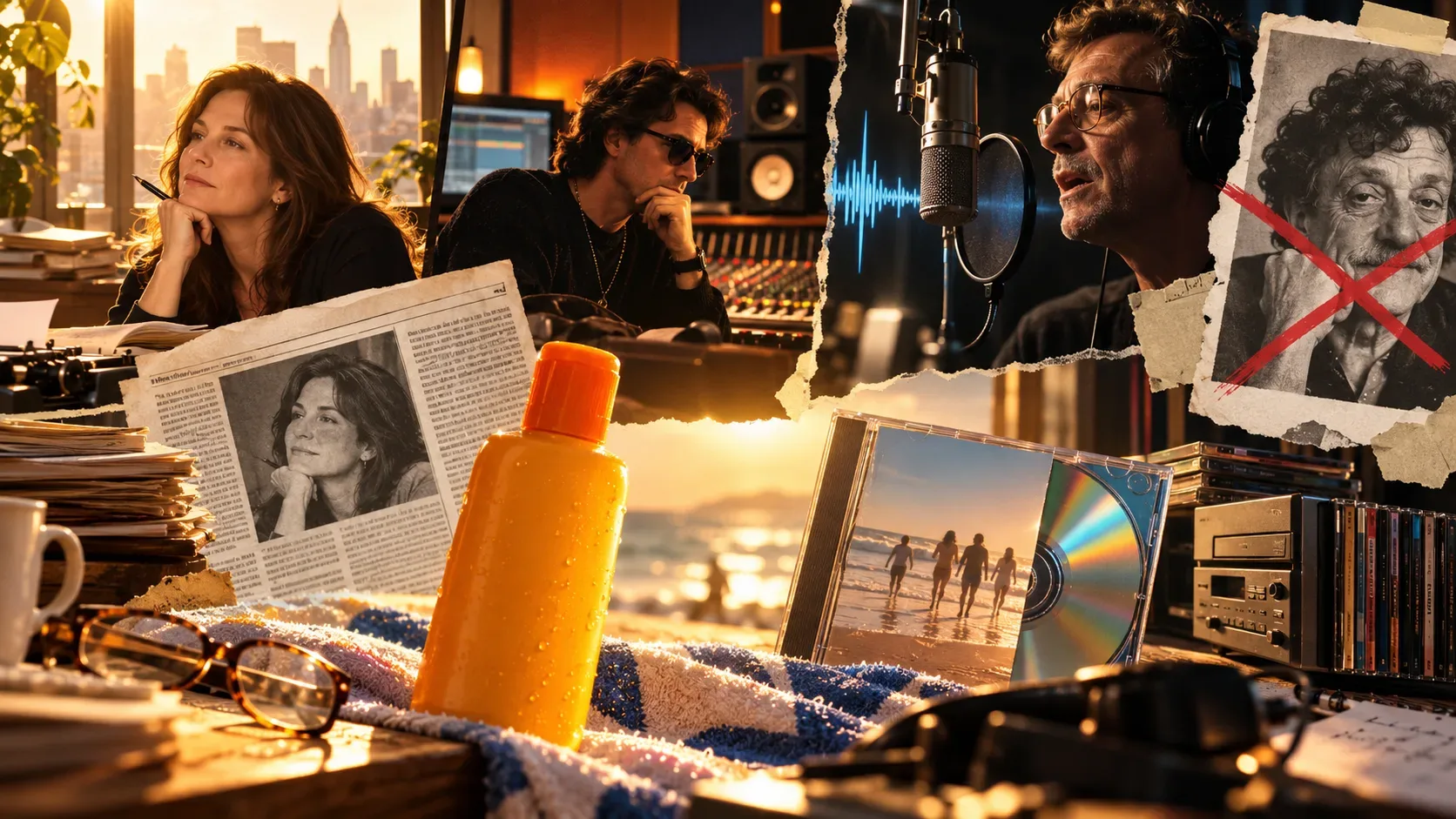
Mary Schmich wrote the text behind Wear Sunscreen, not Kurt Vonnegut. Baz Luhrmann and his collaborators turned her newspaper column into Everybody’s Free (To Wear Sunscreen), while Australian voice actor Lee Perry delivered the spoken narration. Vonnegut’s name became attached to it because the column had already circulated by email as a supposed 1997 commencement address by the novelist at MIT. He never delivered that speech.
A newspaper column, not an actual commencement speech
On June 1, 1997, Mary Schmich published a Chicago Tribune column titled Advice, like youth, probably just wasted on the young. Written as an imaginary commencement address, it offered reflections on aging, decisions and small everyday habits. Schmich later explained that the idea came after she saw a young woman sunbathing near Lake Michigan and remembered not wearing sunscreen when she was younger.
The format made the mix-up plausible: the column sounded like an address to graduates, but Schmich had not spoken at a real ceremony. That distinction disappeared as the text was copied and forwarded online under a different name. The viral version claimed Kurt Vonnegut had delivered those words to the Massachusetts Institute of Technology (MIT) class of 1997.
MIT clarified the record in August 1997 by republishing excerpts from Schmich’s own account of the misattribution. The actual MIT commencement speaker that year was Kofi Annan, then secretary-general of the United Nations. Schmich contacted Vonnegut, who denied writing the piece. The available sources do not reliably identify the first person to attach his name to the email chain.
How Baz Luhrmann turned the column into a track
In Australia, director Baz Luhrmann and music supervisor Anton Monsted were preparing a remix project connected to music from Luhrmann’s films. They encountered the text while it was circulating under Vonnegut’s name, established that Schmich was its writer and contacted her. In a May 6, 2024 interview with The Guardian, Schmich recalled giving permission for the adaptation.
The music has its own lineage. Luhrmann had already been working with Everybody’s Free (To Feel Good), the 1991 dance hit by Rozalla. For Romeo + Juliet (1996), it had been reinterpreted with vocals by Quindon Tarver and King’s College Choir. Wear Sunscreen paired a reading of Schmich’s writing with another reworking of that musical material. None of this made Vonnegut the songwriter.
The recording originated in 1997; according to Australia’s National Film and Sound Archive (NFSA), the long version appeared on the 1998 album Something for Everybody. A shorter edit gained international prominence in 1999. The dates describe different stages of the same story: writing, recording and the single’s later circulation.
Who deserves each Wear Sunscreen credit?
| Role | Credit and contribution |
|---|---|
| Original prose | Mary Schmich wrote the newspaper column published in 1997. |
| Musical adaptation and presentation | Baz Luhrmann led the project alongside Anton Monsted and other collaborators. |
| Spoken voice | Lee Perry, an Australian voice actor, recorded the narration. |
| Musical source material | The track draws on Everybody’s Free (To Feel Good), made famous by Rozalla; the Romeo + Juliet interpretation featured Quindon Tarver and King’s College Choir. |
Lee Perry should not be confused with the Jamaican reggae producer known as Lee Scratch Perry. Nor is the narration spoken by Baz Luhrmann: the director told The Guardian that people sometimes mistakenly thought the voice was his. MusicBrainz release records distinguish Perry’s spoken vocals, Tarver’s performance and Schmich among the credited writers of the recorded work.
Separating the author of the prose from the adaptation team, the narrator and the pre-existing musical material explains why asking for a single “author” often produces an incomplete answer.
Why is Kurt Vonnegut still associated with the song?
The false credit existed before the record. As the email chain spread, Vonnegut’s literary reputation gave the text an appearance of authority, even though there was no evidence he had addressed MIT graduates. Readers encountered and forwarded Schmich’s writing without the context of its original publication.
The recording added an irony of its own: Luhrmann said he asked Lee Perry to perform the piece as he imagined Vonnegut might sound. That was an artistic choice, not an actual recording of the novelist and not proof that he wrote the words. In the 2024 interview, Schmich suggested that a male voice may have helped the track reach more listeners at the time, while making clear that the writing remained hers.
The accurate account therefore keeps four layers apart: Schmich’s authorship, Luhrmann and his team’s musical adaptation, Perry’s narration and music derived from Everybody’s Free (To Feel Good). Vonnegut belongs to the story of mistaken attribution, not to the documented authorship.