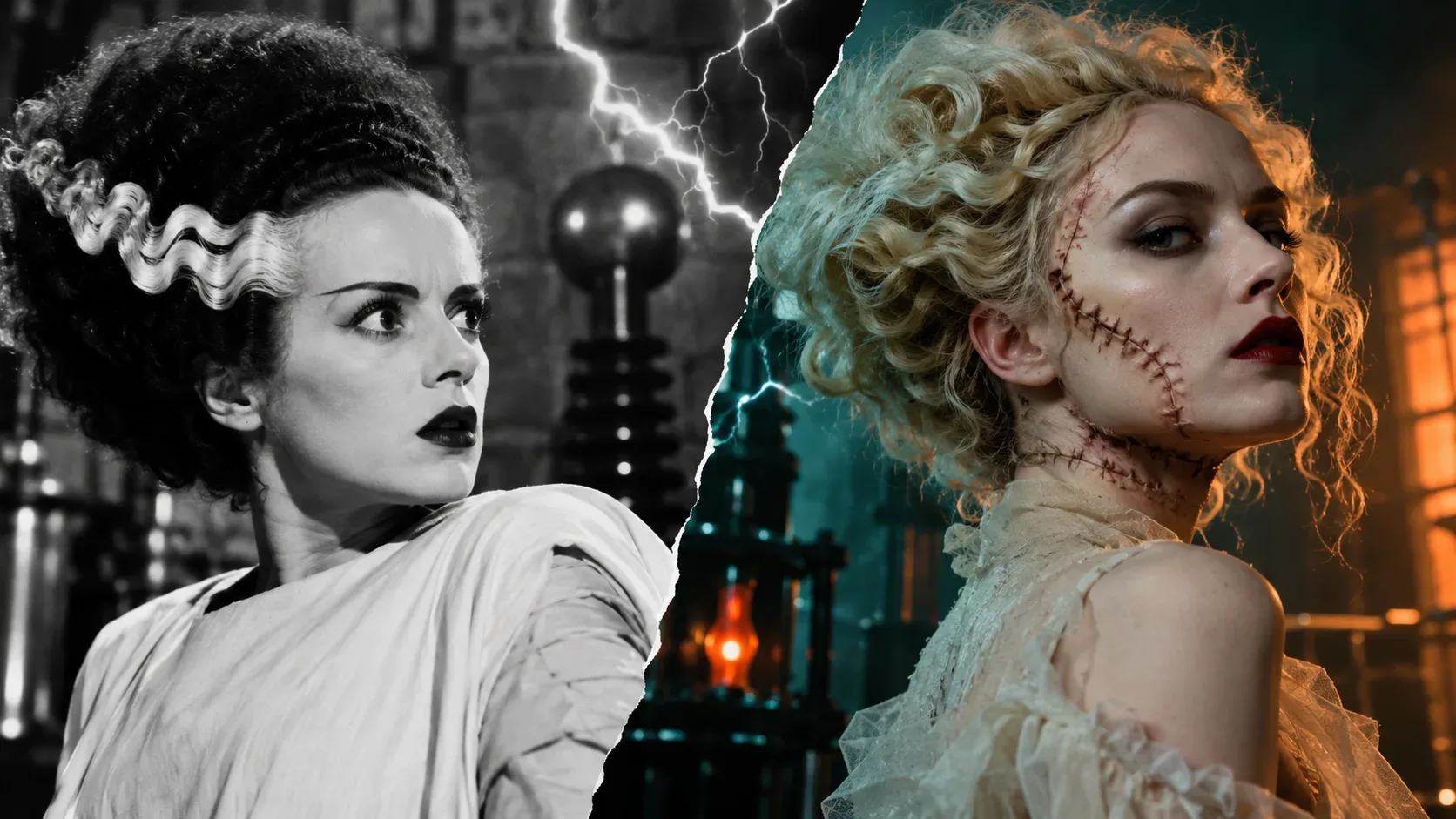
In Bride of Frankenstein (1935), Elsa Lanchester's character appears only briefly and rejects the creature she was made for, without speaking any articulated dialogue. In The Bride! (2026), Maggie Gyllenhaal makes that act of refusal the starting point for Ida's story. Played by Jessie Buckley, Ida is murdered, brought back to life, and confronted with the expectation that she will become Frank's companion. The defining change is one of viewpoint, voice, and the Bride's ability to determine what she wants, rather than merely her appearance.
These are separate productions with different continuities. James Whale's movie is Universal's sequel to Frankenstein (1931); Gyllenhaal's film is a standalone reimagining of the Bride's image and central conflict. It is neither an extended cut of the older movie nor a scene-by-scene remake.
Spoiler warning
The comparison below reveals the Bride's rejection and the ending of the 1935 film, as well as important developments in Ida's story in 2026.
What does the Bride actually do in the 1935 film?
In Bride of Frankenstein, the story still revolves around Boris Karloff's creature and Dr. Pretorius's efforts to persuade Henry Frankenstein to make him a mate. The two scientists reanimate her in their laboratory, but the title character arrives only near the end. The American Film Institute catalog identifies the movie as a Universal production directed by James Whale and released on April 22, 1935.
The Bride receives no personal backstory or extended conversation explaining her wishes. Lanchester communicates through her gaze, abrupt movements, cries, and distinctive hissing. She recoils from the monster and rejects him. He then lets Henry and Elizabeth escape before blowing up the laboratory, killing himself, the Bride, and Pretorius, as documented in the AFI synopsis.
There is a striking irony here: Elsa Lanchester also portrays Mary Shelley in the prologue, while the creature she plays, despite becoming a lasting visual icon, has almost no narrative space. A lack of dialogue does not mean she makes no choice. Her protest is a rejection of the marriage others had decided on her behalf.
How does Ida shift the focus in The Bride! (2026)?
Maggie Gyllenhaal's film moves the action to 1930s Chicago. Ida has a life before she becomes the Bride: her story involves speaking out about abuses connected to powerful men and ends with her murder. At the request of the lonely Frank, played by Christian Bale, scientist Dr. Euphronious, played by Annette Bening, recovers and revives her body. The Warner Bros. official material establishes the premise and cast; contemporary critical coverage documents Ida's earlier identity and Mary Shelley's role in the narrative.
Resurrection does not resolve the ethical question. Ida awakens without memories of her former life, while Frank misrepresents their relationship. She has not freely agreed in advance to be anyone's wife or girlfriend. Her relentless speech, anger, and choices while the pair are on the run turn that imposed role into the central conflict, rather than treating her existence as an automatic cure for Frank's loneliness.
Buckley also portrays Mary Shelley within the film's framing device. This recalls Lanchester's double casting in 1935, but serves a different purpose: the author now shapes the protagonist's identity and voice instead of appearing only in an opening frame.
Was the 1935 Bride passive? The distinction matters
It would be wrong to claim that the classic Bride simply accepts the fate imposed on her. She has little screen time, but her first response to the intended partner is rejection. In an interview covered by Omelete, Gyllenhaal explained that she was struck by the contrast between Lanchester's enduring visual impact and how little narrative room the character receives. The director read the original response as a powerful refusal and began asking what a woman created for the monster might think, desire, or fear if she could speak.
The 2026 reimagining develops that question across a feature-length story. This is not a neat transition from submission to freedom: Ida experiences violence, loses her memory, and faces manipulation. Her greater agency comes from watching how she responds to those pressures, especially when her desires conflict with the Bride identity others have assigned to her.
Side by side: two Brides, two narrative roles
| Aspect | Bride of Frankenstein (1935) | The Bride! (2026) |
|---|---|---|
| Place in the narrative | Visually striking character introduced near the end | Lead character followed before and after her resurrection |
| Earlier identity | Not developed | Ida, a woman murdered in Chicago |
| Voice and expression | Cries, hisses, gestures, and refusal, but no articulated dialogue | Speech, verbal confrontation, and conflicting desires |
| Proposed relationship | Mate made by Henry and Pretorius for the monster | Woman revived by Dr. Euphronious at Frank's request |
| Conflict and scale | Rejection culminating in the laboratory's destruction | Amnesia, manipulation, an escape, and wider social consequences |
How do setting, appearance, and genre change the meaning?
The 1935 picture draws on Gothic imagery: the laboratory, electricity, and black-and-white horror. The 2026 film moves through streets, clubs, pursuits, and references to gangster pictures and musicals. The Bride no longer exists only in front of her creators: her presence provokes public responses and takes on a collective dimension. This expanded social space supports the change in viewpoint by bringing her into contact with other people and conflicts.
The new look retains recognizable references without reproducing the older design. Lanchester's towering hair with light streaks is reinterpreted through Buckley's bleached hair; dark marks around the mouth and face are tied to Ida's resurrection. Speaking to Allure, Gyllenhaal said she wanted to preserve the original character's striking visual presence while grounding the new design in Ida's body and story.
The 1930s setting of The Bride! is a creative choice made in a 2026 film, not proof that both movies share a fictional continuity. Nor should Lanchester's limited role be attributed automatically to censorship: the sources used here establish the classic film's structure and the new director's deliberate decision to question it.
Does a bigger role make the new film beyond criticism?
That is not how the documented critical response describes the outcome. Writing for RogerEbert.com, Tomris Laffly recognizes the ambition and formal risk but argues that excessive dialogue and the feminist resolution diminish part of the impact. Anna Smith, writing for Time Out, instead emphasizes Buckley's energy and the mixture of horror, crime, and musical influences. These are the attributed judgments of two named critics, not an audience consensus or a Dantverse rating.
The most useful distinction, then, is not that the old Bride decided nothing while the new Bride controls everything. In 1935, a refusal closes off the planned union; in 2026, the questions of consent, identity, and desire are expanded into the life of a central character. Gyllenhaal does not replace the classic: she engages with what it showed and what it left unsaid.