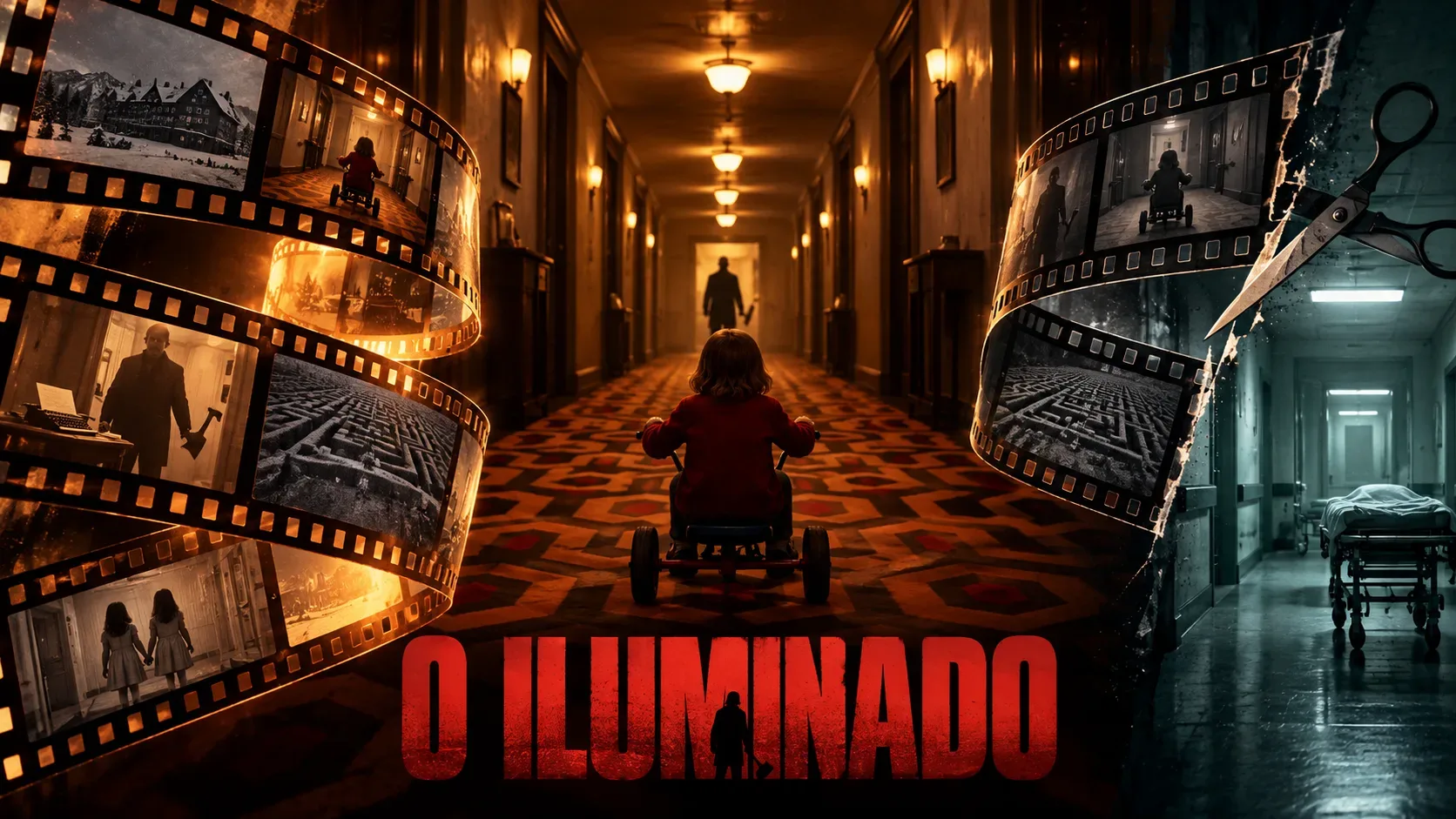
Stanley Kubrick released different cuts of The Shining (1980) because he continued editing the film after its US premiere. First, he removed a hospital epilogue; later, he prepared a shorter international version for European circulation. In an interview with the British Film Institute (BFI), producer Jan Harlan linked the latter decision to the initial reception, Warner Bros.' concerns about the film's ambiguity, and its length. This is not simply a case of one complete edition and another censored one.
Spoiler warning: the discussion below describes Jack's fate and elements of the film's ending.
Three separate stages in the editing history
Confusion arises when the deleted hospital sequence is treated as though it were the same event as the creation of the US and European cuts. They were consecutive decisions, not interchangeable names for a single change.
- US premiere, May 1980: early prints shown during the limited opening included an approximately two-minute coda with Wendy and Danny in hospital. This initial edit is commonly described as running roughly 146 minutes.
- US revision, shortly after opening: Kubrick ordered the epilogue removed from prints already being screened. The approximately 144-minute American cut, without that scene, became established.
- European or international cut, later in 1980: Kubrick removed further dialogue, transitions, and scenes. The BFI describes the resulting edit as around 24 minutes shorter than the 144-minute US cut.
The BFI identifies its presentation of the American version as 144 minutes long and around 24 minutes longer than the European version. The British classification board, BBFC, lists 143 minutes and 37 seconds for a specific theatrical classification of the extended edition. Such rounded runtimes do not necessarily indicate different edits.
What did the European cut actually remove?
The comparison published by Revista Fantastique identifies alterations throughout the film. The international version retains the Torrance family's central story at the Overlook, but brings the action into the hotel more quickly and provides less explicit background about its characters.
| Sequence | 144-minute US cut | European cut |
|---|---|---|
| Interview and hotel tour | Longer conversations and a fuller introduction to the Overlook, including extra dialogue for Jack and Ullman. | Shortens the opening interview and parts of the tour of the hotel's rooms. |
| Danny's medical examination | Shows a doctor examining Danny and speaking with Wendy about Tony and an earlier incident in which Jack hurt the boy. | Removes the medical examination and the conversation revealing that family history. |
| Dick Hallorann and daily life | Spends more time on Hallorann's journey back to the hotel and small scenes involving Wendy and Danny. | Removes parts of the journey, phone calls, and several interstitial scenes. |
| Images near the ending | Includes, among other images, a vision of skeletons encountered by Wendy inside the hotel. | Drops the skeletons and tightens sections of the final progression. |
These changes affect the amount of context and the pacing, but they do not give the European film a different murder, a different identity for Jack, or an entirely different narrative resolution. The idea that the shorter cut leaves more gaps is an editorial interpretation based on the material removed, not proof of Kubrick's private intentions.
What happened to the hospital epilogue?
The scene came after the image of Jack frozen in the maze and before the final 1921 photograph. According to documentation collected by Bloody Disgusting and statements attributed to co-screenwriter Diane Johnson, Wendy and Danny were recovering when hotel manager Stuart Ullman visited them. Johnson described its purpose as reassuring viewers that they were safe.
Kubrick ordered the sequence removed soon after the first American screenings. Accounts of the process indicate that footage was cut from prints already in circulation. Script pages and continuity photographs document the planned and filmed scene, but they cannot reliably reconstruct every shot, line, or gesture as it appeared in theaters. No complete surviving copy of the sequence has been publicly confirmed as available for comparison.
That is why calling it 'the European version's ending' is mistaken: it had already been removed from the 144-minute American cut. Both widely compared versions retain the Overlook's enigmatic ballroom photograph after Jack's fate is shown.
Why do runtimes of 114, 115, 119, 120, and 144 minutes appear?
Two factors must be separated: editorial cuts, which actually remove footage, and playback speed on some home-video editions. Under older PAL systems, film shot at 24 frames per second was often transferred for playback at 25 frames per second. That approximately 4% speed-up reduces the displayed running time without removing four percent of the scenes.
As a result, an international cut lasting around 119 to 120 minutes at theatrical speed may be listed at around 114 to 115 minutes on certain PAL DVDs. The American cut is often rounded to 144 minutes, although the BBFC recorded 143m37s for a particular screening. A catalogue or packaging runtime on its own cannot identify the edit: check the source, format, and scenes. Not every discrepancy in published listings can automatically be blamed on PAL.
Which version did Kubrick approve?
The opposition between 'director's cut' and 'tampered-with version' is unhelpful here. These edits were made during Kubrick's lifetime, and Harlan described Kubrick's involvement in the decision to shorten the film for other markets. There is likewise no sound basis for declaring the longer American edition the only legitimate version or the filmmaker's conclusively preferred cut.
The distinction still matters in later releases: the BFI brought the longer US cut to British cinemas in 2012, while the Criterion Collection explicitly includes the international version in its The Complete Kubrick box set. That documents both cuts as distinct published editions, without establishing which version is currently offered by Brazilian streaming services.
To tell the two apart: look for Danny's examination following his early vision, the extra stages of Hallorann's journey, and the skeletons Wendy sees. Those sequences distinguish the US and European cuts. The hospital scene belongs to an earlier stage of the editing history and is absent from both commonly available versions.