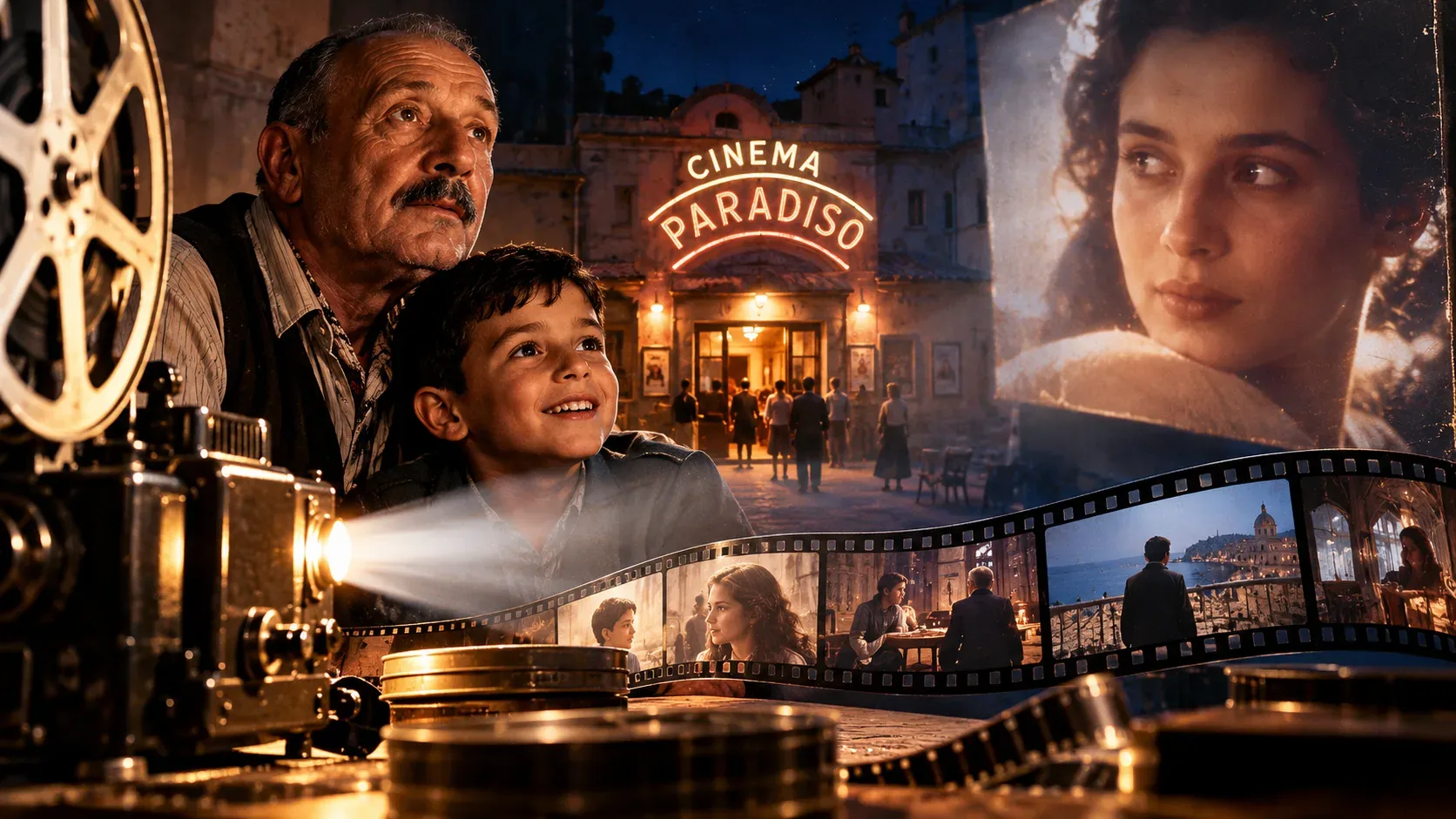
Giuseppe Tornatore's Cinema Paradiso (1988), originally titled Nuovo Cinema Paradiso, is available in a 124-minute theatrical cut and a 174-minute Director's Cut. The roughly 50 additional minutes explore Salvatore, or Totò, and his past romance in greater depth, bringing the older Elena back into the story. They also change how Alfredo's decisions can be understood, but do not replace the famous closing montage of kisses cut from films screened at the village theater. Arrow lists both cuts at these runtimes.
Spoiler warning: the article now discusses both cuts, including Elena's story and the ending.
What does the 174-minute cut add?
In the 124-minute version, Totò's childhood, his bond with projectionist Alfredo, and his love of movies provide the emotional center. His teenage relationship with Elena matters, yet her disappearance from his life largely remains a loss in the past. Adult Salvatore mainly frames the memories and returns to his hometown following Alfredo's death.
The longer cut shifts that balance. Alongside expanded passages from his youth and romance, it gives more space to adulthood: Salvatore reunites with Elena decades later. Agnese Nano plays the younger Elena, while Brigitte Fossey portrays her older self, a character appearance absent from the shorter cut. Pasquale Iannone's essay in Arrow's booklet and reviews written when the extended version returned to theaters in 2002 identify this reunion as the crucial narrative addition.
Other restored material includes sexual content and episodes from Totò's youth. The added running time therefore does not consist solely of a conversation with Elena. Without a shot-by-shot comparison of the discs, an exhaustive list of added scenes, or a claim that every runtime difference represents a new sequence, would be misleading.
Elena, the reunion, and Alfredo's involvement
The extended cut reveals that Salvatore and Elena's separation was more complicated than a teenage romance simply coming to an end. During their reunion, she explains the missed meeting years earlier and her attempt to leave a message that Salvatore never received. Alfredo, hoping the young man would leave the village and build a career, had interfered with their chances of remaining together.
This revelation does not mean Elena spent decades passively waiting. Their reunion brings back feelings and memories, but she has built a life of her own. The longer cut does not turn their encounter into a permanent reconciliation. Writing in The Washington Post, Ann Hornaday stresses that the restored material makes Alfredo's influence on Totò's future more morally complicated.
In the shorter cut, Alfredo's determination that Salvatore leave can largely be read as a generous push toward his calling. In the extended version, an uncomfortable question emerges: how much right did his mentor have to decide what the young man should sacrifice? This is an interpretation of the added scenes, not a documented claim that Tornatore condemns Alfredo.
Where did the 124- and 174-minute runtimes come from?
The history involves more than one three-hour edit being shortened directly into the award-winning film. Rai's archive records a version of roughly 173 minutes shown at the Europa Cinema festival in Bari in 1988. Arrow's booklet, meanwhile, reproduces Tornatore's account that the first cut prepared for commercial release, which opened in Italy on November 19, 1988, lasted about 150 minutes. Following poor results, he re-edited the film to approximately two hours. Its international breakthrough followed a screening at Cannes in 1989.
Some historical records differ by a minute: Rai cites 123 minutes for the short film, while Arrow identifies the edition it sells as 124 minutes. The same caution applies to the 173 minutes reported for earlier screenings and the 174 minutes advertised for the Director's Cut Blu-ray. Numbers alone neither establish a separate edit nor reveal precisely which shots were removed.
| Cut or screening | Documented runtime | What the source confirms |
|---|---|---|
| Europa Cinema festival preview, Bari, 1988 | About 173 min | An early screening described by Rai, not automatically identical to today's home-video edition. |
| First Italian commercial release, November 1988 | About 150 min | A release cut described by Tornatore in the account reproduced by Arrow. |
| Award-winning shorter cut and Arrow catalog edition | 124 min | The theatrical version identified on Arrow's Blu-ray and 4K UHD releases. |
| Director's Cut sold by Arrow | 174 min | The expanded version sold on 1080p Blu-ray; 2002 theatrical reissues were listed with similar runtimes. |
Calling a version the original can therefore be ambiguous: it may refer to an early festival presentation, the first Italian release, or the internationally circulated shorter edit. When choosing a copy, the cut specified by that particular edition matters more than an unspecific label.
Does the closing kiss montage change?
No. After Alfredo's funeral and his return to Rome, Salvatore watches the reel the former projectionist left behind: a compilation of kisses the priest once ordered removed from films screened at Cinema Paradiso. Arrow's booklet explicitly states that this ending remains in both cuts.
What changes is the emotional journey leading to it. At 124 minutes, the present chiefly allows Salvatore to revisit his childhood and the friendship that taught him to love cinema. At 174 minutes, the revelations about Elena and Alfredo's intervention add loss and tension to his memories of his mentor. Writing in The Guardian, Philip French likewise notes that both versions share the final sequence.
Which version of Cinema Paradiso should you watch first?
For a first viewing, the 124-minute cut is the more direct introduction: it focuses on Totò's coming of age and his relationship with Alfredo. For viewers who want to understand Elena's disappearance and reconsider the projectionist's choices, the 174-minute cut is essential: the expanded adult storyline changes the meaning of earlier events. Neither cut needs to be treated as a sequel to the other.
Check the format as well. In the combined 4K UHD and Blu-ray edition listed by Arrow Video, the 124-minute cut is on 4K UHD, whereas the 174-minute cut is supplied on a 1080p Blu-ray. The 4K label on the package does not mean the longer version is in 4K. An overseas product page does not establish availability, subtitles, or distribution rights in Brazil.
Sources and references
- Arrow Video, 4K UHD and Blu-ray edition
- Arrow Films, Blu-ray edition
- Arrow Academy, booklet essay by Pasquale Iannone
- Rai Teche, Tornatore interview and release history
- Turner Classic Movies, article by Felicia Feaster
- The Washington Post, review by Ann Hornaday
- The Guardian, review by Philip French