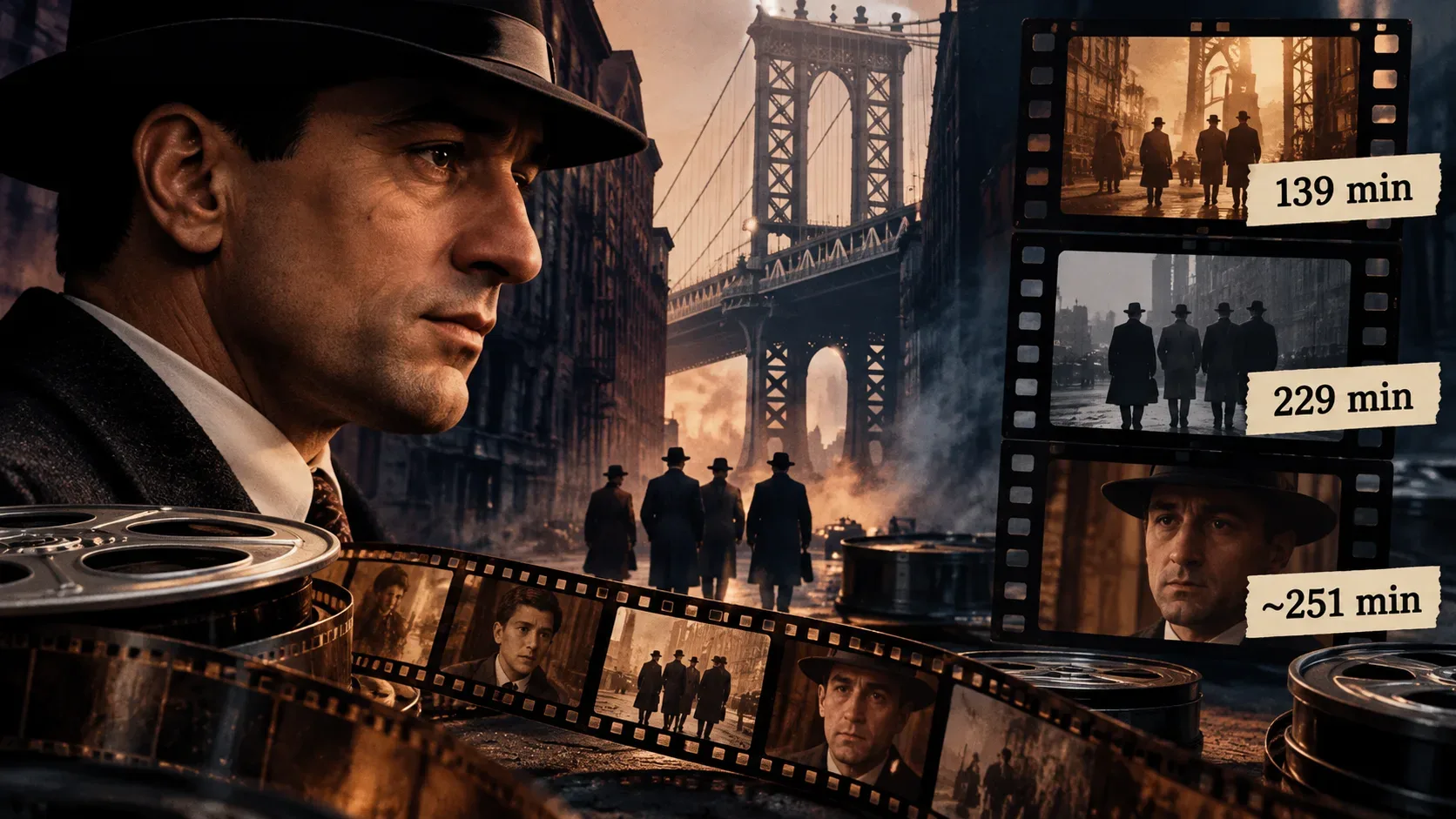
The US version of Once Upon a Time in America (1984) changed the order of the story because distributor The Ladd Company chose to shorten the film for the American market and rearrange its time shifts into chronological sequence without Sergio Leone’s approval. The cut commonly described as 139 minutes differs from the roughly 229-minute European version, which preserves the interwoven narrative. The subsequent restoration, at about 251 minutes, reinstated missing material but cannot automatically be equated with a definitive, complete version originally intended by the filmmaker.
The crucial difference is more than running time: in Leone’s construction, Noodles’ memories shape the order in which the audience discovers events; in the US re-edit, those events unfold in the order in which they took place.
Why did the distributor change the film in 1984?
The AFI Catalog production history records a test screening in Boston on February 17, 1984, followed by negative reactions. The Ladd Company invoked a contract specifying a maximum running time of 165 minutes. Leone refused to reduce his approximately 225-minute version to that limit, so the distributor hired another editor to cut the film and alter its structure.
According to AFI, the new American release followed chronological order from 1921 through 1968, eliminating the flashbacks that shaped Leone’s version. He did not approve the intervention. The US release opened on June 1, 1984, and the director publicly criticized the re-edit later that month.
The commercial wish for a shorter movie helps explain the documented decision, but it does not prove that audiences demanded chronological storytelling. The linear approach was a distributor-led editorial choice, not a new Leone-directed version.
Three periods in the story and why their order matters
The narrative covers three broad stages in the lives of David “Noodles” Aaronson and his friends in New York. This guide identifies them without turning the comparison into a plot recap that reveals the ending:
- 1921 and youth: the group’s formation and its experiences on neighborhood streets.
- The 1930s, during Prohibition: adulthood, criminal activity and growing strains within personal relationships.
- 1968: an older Noodles returns and confronts traces of his past.
Leone’s edit moves among these periods. The later present leads viewers back into memories, and earlier scenes take on new weight when revisited in a different context. Ennio Morricone’s music and transitions between periods are part of that design, as Gian Luca Farinelli observes in notes published by the BFI.
In the US version, youth, adulthood and the 1968 return follow one another. This makes the timeline more straightforward, but changes the storytelling: echoes between past and present are no longer arranged in the same way. That is an analysis of the structure, not a claim that every viewer will experience it identically.
139, 229 and 251 minutes: what does each cut mean?
These are the three running times most often cited to distinguish the editions, but they refer to different stages of the film’s release history. They are not three equivalent director-approved cuts.
| Approximate length | Origin and structure | What it represents |
|---|---|---|
| About 139 min | 1984 US distribution; shortened scenes and chronological sequence. | A commercial re-edit not approved by Leone. |
| About 229 min | Longer 1984 Cannes and European release; nonlinear structure. | The released version associated with Leone’s approved narrative design. |
| About 251 min | Restoration shown in 2012 and released on home video in 2014, with scenes reinstated. | An expanded reconstruction made after Leone’s death, not proof of a definitive complete cut. |
There is an important source discrepancy: TCM uses 139, 229 and 251 minutes, while AFI describes a 227-minute Cannes print and records reports of 135, 144 and 147 minutes for US releases. Such figures can vary with prints, reporting and runtime conventions, making it safer to identify the version, region and edit as well. In that sense, “139 minutes” is a common reference rather than an invariant measurement of every US print.
Both records agree on the central change: a story built around shifts in time became a shortened, linear American version. AFI also documents later US screenings of Leone’s approved long edit. Thus, “US version” here specifically means the commercial re-edit released in June 1984, not every copy later distributed in the country.
What did the restoration bring back, and what remains uncertain?
TCM reports that an intermediate edit of approximately 269 minutes existed before the 229-minute release in 1984. This explains why there was filmed material beyond the Cannes version, but it does not justify treating 269 minutes as a finished, complete cut that Leone actually released.
In 2012, the Leone family and The Film Foundation, associated with Martin Scorsese, took part in a restoration effort. AFI documents scenes recovered from work materials whose image quality varied. One features Louise Fletcher as a cemetery director; Cineteca di Bologna notes published by the BFI also identify a scene of Deborah performing Cleopatra. Warner advertised a 251-minute home-video edition in 2014.
TCM refers to roughly 18 minutes that remained excluded because of rights issues. Since the sources also differ on preliminary runtimes, the 251-minute restoration should not be assumed to contain every shot Leone devised or approved. Its historical importance rests on the documented recovery of material and the preservation of the nonlinear structure.
How to identify the version before watching
To follow Leone’s approach to time as released in 1984, the main reference is the longer cut of approximately 229 minutes. The restored version of about 251 minutes adds scenes while retaining the movement between periods. The short 1984 US cut, by contrast, runs chronologically and is especially useful for understanding the distributor’s intervention.
When looking at a disc or digital listing, check the stated runtime and labels such as theatrical, European cut or extended director’s cut, but confirm the release description: those labels alone do not establish that editions match across countries and formats. No claim about current availability on Brazilian streaming services is made here.