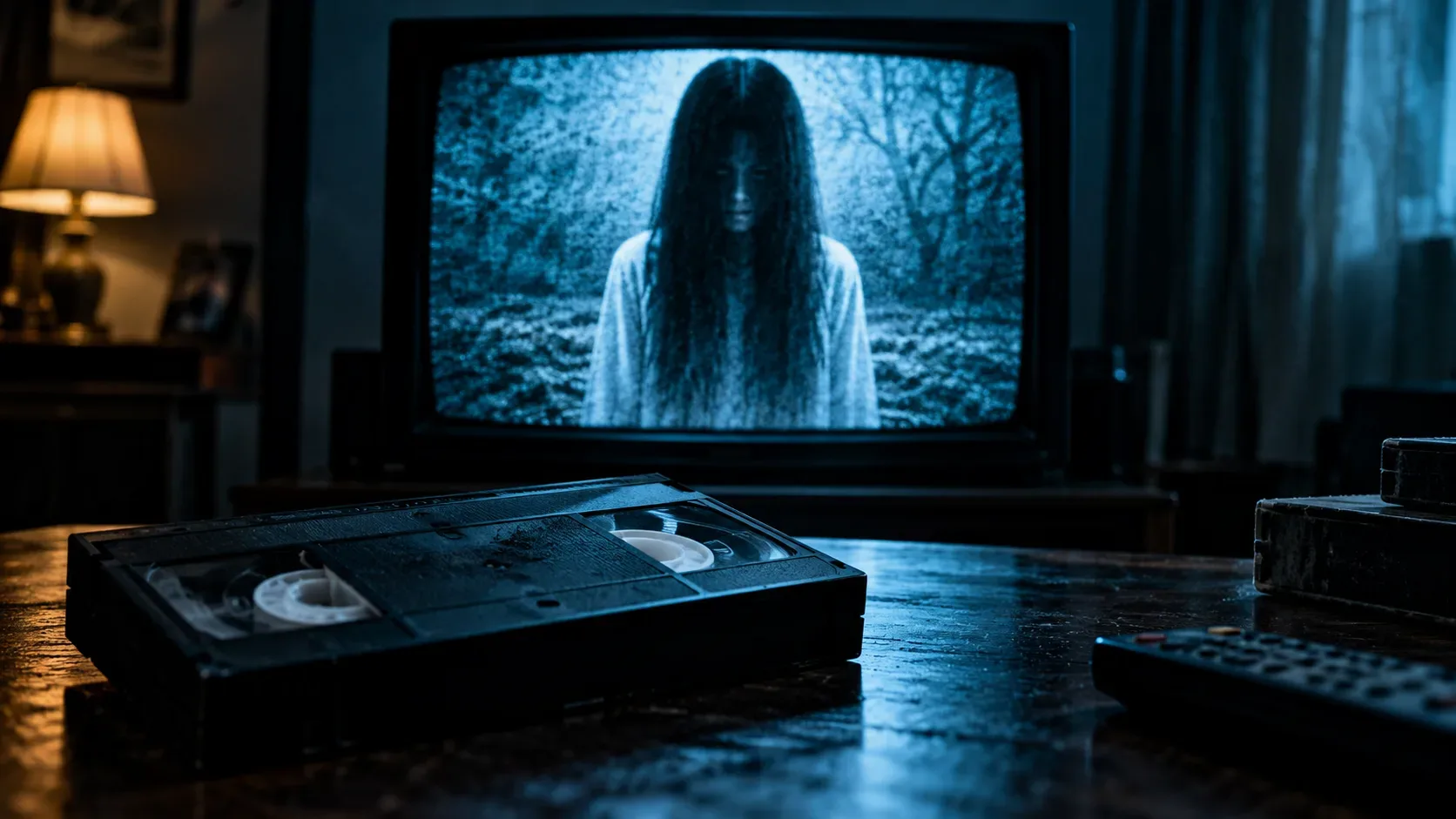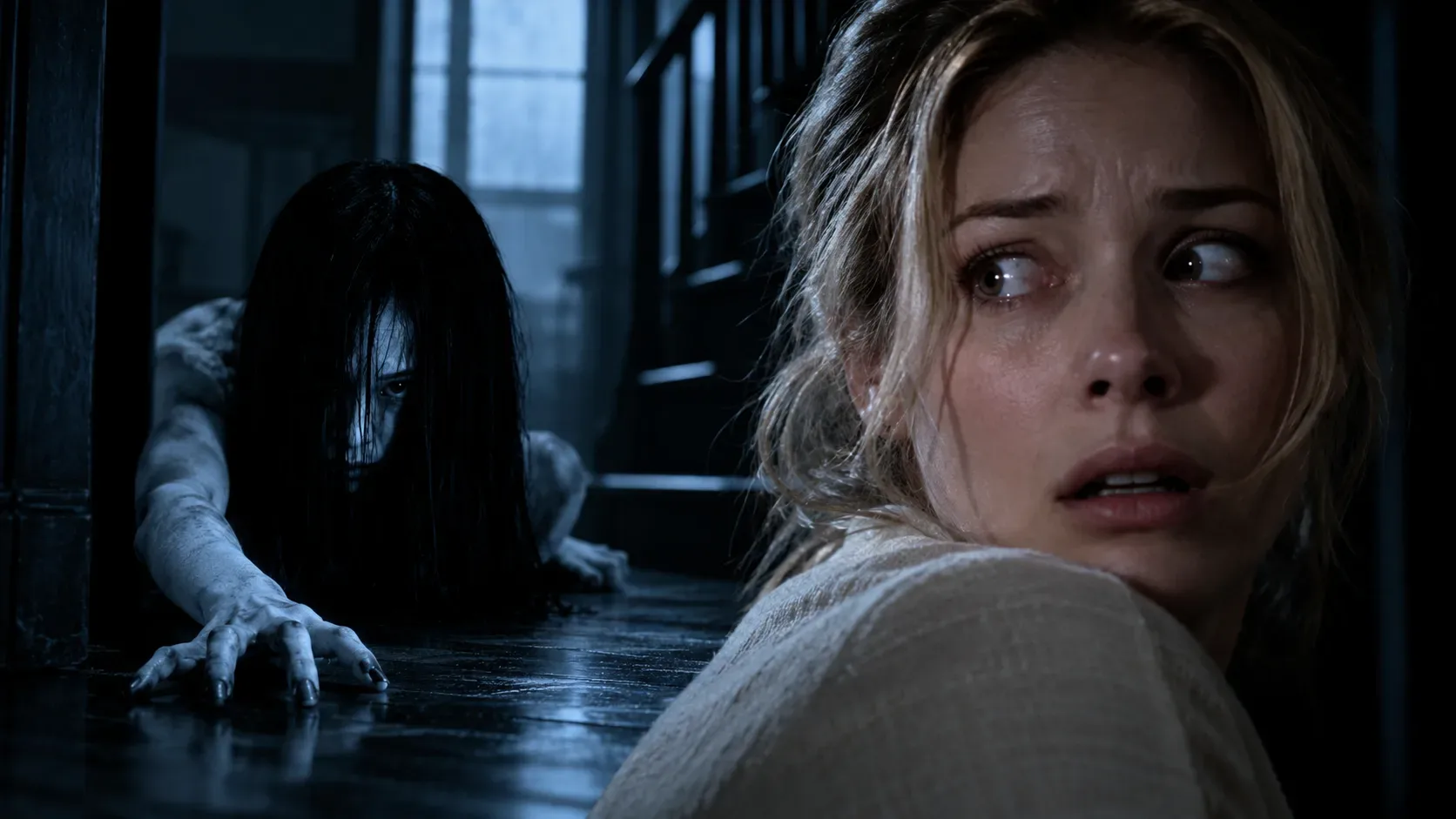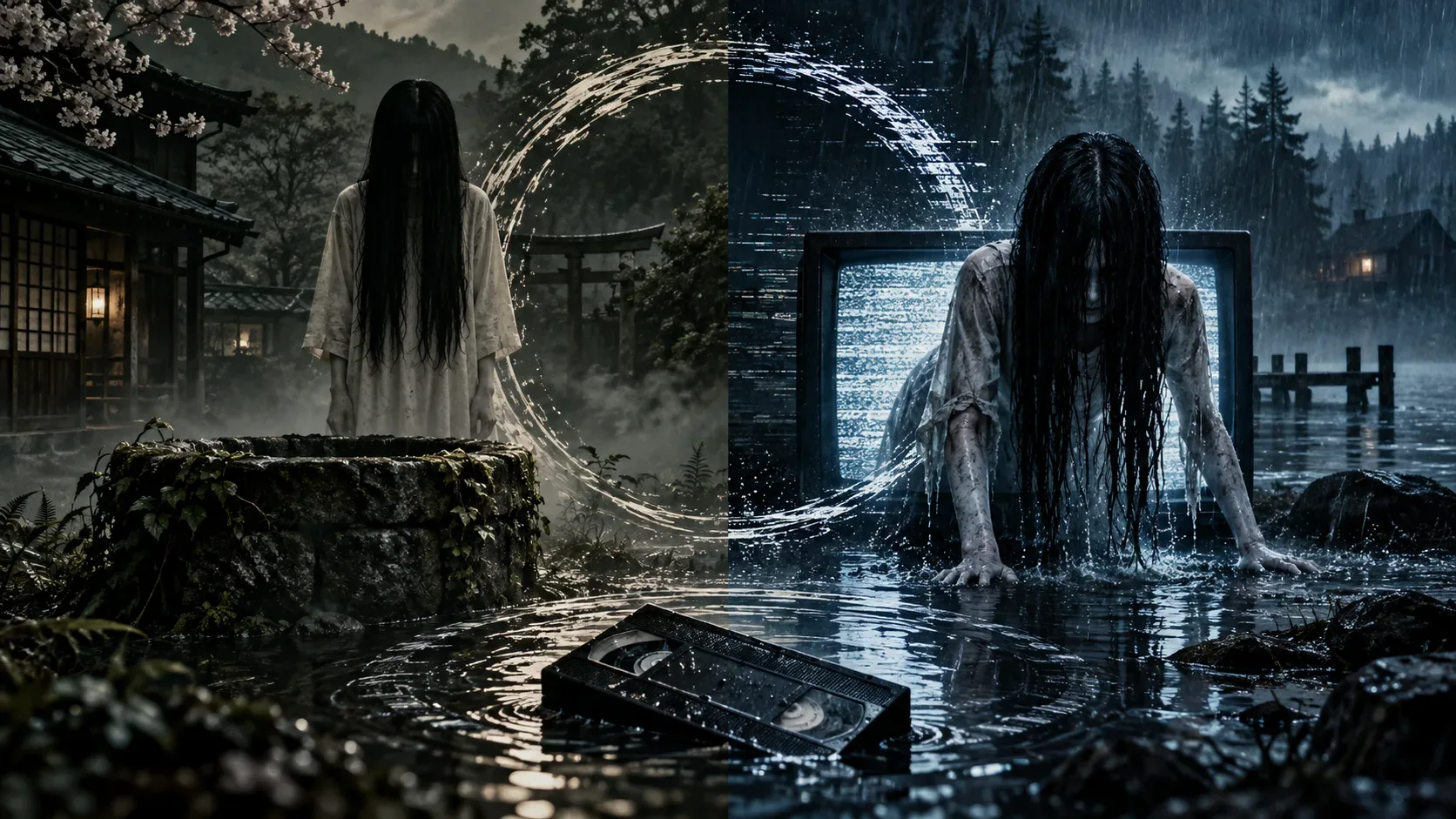
In Ringu (1998), Sadako Yamamura is linked to the vengeful ghosts of Japanese folklore, shaped by family tragedy and uncertainty. In The Ring (2002), the American remake recasts that presence as Samara Morgan, an adopted child whose story unfolds through more explicit clues, disturbing images, and a different family investigation. The cursed videotape, seven-day deadline, and well remain, but the two characters do not have exactly the same origins or dramatic roles.
This comparison concerns the films directed by Hideo Nakata and Gore Verbinski, respectively. It does not merge the continuities of the sequels, Kōji Suzuki’s novel, or other adaptations in the franchise.
A remake, not a continuation of the Japanese story
Kadokawa dates the Japanese release of Ringu to January 31, 1998, and credits director Hideo Nakata, screenwriter Hiroshi Takahashi, and the novel by Kōji Suzuki. Paramount identifies The Ring as a 2002 film directed by Gore Verbinski and starring Naomi Watts. The distributors list running times of 95 and 116 minutes, respectively.
The American film reenacts and changes the same premise rather than continuing the events of the Japanese version. Names, family dynamics, and the setting of the investigation change. Samara should therefore not be treated as Sadako within one shared cinematic timeline.
Spoiler notice: the comparison below reveals elements of Sadako’s and Samara’s origins and deaths, but does not retell the ending of The Ring (2002).
Comparison chart: Sadako and Samara in the two films
The correspondences below refer specifically to the 1998 and 2002 feature films, not to biographies expanded by sequels or books.
| Aspect | Ringu (1998) | The Ring (2002) |
|---|---|---|
| Director and country | Hideo Nakata; Japan | Gore Verbinski; United States |
| Investigator | Reiko Asakawa | Rachel Keller |
| Investigation partner | Ryūji Takayama, with psychic perception | Noah, without the same ability |
| Protagonist’s son | Yōichi | Aidan |
| Figure behind the curse | Sadako Yamamura, portrayed as a young woman | Samara Morgan, portrayed as a young girl |
| Family and the well | Shizuko’s daughter; killed by Ikuma, a father figure | The Morgans’ adopted daughter; killed by Anna, her adoptive mother |
| Cultural link and tone | Vengeful ghost tradition and restrained suspense | American Gothic reinterpretation and more explicit visual horror |
| Shared elements | VHS tape, seven-day deadline, well, and television | VHS tape, seven-day deadline, well, and television |
The origin changed, especially the family relationship
In Ringu, Sadako is introduced as the daughter of Shizuko Yamamura, a woman associated with psychic phenomena. Investigations into her abilities involve Professor Heihachiro Ikuma, a father figure connected to Sadako’s death in the well. Some of the past is conveyed through accounts and visions whose point of view should not be mistaken for proof of every supernatural detail.
In the remake, Samara is the adopted daughter of Anna and Richard Morgan. The farm’s disturbances, intrusive mental images, and the family’s breakdown occupy more of the investigation. Anna is the person who places Samara in the well. The films thus shift responsibility for the family violence and do not provide a simple one-to-one equivalence between Sadako’s and Samara’s mothers. Samara’s biological origins remain uncertain in the 2002 film.
Why Sadako evokes Japanese folklore
In the kaidan tradition of Japanese ghost stories, an onryō is a spirit returning out of resentment or an injustice suffered in life. Long hair hiding the face, pale clothing, the well, and the presence of a violently killed woman connect Sadako to that iconography. This does not mean all those motifs originated with Ringu, or that Japanese culture has only one understanding of ghosts.
In a 2020 study published in Revista de Comunicação e Linguagens, scholar Marisa Mourinha links the films’ specter to folklore, traditional theater, and technologically reproduced images. In a study of motherhood, Lindsey Scott highlights the change in the person responsible for the character’s death: a man in the Japanese story, an adoptive mother in the American one. These are scholarly readings of the films, not statements of intent by the directors.
The protagonists and psychic abilities were rewritten too
In the original, Reiko Asakawa investigates the tape with Ryūji Takayama, her former husband, who shows psychic sensitivity. In the American film, Rachel Keller works with Noah, a former partner who does not play the same psychic role. Reiko’s son is Yōichi; Rachel’s is Aidan. The danger faced by the children links the stories, but the investigative methods and family relationships are not identical.
The recording itself differs as well. The Japanese tape includes images referring to Shizuko’s history, the island, and earlier events; the American version arranges other visual clues around Samara, including horse imagery. The tape is more than a lethal object: it also shapes the language of the mystery in each adaptation.
Do Ringu and The Ring create fear in the same way?
Both films use apparitions, television, water, and disorienting images. What differs is how those elements are deployed. Ringu favors restrained scenes and a creeping unease as the investigation unfolds. The Ring heightens the threat’s physical side through cold-toned cinematography, drenched settings, and more forceful images.
In a comparative essay for Ghouls Magazine, Sarah Miles contrasts the Japanese film’s gradual suspense with the more visceral horror of the American film, without declaring one inherently superior. These choices do not justify the simplistic rule that all Japanese horror is subtle and all American horror relies on jump scares. They describe these particular films, alongside an attributed critical interpretation.
What stayed the same and why the distinction matters
Both versions use the legend of a tape that threatens to kill its viewer after seven days; the investigators must discover how the ghost and recording are connected. The well, television, and circulation of images still organize the plot. The remake preserves the basic mechanism of the threat while changing its human history and the cultural codes through which audiences understand it.
The clearest way to compare Sadako and Samara is to start with their shared narrative problem and examine what each adaptation does with its character. They share a well, but the meaning of the figure emerging from it is not identical.