Spoiler warning: this article reveals the deaths, the origin of the curse and the ending of The Grudge (2004).
In the American version of The Grudge (2004), Karen Davis survives the fire she starts at the Saeki family home, but she does not destroy the curse. Firefighters save the building, and Kayako appears again to haunt Karen in the final sequence. The story interweaves three periods: the Saeki murders, the Williams family’s experiences and Karen’s investigation.
Which version of The Grudge does this article explain?
This account concerns the 2004 film starring Sarah Michelle Gellar, directed by Takashi Shimizu and set in Tokyo. It is the American adaptation of the Ju-on story, not the Japanese film Ju-on: The Grudge (2002), The Grudge 2 (2006) or the film released in 2020. The US theatrical release was on October 22, 2004; the film reached Brazilian theaters on January 7, 2005.
The reconstruction below follows the major events shared by the American film’s narrative. Additional scenes from the extended version are discussed separately rather than being presented as material necessarily included in the theatrical release.
The Grudge (2004) in chronological order
- Around 2001, the Saeki tragedy. Kayako develops obsessive feelings for American professor Peter Kirk and records them in a diary. Her husband, Takeo Saeki, discovers the entries and kills her. He also kills their son Toshio and subsequently dies. This violence gives rise to the curse that remains attached to their home.
- Peter discovers the aftermath. Visiting the house, the professor sees evidence of the deaths and discovers Kayako’s connection to him. Shaken, he leaves and later jumps from the balcony of his apartment in front of his wife, Maria. His death is shown at the opening of the film, even though it belongs to the story’s past.
- In 2004, the Williams family moves in. Matthew Williams settles there with his wife Jennifer and his mother Emma, who requires care. Matthew’s sister Susan also lives in Tokyo. The supernatural manifestations strike the residents and pursue Susan even after she flees elsewhere.
- Care worker Yoko disappears. While checking on Emma, Yoko is attacked at the house. When she fails to return to work, Alex, who oversees the care service, sends American student Karen Davis to replace her.
- Karen enters the house and finds Toshio. Karen finds Emma neglected, discovers a hidden boy and witnesses Kayako appearing near the elderly woman. Emma dies; police later find Matthew and Jennifer’s bodies in the attic.
- Victims keep appearing beyond the house. Susan is pursued at her workplace and apartment; Alex faces a horrific manifestation of Yoko. Karen investigates the Saeki family and Peter’s involvement while Detective Nakagawa attempts to stop further attacks.
- The plan to burn the house fails. Nakagawa brings gasoline to the property but is overcome by Takeo’s apparition. Karen’s boyfriend Doug enters the home too and falls victim to the curse. Karen tries to save him and ignites the fuel.
- The ending takes place after the fire. Karen is rescued, Doug is dead, and the building has not been destroyed. As she approaches her boyfriend’s body, Kayako appears again. The film does not show Karen dying.
How did Kayako’s curse begin?
Its origin lies in Takeo’s violence against his own family. After discovering the diary in which Kayako wrote about Peter Kirk, he reacts furiously, kills his wife and son, and eventually dies himself. Kayako and Toshio begin manifesting as supernatural presences. The film’s premise connects a death surrounded by hatred and suffering to a curse attached to the place where it happened.
That does not make the people who die in the house responsible for the original crime. The curse also strikes visitors who know nothing about it, including the care workers and the Williams family. The house is its point of origin, not its boundary: the apparitions pursue Susan elsewhere and reappear before Karen after the fire. Kayako’s characteristic rattling sound recalls the violence done to her neck; the extended cut makes this connection clearer.
What happens to the Williams family, Yoko, Susan and Emma?
Matthew and Jennifer do not grasp the danger when they move in. Jennifer is terrorized inside the house; Matthew finds his wife incapacitated and is also attacked. When police arrive to investigate Emma’s death, they find the couple’s bodies in the attic. Emma, who depends on care, is exposed to the entity while left alone.
Yoko disappears before Karen takes over as care worker. Her figure later returns in disturbing form and confronts Alex at the workplace. Susan, Matthew’s sister, tries to escape the manifestations while away from the residence, but is pursued to her apartment. These parallel stories show that the curse does not stop when someone closes the Saeki house’s front door.
What does Peter Kirk have to do with the murders?
Peter is not portrayed as the person responsible for the violence. He is the professor for whom Kayako had unrequited feelings, recorded in letters, photographs and the diary that provokes Takeo’s jealousy. After visiting the home and discovering the aftermath of the tragedy, Peter takes his own life. The film links these events without establishing conclusively whether his suicide resulted from guilt, trauma or supernatural influence.
Karen discovers clues while investigating documents and photographs, including images in which Kayako appeared near Peter and Maria. Detective Nakagawa already knows that the home was linked to earlier deaths and disappearances. The visions Karen experiences when she returns to the house bring the past and present together, allowing viewers to recognize the curse’s cause.
Why does Karen set the house on fire, and why does it fail?
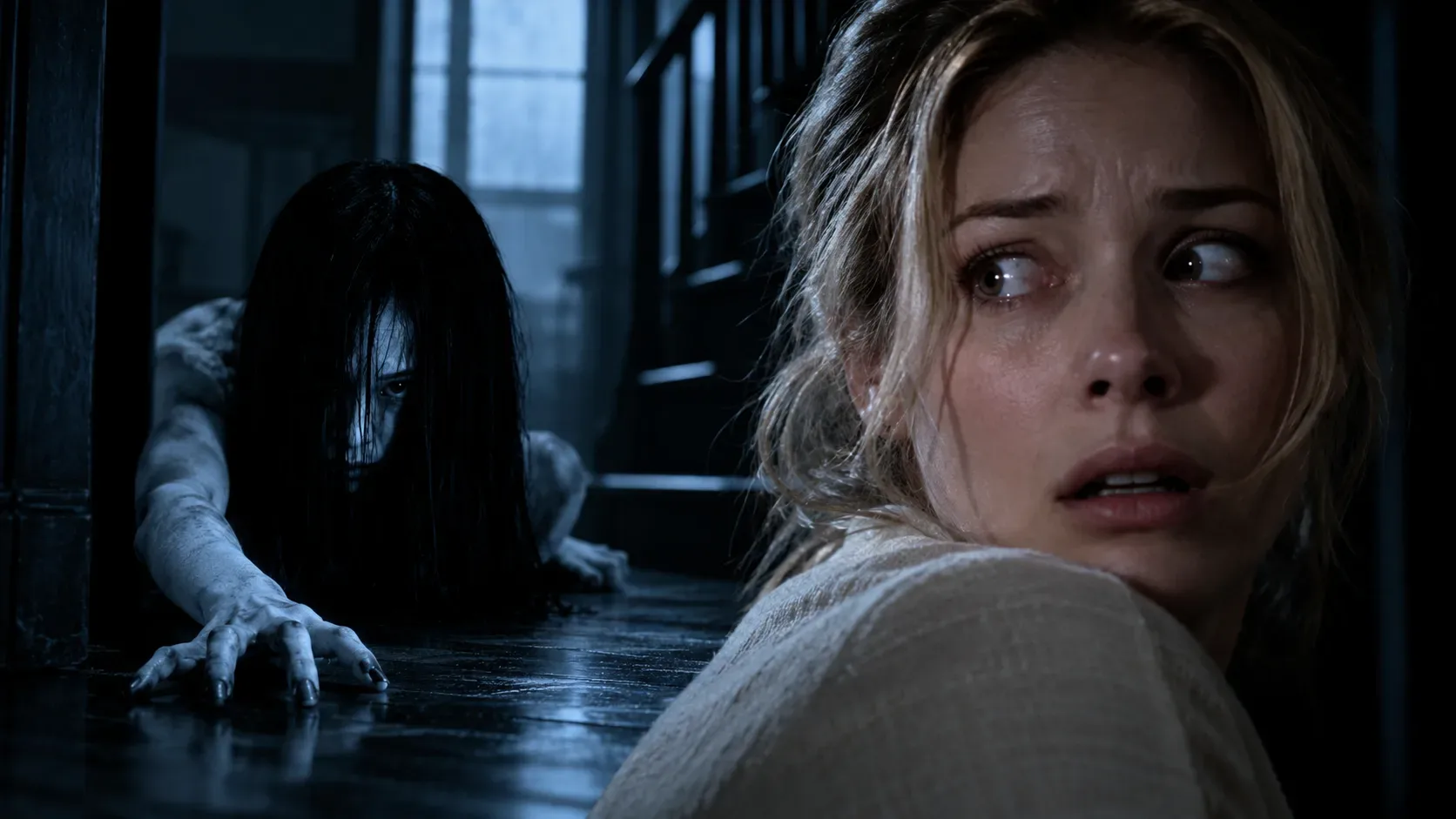
Nakagawa arrives first with gasoline, believing that destroying the location might end the attacks. Takeo’s apparition prevents him from finishing the plan. When Karen returns to look for Doug, she finds her boyfriend incapacitated and attempts to drag him outside. Kayako appears on the staircase, and Doug dies before he can escape.
Trapped, Karen uses the fuel the detective left behind and Doug’s lighter to start a fire. The blaze allows her to get out alive, but it is not a victory: the house is saved and Kayako’s presence remains. The ending thus separates Karen’s physical survival from any suggestion that she has broken the curse.
Does Karen die at the end of The Grudge (2004)?
No. By the end of this film, Karen is alive and traumatized. She learns that Doug has died and that the house is still standing. In the sequence beside her boyfriend’s body, a disturbing vision gives way to Kayako’s presence behind her. The final scare shows that danger persists, but it does not depict Karen’s death.
Events involving the character in a later sequel should not be used to rewrite the 2004 ending. Considered on its own, the film ends with Karen alive and still threatened, without a definitive explanation of how far the curse will eventually reach.
Why is the story told out of order?
The film opens with Peter’s suicide, cuts to other characters’ experiences and only later reveals the information needed to understand that death. The Saeki tragedy is presented through memories and visions. The Williams family’s earlier experiences also appear in segments intercut with Karen’s arrival instead of one uninterrupted chronological sequence.
The key is to separate the origin (Kayako, Takeo, Toshio and Peter), the spread (the Williams family, Yoko and Susan), and the attempt to stop it (Karen, Nakagawa and Doug). This structure clarifies causes and consequences without treating every apparition as a separate historical period. In his 2004 review, Roger Ebert questioned the film’s fragmented structure; rearranging the events makes their connections easier to follow.
Do the theatrical and extended cuts tell the same story?
The central narrative is the same, but its presentation differs. The US theatrical cut was rated PG-13; the unrated extended edition adds violent imagery, expands moments involving Kayako, Toshio and Takeo, and offers more visual context for the origin of Kayako’s noise. A more explicit explanation of Takeo’s death appears in supplementary material associated with the extended cut, whereas the theatrical version leaves that point less detailed.
In an interview published in October 2004, Shimizu also mentioned an alternate ending intended as a DVD extra, not as a conclusion automatically replacing the theatrical one. The ending used to explain Karen’s fate here is the established conclusion of the 2004 release: fire, Karen’s survival and Kayako’s return.
Sources and references
- Sony Pictures, official The Grudge (2004) film page
- American Film Institute, The Grudge (2004) film record
- AdoroCinema, O Grito (2004) release details and synopsis
- IMDb, The Grudge (2004), frequently asked questions
- IMDb, The Grudge (2004), detailed plot synopsis
- Roger Ebert, review of The Grudge, October 21, 2004
- ComingSoon, interview with Takashi Shimizu about DVD editions