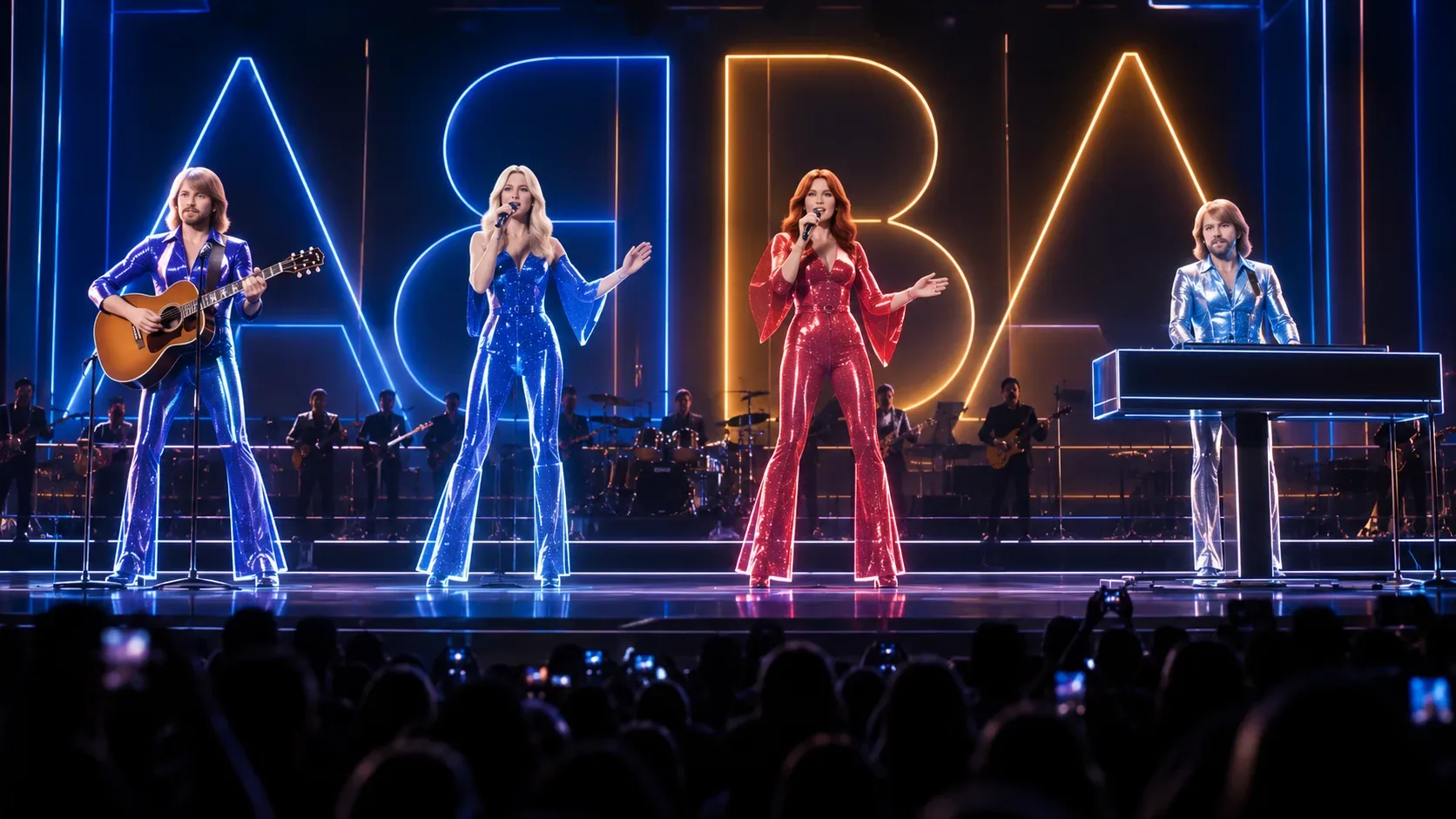
ABBA Voyage does not use holograms in the technical sense. The show features digital versions of Agnetha Fältskog, Björn Ulvaeus, Benny Andersson and Anni-Frid Lyngstad, created through performance capture and computer animation. Their images appear through a combination of display surfaces, optical staging and lighting coordinated with a ten-piece band performing live. All four original members helped make the production, but they are not physically onstage during its London performances.
That distinction matters because the production combines three different elements: a visual performance prepared in advance, ABBA vocals drawn from recordings and musicians actually present in the arena. It is this combination, rather than volumetric holographic bodies floating in the air, that creates the impression of an ABBA concert.
How ABBA’s digital avatars were created
The original performers were the starting point. In 2020, all four ABBA members reunited in Stockholm for performance-capture sessions. According to engineering magazine Ingenia, the sessions lasted five weeks and used 160 cameras to document their gestures, expressions and distinctive movements. Producer Svana Gisla confirmed in an Industrial Light & Magic (ILM) interview that part of the capture took place in February of that year.
Motion capture tracks points observed by cameras so that a performer’s gestures can drive a three-dimensional character. The footage of ABBA provided an essential reference, but it was not simply played back as ordinary video. Younger dancers also worked through choreography under Wayne McGregor’s direction, maintaining characteristics of the group’s physicality while extending the movements required by the show.
ILM turned that material into digital characters styled after ABBA’s 1970s era. The artists had to recreate costumes, hair, skin, facial expressions and believable movement. In ILM’s May 2025 interview, supervisor Ben Morris explains that real costumes were manufactured as references for their digital counterparts, while simulating hair and fabric over extended sequences presented challenges unlike those of a short cinematic shot.
How the group appears onstage without being there
The avatars are modelled as three-dimensional characters, but audiences see rendered images presented through surfaces and stage illusions, not physical bodies occupying the stage. MusicRadar describes large displays and two-dimensional images of the performers in the presentation area, with additional camera perspectives on side screens. Ingenia notes that the producers have not disclosed every optical detail behind the illusion.
For that reason, digital avatars and an illusion of presence are more accurate descriptions than claiming the production uses volumetric holography. Connections to traditional techniques such as the Pepper’s ghost effect have appeared in reports as possible explanations, not as a fully disclosed official technical specification.
Lighting is crucial. Ben Morris and Svana Gisla describe how computer-generated lighting was matched to real spotlights and lasers. Highlights on the virtual costumes have to track the physical effects inside the arena. When digital scenery and the actual venue share convincing lighting, the boundary between the image and the physical stage becomes harder to detect.
What is digital, recorded and genuinely live
Breaking the production down into individual elements makes the distinction easier to follow:
| Element | What happens during the performance |
|---|---|
| The four original members | They contributed performance capture and creative input but do not physically perform in the arena. |
| Agnetha, Frida, Björn and Benny seen onstage | These are digital avatars made in advance and presented in synchronisation. |
| ABBA lead vocals | The show uses recorded vocal material adapted for its arrangements; the original members are not singing it live in the venue. |
| Concert band | Ten musicians perform live, with instrumentalists and backing vocalists in the line-up. |
| Some piano passages | According to engineer Bernard Lohr, certain songs use Benny’s previously recorded piano so the notes match his onscreen performance. |
| Lighting, lasers and effects | Physical equipment runs during the show, synchronised with prerecorded digital lighting and imagery. |
This combination rules out two equally misleading descriptions: that ABBA have returned to play together in person, or that the event is simply a video with a fully prerecorded soundtrack. The live instrumental performance is fundamental to the production.
How recorded audio works with a real band
The music required substantial engineering, too. In an interview with Headliner, Bernard Lohr, an engineer associated with Benny Andersson’s Mono Music studio, explained that the singers’ vocals and, on certain songs, Benny’s piano were prepared before the live performances. Many of ABBA’s original recordings did not use a fixed metronome click.
To let musicians play in time with the vocals, avatar movements and imagery, the team edited the recordings and straightened out tempo variations. In other words, the band plays its parts during the event, but must follow established timing references to keep picture and sound aligned. MusicRadar likewise describes the combination of live performance and tightly synchronised backing tracks.
Hearing Agnetha’s and Frida’s familiar voices therefore does not mean they are singing unseen backstage. Recorded vocals are integrated with musicians in the room, which is different both from an entirely mimed performance and from a digital group improvising live.
Why “hologram” and “artificial intelligence” can be misleading
- Hologram: a popular shorthand for virtual figures onstage, but not an accurate account of the technology confirmed for ABBA Voyage.
- Digital avatar: the appropriate term for computer-generated recreations shaped by the original artists, animators and dancers.
- Artificial intelligence: the sources reviewed do not establish that the visuals or movements are generated by AI in real time during performances.
- Playback: recorded and synchronised elements, particularly lead vocals, are present, but they do not replace the band’s live performance.
What audiences experience at the ABBA Arena
The show opened in London in May 2022 and continues in an arena designed around the sound, displays and visual effects. The official website gives its running time as approximately 100 minutes with no interval and confirms that none of the four original performers is physically at the venue. Audiences see a digital recreation developed with their participation, accompanied by real musicians.
For visitors, one practical detail matters: official venue rules prohibit photography, filming and audio recording inside the auditorium during the concert. Dates, the show configuration and other visit conditions can change, so those details should be checked on the official website for the chosen performance. The essential format is nevertheless clear: digital ABBA on display, a live band onstage and recorded voices in sync.