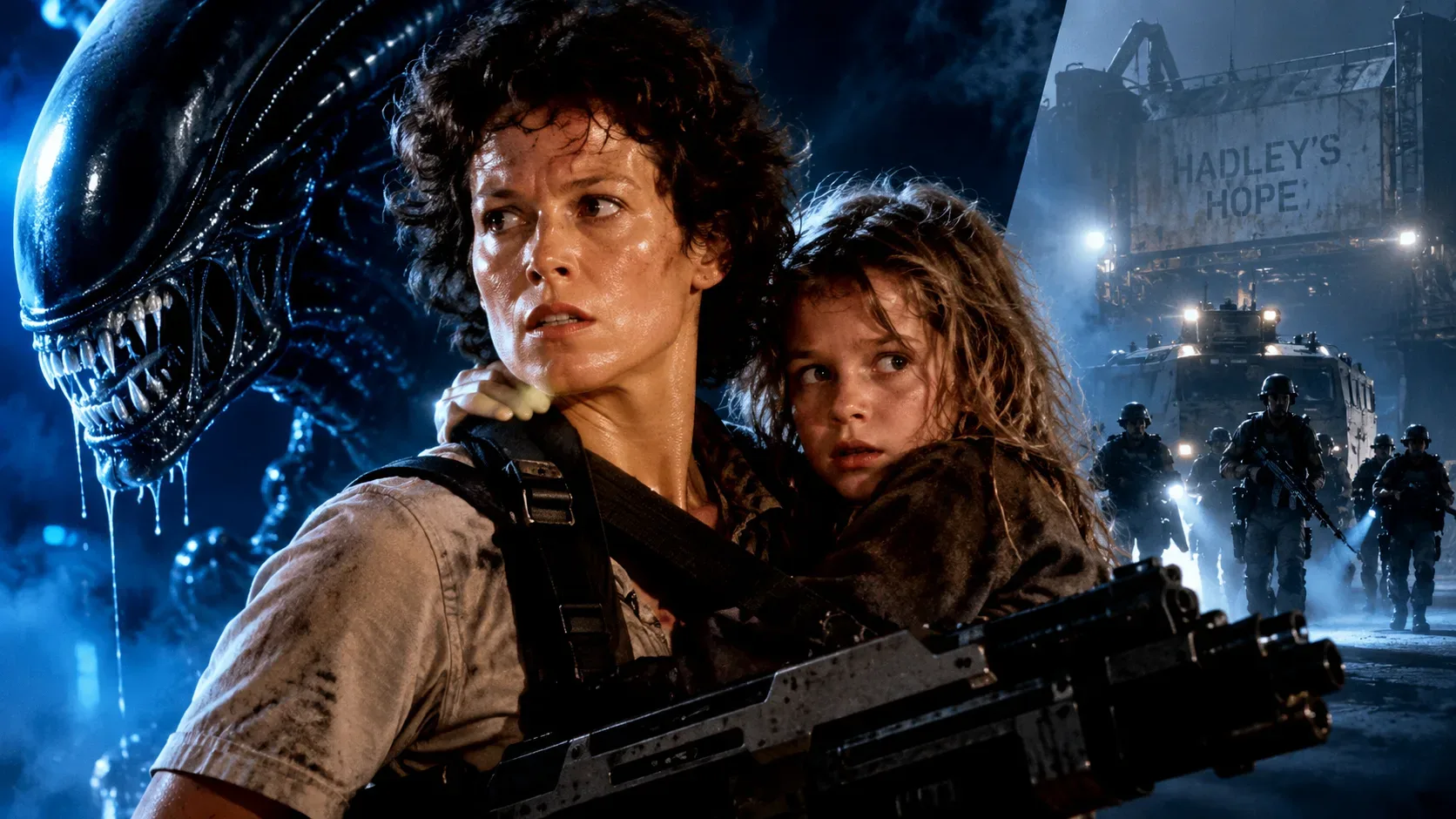
The theatrical cut of Aliens (1986) runs approximately 137 minutes, while the Special Edition lasts about 154. Those additional 17 minutes do not replace the story or change its ending. Instead, they restore material that deepens the bond between Ripley and Newt, shows Hadley’s Hope before the disaster, and follows the Colonial Marines’ use of automated sentry guns. The essential difference is one of perspective and pacing.
Directed by James Cameron, the film opened in the United States on July 18, 1986, according to 20th Century Studios. The expanded cut was released on LaserDisc in the United States in December 1991, as documented at the time by the Los Angeles Times. Specifications for a later 4K home release explicitly list both cuts, with approximate running times of 137 and 154 minutes.
Spoiler warning: the comparison below reveals plot details from Aliens and scenes exclusive to the Special Edition.
The differences between the two cuts at a glance
| Aspect | Theatrical cut (1986) | Special Edition |
|---|---|---|
| Approximate runtime | 137 minutes | 154 minutes (17 minutes longer) |
| Ripley and Newt | Their protective bond develops without the full explanation of Ripley’s personal loss. | Restores the news about Amanda, Ripley’s daughter, and expands an intimate conversation with Newt. |
| Hadley’s Hope | The colony is known mainly through the evidence discovered by the rescue team. | Shows residents before the collapse and the Jorden family discovering the derelict spacecraft. |
| Defending the colony | The siege proceeds without the complete automated-gun sequences. | Includes the preparation, deployment, and battles involving the sentry guns. |
| Marines and Hicks | Leaner introductions and relationships. | Adds Hudson’s boasting, a false alarm, and a personal farewell between Hicks and Ripley. |
| Narrative effect | A faster arrival at danger and more mystery around the colony. | More context, dramatic pauses, and an additional stage of attrition during the siege. |
Amanda Ripley: why the relationship with Newt takes on new meaning
In the extended cut, Burke tells Ripley that Amanda, the daughter she left behind on Earth, died while her mother was lost in hypersleep. That information turns the decades separating the two films into a specific bereavement: Ripley has lost not only years of her life but also the chance to watch her daughter grow up. The theatrical cut retains her trauma and courage, but does not make this aspect of her grief explicit.
Later, Newt asks Ripley about babies, whether she has been a mother, and what happened to her daughter. The restored conversation brings together two people marked by family separation. Ripley’s determination to protect Newt thus also carries an echo of Amanda. This is an interpretation of the film’s dramatic construction, not a claim that Ripley literally sees Newt as a replacement for her daughter.
Hadley’s Hope: the Special Edition shows the colony before its destruction
In the theatrical cut, the Marines arrive at Hadley’s Hope to find an almost lifeless place scarred by disaster. Viewers learn what happened largely alongside the team. The longer version interrupts that mystery-building approach to show a functioning colony, with workers, families, and an everyday routine before the infestation.
One sequence follows the Jorden family, including young Newt, her brother, and their parents, to the derelict alien spacecraft on LV-426. Her father enters and is attacked by a facehugger. These scenes make the connection between the colonists’ expedition and the beginning of the crisis visible. The benefit is causal clarity: viewers better understand Newt’s background and how the danger reached the community. The trade-off is suspense: when the Marines arrive, the audience already knows more than they do about the disaster’s origins.
Sentry guns: the siege gains a battle missing from the theatrical cut
Among the most substantial additions are the sentry guns, automated defensive weapons set up at access points to the survivors’ refuge. The expanded version shows the equipment being recovered, deployed, and tested before following xenomorph attacks as the ammunition counters fall on the control screens.
The weapons temporarily hold back parts of the assault but do not eliminate the threat. This creates a period of resistance and attrition between the major action sequences: the group has powerful technology, yet the siege is still becoming untenable. The theatrical version moves into the subsequent events without spending as much time on this tactical stage.
Other restored scenes and what they contribute
Smaller additions change the texture of the characters. During the descent, Hudson boasts about the Marines’ arsenal, making his overconfidence more obvious. A movement reading in the colony leads to caged animals rather than monsters; Ripley briefly hesitates before entering the complex. The extended cut also includes more of the inquiry into Ripley, interior views of the Sulaco, and dialogue involving Burke.
In another exchange, Hudson speculates that a queen might organize the aliens. This verbally foreshadows a later revelation rather than starting a separate plot. Near the final rescue, Ripley and Hicks exchange first names, Ellen and Dwayne, creating a moment of intimacy amid the urgency. None of these passages changes the central events, but they adjust the group’s humor, tension, and relationships.
What stays the same, and what is still absent from the Special Edition
Both cuts follow the same mission on LV-426, the same core cast of characters, and the same decisive confrontation. The Special Edition expands the buildup, context, and certain relationships; it does not introduce an alternate ending or a different continuity. The shorter film therefore remains entirely understandable, including the connection between Ripley and Newt.
It is also important to distinguish footage restored to the movie from bonus material on a home release. The sequence showing Burke cocooned is listed separately as a deleted scene in the 4K release materials, not among the passages integrated into the Special Edition. Access to a disc with extras does not mean every extra belongs to either completed cut.
Pacing: more mystery in theaters, more context in the extended version
The 1986 version keeps its attention on the Marines’ discoveries and preserves the colony as a mystery for longer. The Special Edition reveals events earlier, makes room for Ripley’s grief, and extends the siege with the automated-gun battle. This trade-off explains why one cut may feel tenser to viewers who value the unknown, while the other may satisfy those looking for causes, emotional development, and military detail.
In a December 1991 Los Angeles Times report, Cameron described the longer cut as close to what he had intended when writing and filming Aliens. That is an attributed statement about his creative intention at the time, not a verdict that every viewer should prefer that version.
Which version should you watch first?
For a first viewing with fewer early revelations and a tighter pace, the theatrical cut is a good starting point. For a revisit, or for anyone who wants to know more about Amanda, Newt’s history, everyday life in Hadley’s Hope, and the Marines’ defense strategy, the Special Edition adds meaningful material. Both tell the same story through different editing choices.
When choosing, check the version label and runtime: approximately 137 minutes indicates the theatrical cut, and 154 minutes the Special Edition. The existence of a home release containing both does not establish that both are available on every streaming service or in the Brazilian catalog.