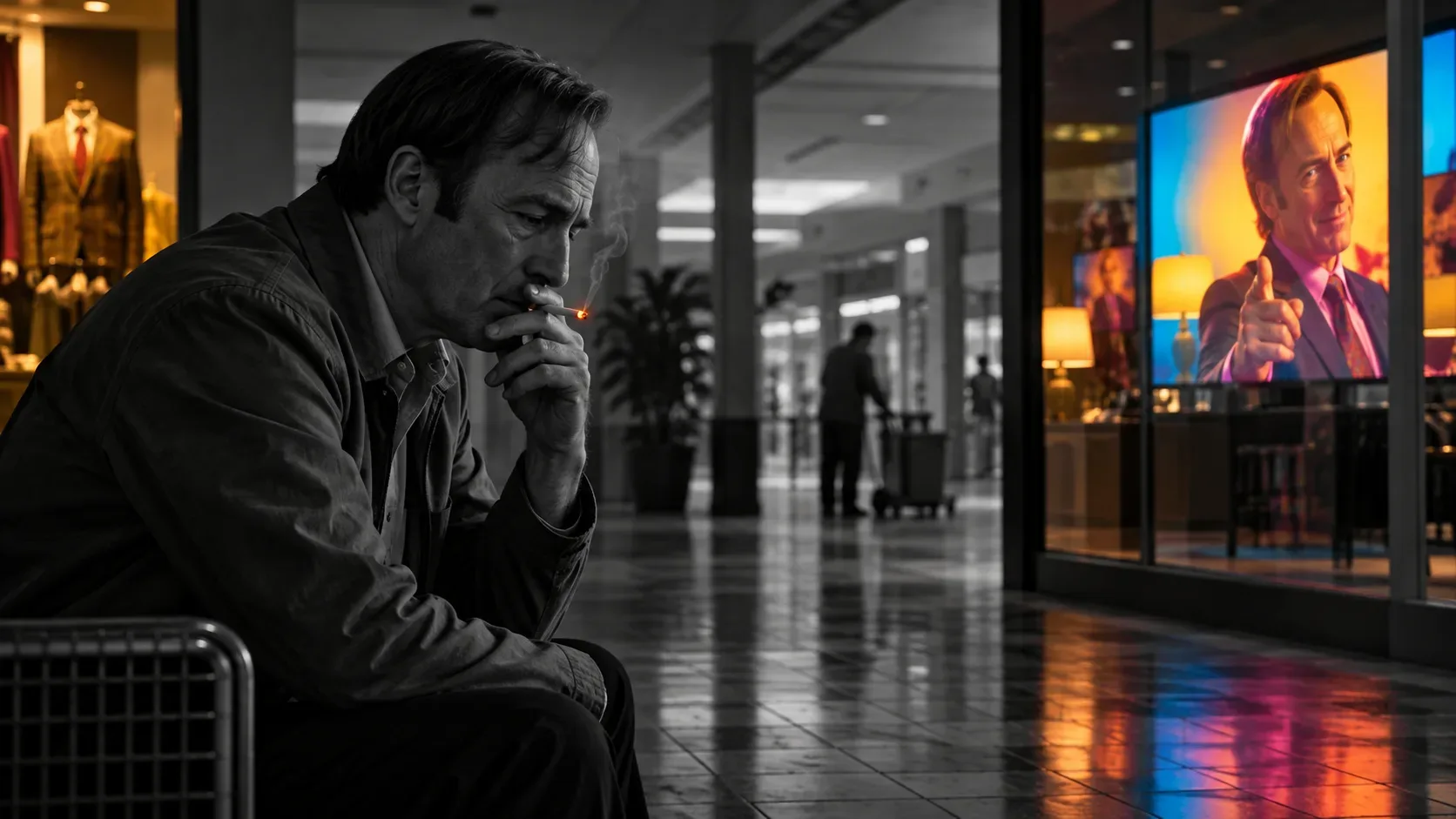
Gene Takavic’s scenes in Better Call Saul are mostly black and white to distinguish Jimmy McGill’s hidden life after Breaking Bad and convey how much of his former identity has been drained away. When color appears, it draws attention to what still matters emotionally: first, Gene’s nostalgia for Saul Goodman’s advertisements; by the finale, his bond with Kim Wexler. Series co-creator Peter Gould has explained these uses separately, so they should not be reduced to a single symbol.
Warning: this article contains spoilers for Season 6, Episodes 12 and 13, including the Better Call Saul series finale.
What does black and white say about Gene’s life?
In the pilot’s opening, Jimmy is already living as Gene Takavic and working at a Cinnabon in Omaha, Nebraska. This part of the story takes place after his escape from the events of Breaking Bad, while much of Better Call Saul goes back in time to show how Jimmy became Saul Goodman. The contrast in color helps viewers distinguish those periods without an on-screen explanation.
In a 2023 interview with Awards Daily, Gould said the initial idea was straightforward: show a once-flamboyant man living in a world drained of color. As the show kept returning to Omaha, the team decided to retain the monochrome look for the story’s final stretch rather than gradually shift back into color. He also described a practical and expressive benefit: Gene’s city could feel like a visual world of its own.
The choice goes beyond applying a filter. In an interview published by AMC, director Michelle MacLaren explained how lighting moves Gene between brightness and shadow in Nippy (Season 6, Episode 10), depending on what he is doing. The film-noir influence amplifies his fear of exposure, the threat of being watched and the dangerous excitement of returning to cons. This is a deliberate directorial language, not a rigid rule that every dark shot signifies guilt.
Why are Saul Goodman’s commercials shown in color?
The first clue appears in the pilot itself: alone, Gene watches his old Saul Goodman advertisements, with the color footage reflected in his glasses. The ads bring back the flamboyant persona he built in Albuquerque, complete with a confidence he can no longer display openly in Omaha.
The effect returns in Waterworks (Season 6, Episode 12), when Marion finds his old commercials online and identifies the man calling himself Gene. Color from the video is once again reflected in his lenses. This time, the image that revives Saul’s memory also helps expose his identity. Critical Hits highlights that reversal between remembrance and discovery.
Gould told TVLine and Variety that he mainly reads those reflections as the character’s passion and nostalgia for being Saul Goodman, rather than Jimmy McGill. That distinction matters: Gene misses the glamour of the mask, even though it is linked to choices that destroyed his life. The show does not say the ads prove he was genuinely happy, and the color does not excuse the former lawyer.
Why are the flame and cigarette ember colored when Kim appears?
In Saul Gone (Season 6, Episode 13), Jimmy and Kim reunite in prison and share a cigarette, echoing a gesture that brought them close in the pilot. Against the black-and-white photography, the flame and glowing tip take on a subtle color. Unlike the commercial, this highlight is not about a desire to revive Saul.
According to Gould, the small point of color now represents Jimmy’s relationship with Kim. She knows both who he used to be and who he became. In remarks reported by Variety and TVLine, the creator said he wanted the effect to be understated so it would not distract from Bob Odenkirk and Rhea Seehorn’s performances. The ember’s red and orange suggest a trace of intimacy in an otherwise deprived environment.
The reunion follows Jimmy’s decision to give up a deal that might have meant roughly seven years in prison, acknowledge his responsibility in court and receive an 86-year sentence. By calling himself Jimmy McGill again, he changes his relationship with the truth, but he cannot undo his crimes or recover his old life. The cigarette scene suggests human closeness; it does not confirm a romantic reunion or a future release.
Does the finale return to full color?
No. The production keeps the finale in black and white, using color only for carefully chosen details. The distinction matters: the photography does not function as an automatic gauge of redemption. Turning the entire picture colorful might imply a complete restoration that the story never provides.
The two forms of nostalgia are different, too. In the commercials, color reflects Gene’s fascination with the Saul persona and the danger of recognition. With Kim, it points to the possibility of being seen without performing that role. As Gould explained, the latter bond is the emotional purpose of the visual effect, not a promise that the two will live together.
When color appears: three key moments
The sequence makes it easier to distinguish the meanings without mixing up episodes:
| Moment | What appears in color | Narrative purpose |
|---|---|---|
| Season 1 pilot | Old Saul commercials and their reflections | The contrast between Gene’s life and nostalgia for the Saul persona. |
| Waterworks, Season 6, Episode 12 | Commercial footage and reflections in Gene’s glasses | Saul’s past helps Marion identify Gene. |
| Saul Gone, Season 6, Episode 13 | The flame and ember of the shared cigarette | The bond with Kim preserves a small point of affection in the present. |
The question, then, is not simply why a scene turns colorful. What matters is which detail receives color and which version of Jimmy it brings to the surface. Gould’s explanation leaves room for the finale’s ambiguity without treating every visual choice as a literal message.
Sources and references
- AMC: Michelle MacLaren on Nippy and black-and-white photography
- AMC: Vince Gilligan discusses Waterworks, Kim and the final opening credits
- TVLine: Peter Gould on color and Jimmy’s final scene with Kim
- TVLine: interview on Jimmy’s fate in the series finale
- Variety: Peter Gould, Bob Odenkirk and Rhea Seehorn on the cigarette scene
- Awards Daily: Peter Gould on keeping Omaha in black and white
- Critical Hits: analysis of the color commercial and Marion’s discovery