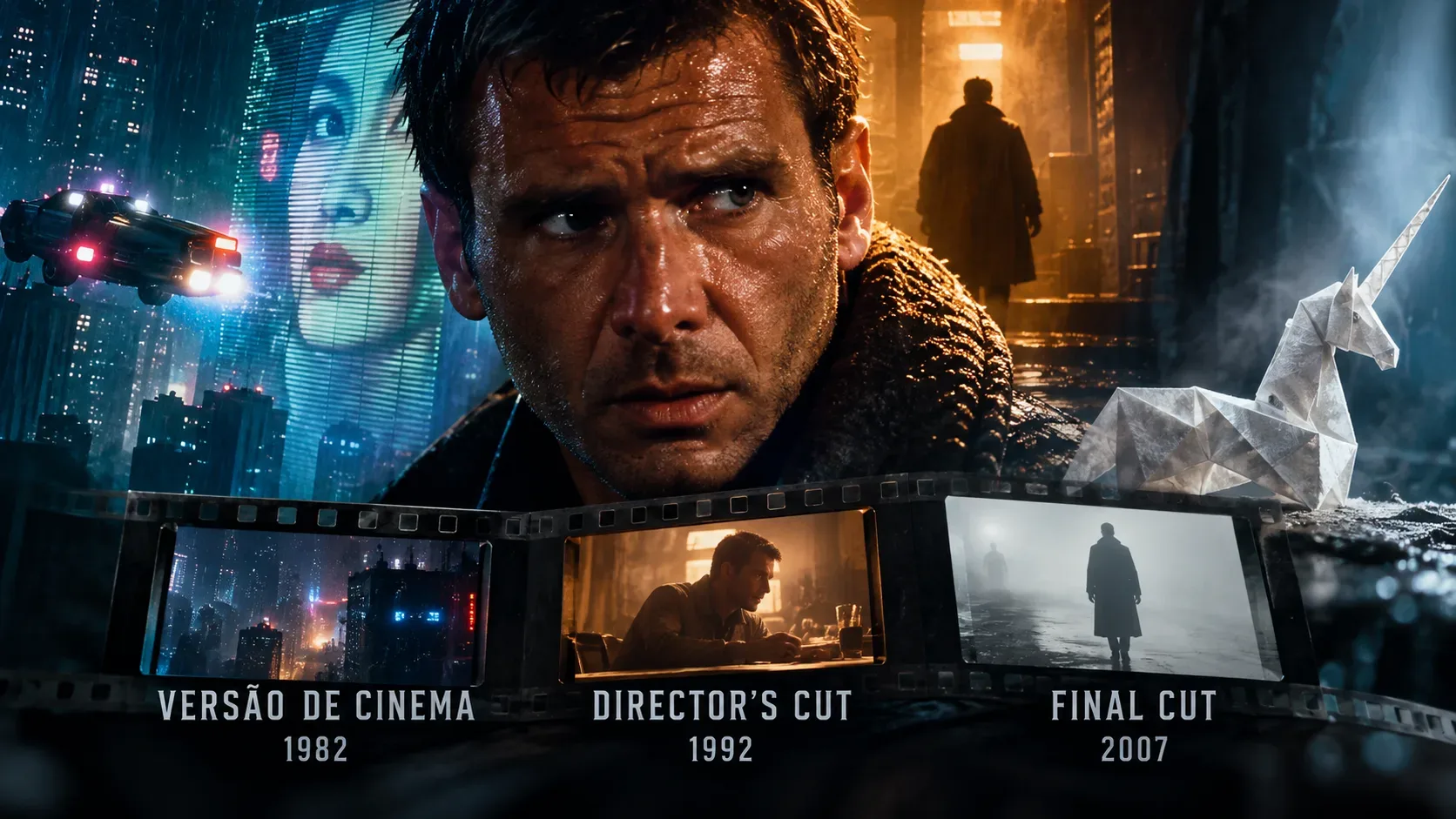
Spoiler warning: this article discusses Blade Runner (1982), including its ending. The unicorn changes the way Rick Deckard is understood because the dream restored in the 1992 Director’s Cut and retained in the 2007 Final Cut connects to the small origami figure found near the elevator at the end. If Gaff knows an image that appeared to belong only to Deckard’s mind, the film raises the possibility that Deckard has implanted memories. It is an intentional clue supporting Ridley Scott’s interpretation, not an explicit on-screen confirmation delivered through dialogue.
How the dream and the origami work together
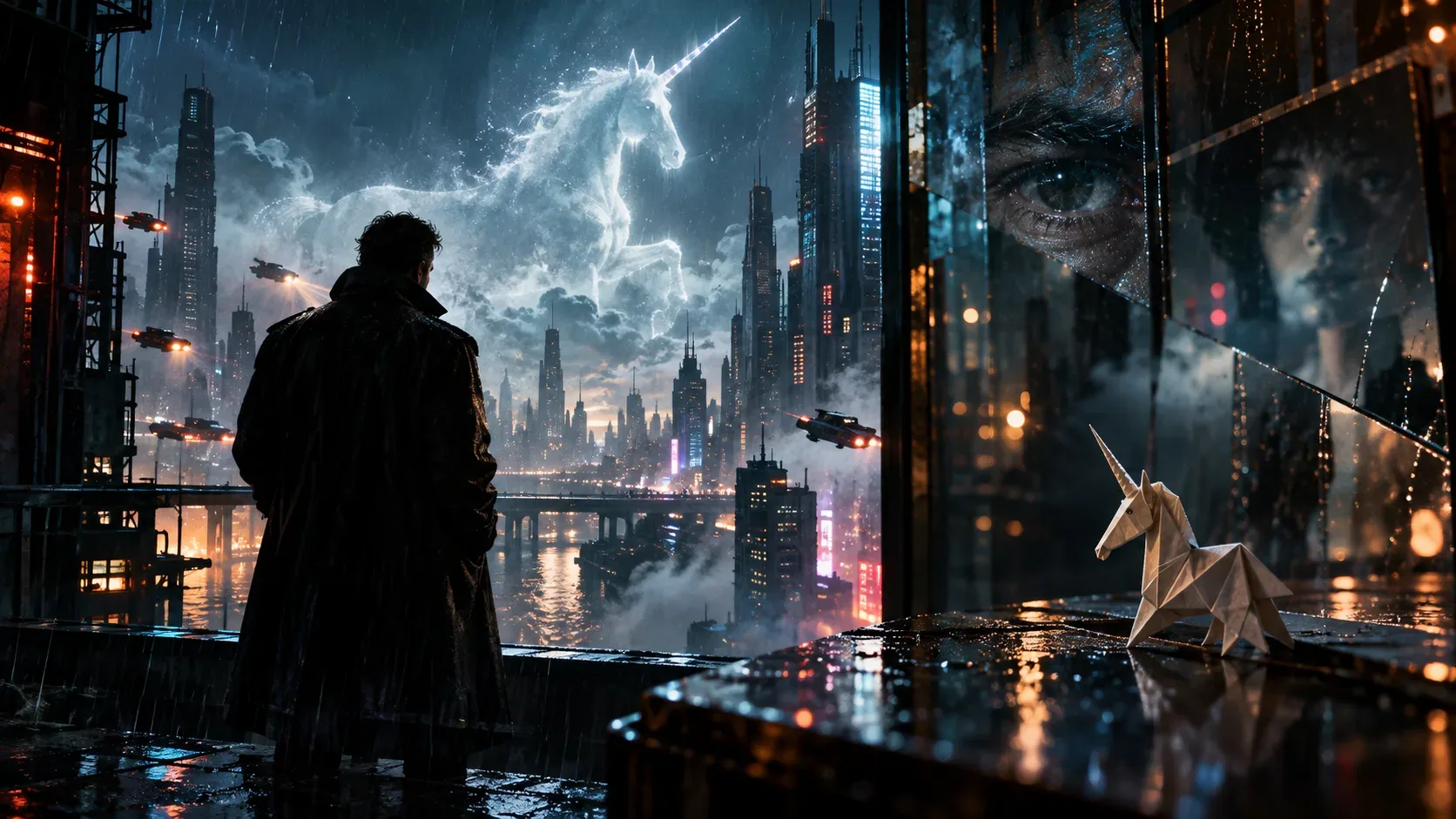
The dream shows a unicorn in a forest, far removed from the industrial Los Angeles in which Deckard works. At first, the image feels private and unrelated to his assignment. At the end, as he leaves with Rachael, Deckard finds a little silver-paper unicorn. The folded figure is associated with Gaff, the police officer who makes origami figures throughout the story.
Without the dream, the object can primarily be read as a message from Gaff: he was there, could have found Rachael, and chose to let her live. With the dream included, another question arises: how could Gaff know an image from Deckard’s private thoughts? One interpretation is that the unicorn belongs to a fabricated set of memories or mental images known to someone with access to a replicant’s file. This is an inference from the scene, although Scott has explained the connection in interviews.
The distinction matters because the film has already established, through Rachael, that an artificial person can possess implanted memories and believe them to be genuine. The additional image extends that possibility to the investigator tasked with identifying other replicants, reversing his apparent position in the world he polices.
What the 1982 theatrical release left out
The comparison here concerns the US theatrical cut released in 1982, not every print from that year. It includes Deckard’s voice-over narration and a more optimistic conclusion that follows the couple’s escape beyond the elevator. The unicorn dream is absent. A separate international cut from 1982 featured differences in violent material and should not be confused with later editions.
The origami can still be seen at the end, without the audience having previously witnessed the same creature inside Deckard’s mind. Gaff’s decision to spare Rachael therefore remains a possible reading, but the specific link to implanted memories loses its most important visual counterpart. Reporting published by the Los Angeles Times in 1992 traced the removal of the dream, the added exposition and the more hopeful ending to decisions made after test screenings.
1982, 1992 and 2007: what changes the question
| Cut | Unicorn dream | Deckard voice-over | Ending |
|---|---|---|---|
| US theatrical (1982) | Absent | Included | Extended, optimistic escape |
| Director’s Cut (1992) | Restored in a shorter form | Removed | Ends at the elevator |
| Final Cut (2007) | Included in a fuller version | Removed | Ends at the elevator |
The 1992 Director’s Cut was assembled with input from Scott, but it did not receive the same degree of direct finishing control as the 2007 Final Cut. For the latter, the director oversaw a more comprehensive revision of the edit, picture and sound. The version history published by the Philip K. Dick website notes that the unicorn sequence appears in a fuller form in the Final Cut. Nevertheless, the key interpretive change had already arrived with the dream’s restoration.
Why removing the narration matters too
In the American theatrical cut, Deckard’s voice explains parts of the story and guides viewers through the conclusion. Removing that voice-over in the two later cuts reduces the explanations he provides. Viewers have to connect gestures, objects and silence without being supplied with the protagonist’s ready-made account of what they mean.
The extended exterior ending from 1982 also disappears. By stopping when the elevator doors shut, the 1992 and 2007 versions leave more room for the threat surrounding Deckard and Rachael. Rather than becoming a detail on the way to a reassuring escape, the origami becomes one of the last pieces of information the film gives us.
So is Deckard a replicant? What the evidence actually says
Ridley Scott has never treated the idea as a mere coincidence. Speaking on the Fresh Air program on December 20, 2007, he explicitly stated that Deckard is a replicant in his conception and that this was his intention from the beginning. The BFI also records Harrison Ford’s opposing preference for Deckard to be human, giving audiences someone human with whom to identify.
A director’s stated intention is significant evidence about how a film was designed, but it is not the same thing as a conclusive spoken revelation or diagnostic test within the plot. The origami still supports the reading that Gaff spared Rachael, while the dream creates additional doubt about where Deckard’s memories come from. The Final Cut intensifies that doubt without having to settle it through exposition.
That is why watching only the 1982 release and watching the Final Cut can lead to different questions. The earlier cut leaves the unicorn largely as a potential message from Gaff and emphasizes escape; the later cut makes the object echo something inside Deckard’s own mind. The editing change moves the question from who hunts replicants to who might be one of them.