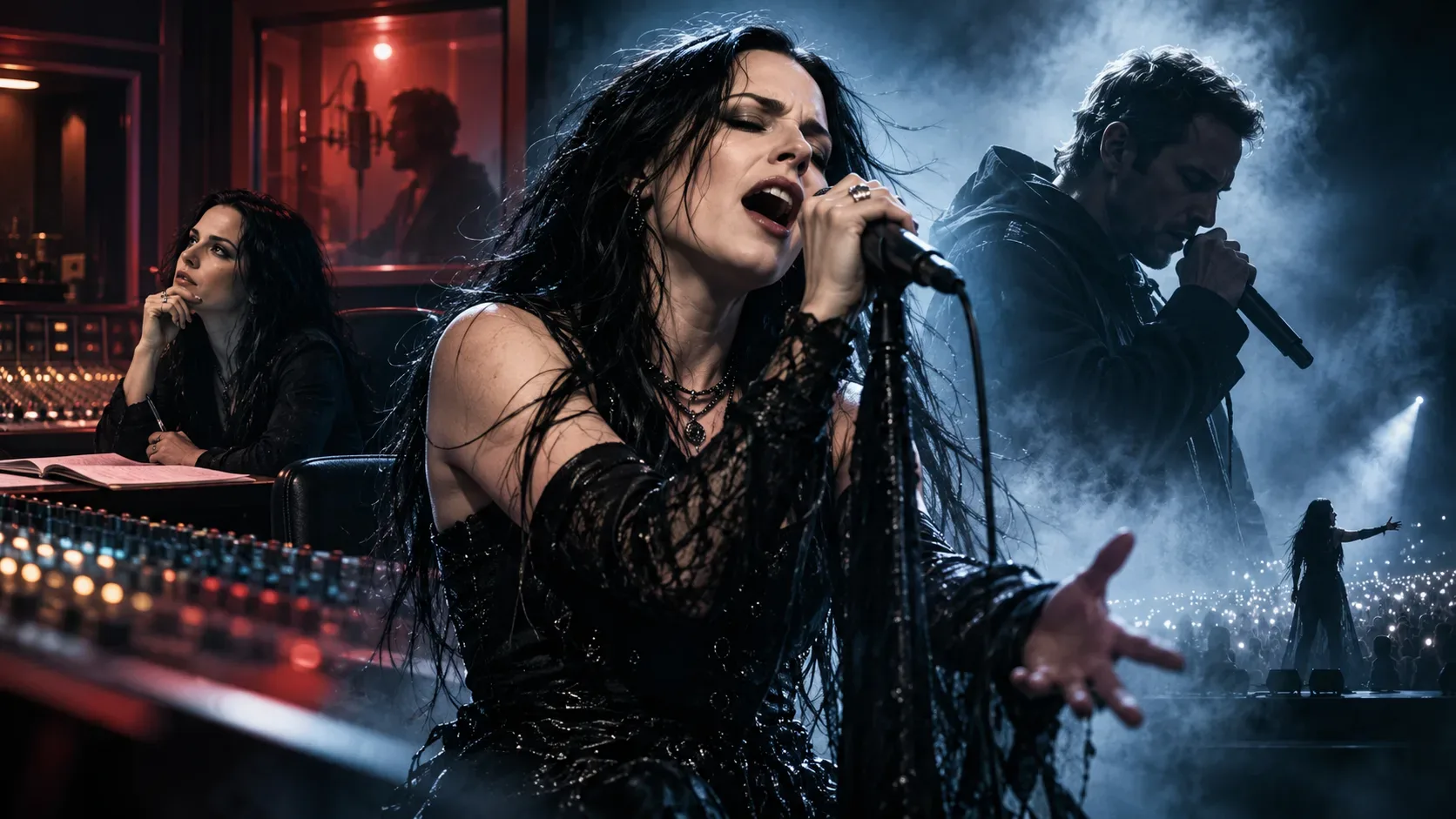
The male voice on Evanescence's 2003 recording of Bring Me to Life was added under pressure from Wind-up Records, not at Paul McCoy's insistence. Amy Lee objected to putting a rapper in the band, but accepted a guest appearance on a single track to protect the lineup and the rest of the music. Years later, she came to appreciate the duet and made a point of explaining that McCoy, the singer of 12 Stones, had supported her during the recording rather than caused the demand.
That distinction matters. Lee has not withdrawn her criticism of the label's interference. What evolved was her view of what the collaboration made possible and, especially, how she told the full story of the guest vocalist.
Before the duet, the label wanted a man in the band
In a September 2020 interview with Marianne Eloise for The Forty-Five, Lee said the label wanted something familiar to introduce Evanescence to radio audiences. As she described the executives' thinking, opening a song with piano and a woman's voice looked risky in the rock market of the time. According to Lee, the initial proposal was to add a man to the band permanently.
She refused. In an interview with Tom Power on Q, reported and transcribed by Blabbermouth in July 2026, she said the label wanted auditions for a rapper who would appear on roughly ten of the project's twelve songs. She recalled the group returning home for about three weeks after a dispute that left the album's future in doubt. This is Lee's account of the negotiations, not independent documentation of the label's internal discussions.
When a place on the soundtrack to Daredevil became possible, the label set a condition: Bring Me to Life had to include the male part and serve as the first single. Pressure that had initially threatened the band's whole identity was therefore limited to one recording. The compromise allowed a guest singer without making him an Evanescence member.
What was Paul McCoy's role, and who wrote his part?
McCoy fronted 12 Stones, another act associated with the same record label. In her 2026 interview, Lee said they were already friends and that the bands were recording around the same time. McCoy was suggested by the label, but he did not originate its commercial requirement. Lee also said she wrote the rap passage; in a 2016 Metal Hammer interview, she explained that she worked with him to make the performance fit Evanescence's sound.
This distinction explains the tension. The decision to include a second voice emerged from the negotiations, yet Lee still made creative choices about how it would sound. Accepting the collaboration did not mean agreeing that the band should repeat the formula across its other songs.
Why did Bring Me to Life's first impression worry her?
Nu metal and rap rock had a strong presence in the early 2000s, and Lee has named Linkin Park as one of the reference points in the industry's thinking. In her account, the label wanted a recognisable entry point for listeners. She feared Evanescence's first widely heard song would frame the group as a female version of another band, obscuring the distinctiveness of her voice, the piano and the songwriting.
In 2026, she also described fearing that the group might become a one-hit wonder because its breakthrough single differed from the rest of Fallen. That concern does not establish that the male vocal caused the song's commercial success, or that audiences actually misunderstood the band. It documents Lee's artistic anxiety before release.
From her 2023 objections to her 2026 recognition
Read chronologically, Amy Lee's comments reveal a more nuanced position than simple regret or reconciliation:
- 2016: speaking to Metal Hammer, she called the rap a concession to the label but stressed that she wrote the passage and worked with McCoy on it.
- 2020: she told The Forty-Five that a one-song agreement replaced the demand for a full-time rapper in Evanescence.
- 2023: in remarks published by Metal Hammer, she maintained that the sound was not her style and highlighted the fact that the band did not have to change its overall identity.
- 2024: in an iHeartRadio interview, she said a famous duet had become a welcome way to bring other artists onstage at festivals. She also praised McCoy.
- 2025: Lee and McCoy performed Bring Me to Life together again at Louder Than Life in Louisville, a reunion noted by Metal Hammer in 2026.
- 2026: on Q, Lee explained that repeatedly recounting the label dispute without its ending had unfairly made McCoy sound like the villain. She described him as someone who made a difficult experience more positive.
Did she grow to like the rap, or did her view of Paul change?
The two questions require different answers. Lee has not said that forcing a rap section onto the track became a sound artistic decision. Her commitment to the band's creative independence remains evident. Her later comments about McCoy, however, do not describe personal dislike that eventually turned into affection: they say he was understanding from the beginning, and that she wanted his contribution to be recognised more clearly.
In 2024, she pointed out that the part written for another voice makes spontaneous guest appearances possible at festivals. In 2026, she described McCoy as a hero of the experience because of the support he gave her. Their shared performance in 2025 illustrates that distinction without erasing the original conflict with Wind-up Records.
The other versions make the disagreement audible
The recording on Fallen, released in 2003, is the familiar version featuring McCoy. On Synthesis in 2017, Evanescence revisited older songs through orchestral and electronic arrangements, including a new interpretation without the rap. The 2023 twentieth-anniversary edition of Fallen also brought an official release of a demo recorded in 2002, likewise without that section. These are different recordings: one is a later reinterpretation, while the other preserves an earlier stage of the song.
The comparison gives the debate a tangible form. One version captures how the band was introduced in 2003; the others show that the song could exist outside that format. Lee could continue to oppose the commercial demand while acknowledging Paul McCoy's personal contribution to the recording.
Sources and references
- Metal Hammer, Amy Lee interview (2016)
- The Forty-Five, Marianne Eloise interview (2020)
- Metal Hammer, Amy Lee statements (2023)
- Blabbermouth, iHeartRadio interview (2024)
- Metal Hammer, Dannii Leivers interview (2026)
- Blabbermouth, Q with Tom Power interview (2026)
- Evanescence, official release timeline
- Evanescence, Bring Me to Life (2002 Demo), official upload (2023)