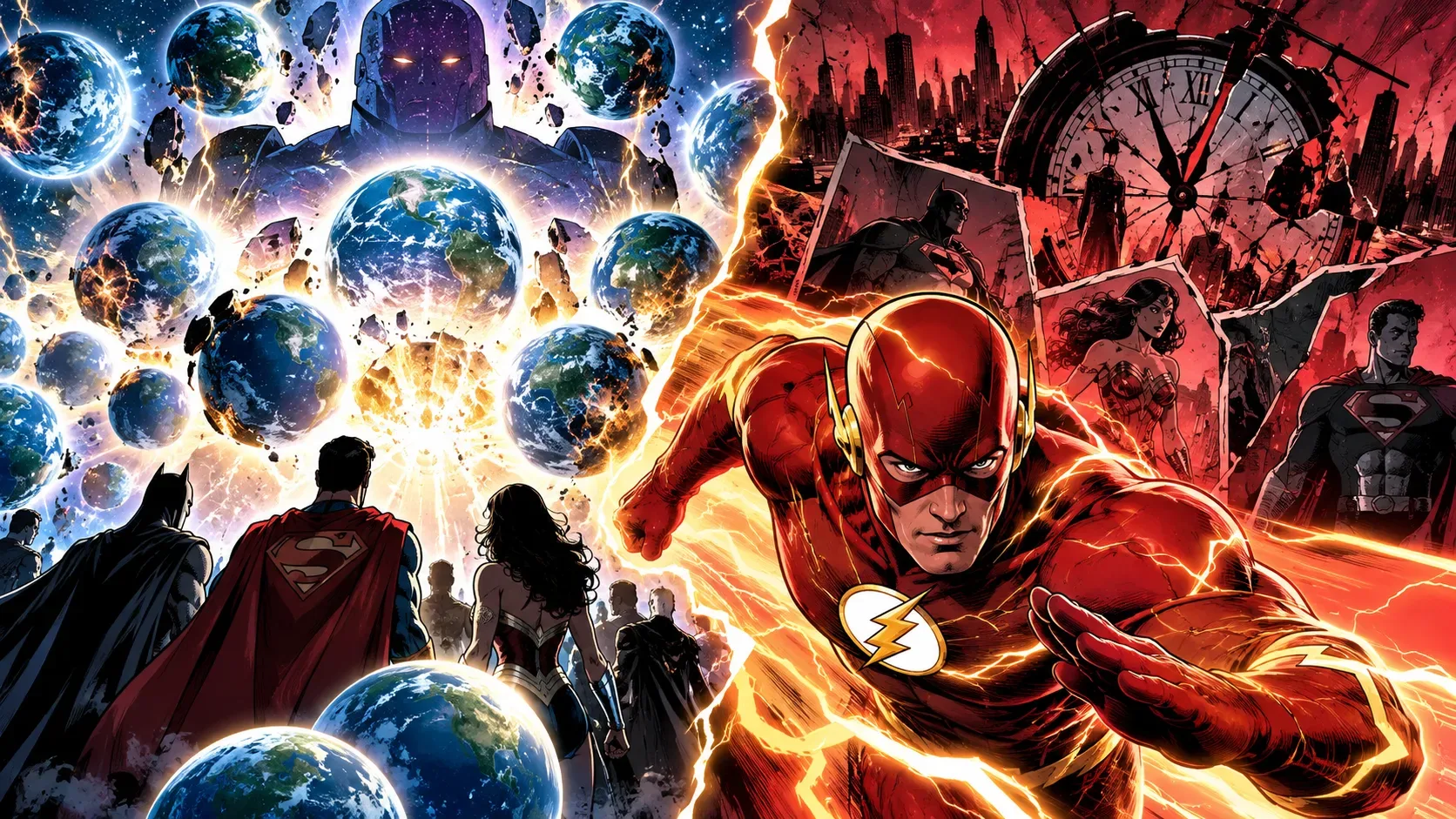
Crisis on Infinite Earths, published in 1985, reshaped DC's multiverse and opened the Post-Crisis era, bringing different Earths into a main continuity. Flashpoint, in 2011, triggered another reorganization, this time tied to the publishing relaunch called The New 52. Neither event uniformly and permanently erased every previous story for every character.
Spoiler warning: this article discusses major events in the Crisis on Infinite Earths and Flashpoint comics, along with their consequences for the heroes.
What did Crisis on Infinite Earths actually reset?
Before Marv Wolfman and George Pérez's 12-issue miniseries, the publisher placed different versions of its heroes on parallel Earths. Earth-One was primarily associated with Silver Age characters; Earth-Two preserved Golden Age heroes such as the Justice Society. Other worlds housed their own teams and characters. As the creators recalled in an interview with DC, the editorial aim was to make that complex arrangement easier to follow.
In the story, the Anti-Monitor threatens reality, and the outcome produces a main universe with a reconfigured history. Above all, the event changed how worlds and character versions related to one another. The Justice Society, for example, became part of the history of the same Earth inhabited by the Justice League rather than remaining simply isolated on the former Earth-Two.
The restructuring also paved the way for new origins in ongoing titles. John Byrne's The Man of Steel retold Superman's origin in 1986, while Wonder Woman entered a new era under George Pérez. Clark Kent's past changed, but this did not mean replacing him with an unrelated character. DC itself explains that Superman's history was rewritten and subsequently adjusted again.
Barry Allen died during Crisis, and Wally West took over as the Flash in later stories. This shows the event's scope: while some titles received new origins, others carried consequences of earlier events forward. Post-Crisis, then, names a new historical configuration, not a button that wiped every biography clean.
What did Flashpoint change in 2011?
In Flashpoint, written by Geoff Johns and illustrated by Andy Kubert, Barry Allen changes the past to prevent his mother's murder. That interference creates a dramatically different alternate reality. The ending does not simply restore everything exactly as it was: it acts as the transition into another version of DC's main continuity.
The publishing change arrived with The New 52. In 2011, DC launched 52 series with new issue #1s and redefined origins, relationships and career timelines for numerous characters. Superman provides a concrete example: his history with Lois Lane was revised, and the marriage that had existed before Flashpoint was no longer part of the New 52 Superman's initial background.
But reboot needs qualification. Batman and Green Lantern were notable exceptions. DC explains that their series retained ongoing story arcs, especially work associated with Grant Morrison and Geoff Johns. This did not leave their entire past unchanged: Batman's timeline was compressed and details of his origin were revised, even as elements such as Damian Wayne remained.
Before and after: comparing the two events
| Aspect | Crisis on Infinite Earths (1985-1986) | Flashpoint and The New 52 (2011) |
|---|---|---|
| Universes | Several classic Earths are consolidated into one main Post-Crisis continuity. | The main timeline is reshaped into the primary New 52 Earth; this does not permanently eliminate every alternate reality. |
| Superman and Wonder Woman | New introductions and origins become prominent in the post-Crisis series. | Personal histories and origins are revised again, to differing degrees; Clark and Lois's lives are one example. |
| Batman and Green Lantern | They belong to the reorganized setting without necessarily losing their entire past. | Their series preserve major earlier arcs, even as ages, timelines and origins receive adjustments. |
| The Flash and legacy | Barry Allen's death makes way for Wally West as the Flash. | Barry remains central; parts of the earlier legacy, including the original Wally, are initially absent or altered. |
| Publishing impact | Establishes the historical Pre-Crisis/Post-Crisis distinction. | Establishes the Pre-Flashpoint/New 52 distinction, later revisited by Rebirth and other stories. |
This table covers changes to the main comic-book continuity. It does not automatically describe DC movies, television series, animated projects or every alternate universe, all of which may operate under their own rules.
Why were Batman and Green Lantern exceptions, yet still affected?
Restarting a comic at issue #1 does not, by itself, prove that its hero's entire life began from scratch. For Batman, stories involving his family and Damian's journey remained important; at the same time, he was assigned a shorter career in the revised timeline. DC's official character history documents this mixture of preservation and revision.
Green Lantern followed a similar principle: the relaunch maintained the momentum of important ongoing storylines. It is therefore more accurate to speak of a selective restructuring of continuity than to describe every New 52 title as a completely new and disconnected universe.
Did Rebirth and Infinite Frontier undo both resets?
DC Universe: Rebirth in 2016 was presented by the publisher as a restoration of relationships and legacies, not a third complete reboot. The original Wally West returned to prominence, and older stories once again informed characters' and teams' lives. Later, Dark Nights: Death Metal and Infinite Frontier expanded the multiverse's possibilities and the heroes' connections to forgotten histories.
The key caveat appears in an explanation by columnist Alex Jaffe on DC's website: characters remembering different versions of their histories does not make every past event simultaneously true in the reality currently in effect. Saying that everything became canon again would therefore go further than the evidence allows.
How can you identify a DC story's continuity?
Check three clues together: the publication year, the title's volume or publishing era, and the story's context. An issue #1 can simply launch a new volume, while a crossover may change a character's narrative past without erasing the character's existence. Pre-Crisis, Post-Crisis, Pre-Flashpoint and New 52 are useful labels, but they do not replace checking the particular issue.
The essential distinction is that Crisis on Infinite Earths consolidated versions that previously occupied different Earths and established the Post-Crisis framework, while Flashpoint led to a new version of the main timeline in 2011 with selective carryovers. DC continued to reinterpret the consequences of both events in subsequent decades.
Sources and references
- DC: Marv Wolfman and George Pérez discuss Crisis on Infinite Earths
- DC: the Justice Society and Justice League after Crisis
- DC: Superman continuity reading guide
- DC: why Flashpoint matters
- DC: why Batman and Green Lantern were New 52 exceptions
- DC: official Batman character history
- DC: the purpose of Rebirth in 2016
- DC: 2021 Infinite Frontier announcement
- DC: column on memory and canon after Death Metal