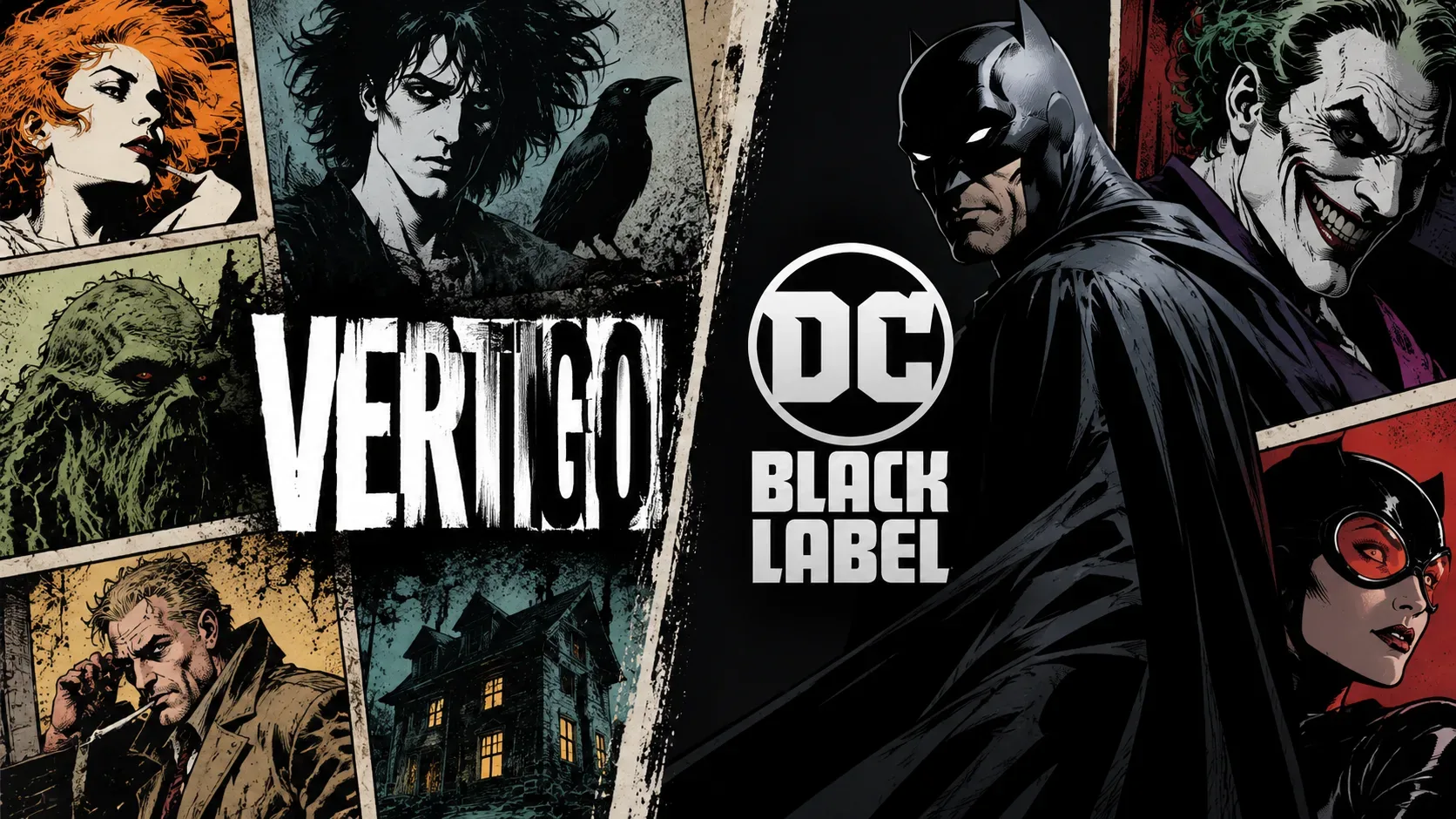
Since Vertigo's return in 2026, DC's main distinction has been this: Vertigo focuses primarily on original stories independent of the publisher's superhero universe, while DC Black Label mainly publishes mature-oriented stories featuring DC characters and properties, often outside the main continuity. This is an editorial distinction, not a ranking in which one imprint is more adult than the other. DC itself explained the separation in February 2026, following years when their remits had overlapped.
When choosing a comic, the most useful question is whether you want an original creation, such as 100 Bullets, or a different interpretation of familiar characters, such as Batman and Swamp Thing. However, the logo on the cover needs to be considered alongside the edition: older books may be reprinted under a different imprint.
Original Vertigo, today's Vertigo and Black Label: what changed?
Vertigo launched in 1993 as a home for more mature comics, originally with strong ties to characters and concepts already associated with DC. Series including Swamp Thing, Hellblazer (John Constantine), Animal Man and Doom Patrol helped establish its early identity. The line later embraced stories disconnected from superhero continuity, including 100 Bullets, Fables and Y: The Last Man. Both approaches coexisted for years.
As DC reorganized its publishing lines around the New 52 era, DC-owned characters increasingly returned to other parts of its catalog. In 2018, DC introduced Black Label as a home for more mature, creator-driven interpretations of those characters, without requiring the stories to follow the regular timeline. After the Vertigo brand went on hiatus, some original stories also appeared under Black Label, which helps explain the confusion.
With the relaunch reaching comic shops in February 2026, DC again separated the two missions. Speaking to Popverse, executive editor Chris Conroy described Black Label as a home for DC-owned properties aimed at adult readers, and Vertigo as the route for original, creator-owned work.
| Criterion | Historical Vertigo (from 1993) | Relaunched Vertigo (2026) | DC Black Label (from 2018) |
|---|---|---|---|
| Editorial approach | Mature stories using DC characters as well as independent works. | Primarily original stories outside the DC Universe. | Primarily mature interpretations of DC characters and properties. |
| Established DC characters | Yes, especially early on: Constantine, Swamp Thing and Animal Man. | Not the announced direction for new titles. | Yes, this is the line's defining focus. |
| Works without DC characters | Yes, including 100 Bullets, Fables and Y: The Last Man. | Yes, they are central to the revival. | There were exceptions while Vertigo was inactive. |
| Continuity | Varied by title and period. | Generally does not share the regular superhero universe. | Often offers takes outside the main continuity; each edition's status still needs checking. |
| Reprints | The original imprint remains part of the book's publication history. | New editions of original works may carry the Vertigo imprint. | Reissues of older Vertigo stories involving DC characters will generally use Black Label. |
This comparison reflects DC's announced editorial policy, not an exception-free rule covering every comic ever published. Nor does the imprint alone establish a book's age rating or canon status.
Why were Constantine and Swamp Thing published by Vertigo?
Because the Vertigo of 1993 did not have the same catalog split as the current version. Early on, the imprint allowed DC-related series to explore more adult material; wholly original properties became more prominent later. That is why finding Hellblazer or Swamp Thing with a Vertigo logo on an older edition is historically accurate.
DC's stated direction changed in 2026: future mature stories featuring those characters, along with relevant reprints, will largely appear under Black Label instead. A concrete example is Swamp Thing 1989, Rick Veitch's 2026 Black Label miniseries completing material conceived decades earlier. The project belongs to Swamp Thing's publishing history, but its 2026 edition bears the Black Label imprint.
What about original stories previously published by Black Label?
This is the most useful exception to understand when buying or organizing a collection. During Vertigo's absence, The Nice House on the Lake appeared under Black Label even though it did not rely on DC superheroes. Its follow-up, The Nice House by the Sea, became part of the relaunched Vertigo line. DC said that future reprints of The Nice House on the Lake are expected to carry the Vertigo imprint. That is guidance for future editions, not a retroactive alteration of covers readers already own.
The reverse applies to older titles involving DC characters: a new edition may carry the Black Label name even if the original was associated with Vertigo. Identifying the actual printing is therefore more reliable than deciding solely from the series name or its original publication date.
Which 2026 comics make the difference clear?
For Vertigo's return, DC presented Bleeding Hearts, End of Life and The Peril of the Brutal Dark: An Ezra Cain Mystery, alongside the continuation of The Nice House by the Sea and new stories tied to 100 Bullets. They illustrate the imprint's interest in horror, crime, fantasy and other original narratives that do not depend on Batman, Superman or shared superhero continuity.
Black Label, meanwhile, has earlier touchstones such as Batman: Damned and a 2026 example in Swamp Thing 1989. The separation remained visible in DC's October 16, 2026 announcements: the publisher introduced the anthology DC Black Label Presents, featuring Zatanna, Poison Ivy and OMAC, while assigning projects including Hide Nor Hair and 100 Bullets: Enemigos to Vertigo. Projects announced for a later publishing slate should not be mistaken for issues already available.
How can you choose the right imprint?
- Looking for an original story? Start with today's Vertigo catalog. It favors new worlds, genres and characters without requiring previous knowledge of superhero crossovers.
- Want darker, more adult takes on Batman, Constantine or Swamp Thing? Black Label is a useful starting point, but check whether a particular book is a standalone story, a reprint or part of a different line.
- Shopping for a Vertigo classic? Check the year, publisher, cover and edition details. A recent collected edition may not use the same logo as the original comic.
- Concerned about age guidance or continuity? Look up that edition's content rating and publisher description. The imprint name alone cannot settle those questions.
In short, the current split is about where the characters come from and the imprint's editorial mission: Vertigo concentrates on original properties, while Black Label offers mature new interpretations of DC properties. The history of both imprints explains why one series can carry different labels over time.
Sources and references
- DC, Alex Jaffe: What Is Vertigo? (3/2/2026)
- DC, Alex Jaffe: Black Labels and WildStorms: A Brief History of DC’s Imprints (26/1/2026)
- DC: DC Launches New Publishing Imprint DC Black Label (8/3/2018)
- DC: DC Unveils Ten Bold New Comic Book Series in Its DC Vertigo Imprint for 2026 (9/10/2025)
- DC: DC Announces Swamp Thing 1989 (22/1/2026)
- DC, Alex Jaffe: Every DC Comic Announced at New York Comic Con (16/10/2026)
- Popverse, Chris Arrant: How DC Is Splitting Vertigo and Black Label (28/11/2025)