Spoiler warning: the following recap reveals the complete plot of Jumanji (1995), including the ending and revised timeline.
In Jumanji (1995), Alan Parrish becomes trapped inside a board game in 1969 and only returns when Judy and Peter roll the combination needed to release him in 1995. Once Sarah rejoins the table, all four players must survive the consequences of their turns until Alan reaches the final space and says the game’s name. Completing the game erases the disasters it caused and sends Alan and Sarah back to their childhood in 1969, while preserving their memories of the adventure.
From 1869 to 1969: how Alan enters Jumanji
In 1869, two boys bury a chest and hope no one will find it. A century later, in Brantford, young Alan Parrish hears drums coming from a construction site, digs up the chest and takes the Jumanji board game home.
Alan is bullied by other boys and clashes with his father Sam, who owns a shoe factory. At the factory, Alan had accidentally caused an accident involving a prototype designed by employee Carl Bentley, who took the blame. That evening, Sarah Whittle visits Alan, and they try the game together.
The board moves its pieces automatically and displays cryptic messages. Bats appear, followed by the decisive penalty: Alan is pulled into the game’s jungle and must wait until someone rolls a five or an eight. Terrified, Sarah runs away. The game has been interrupted, not completed.
What are the board game’s rules in the film?
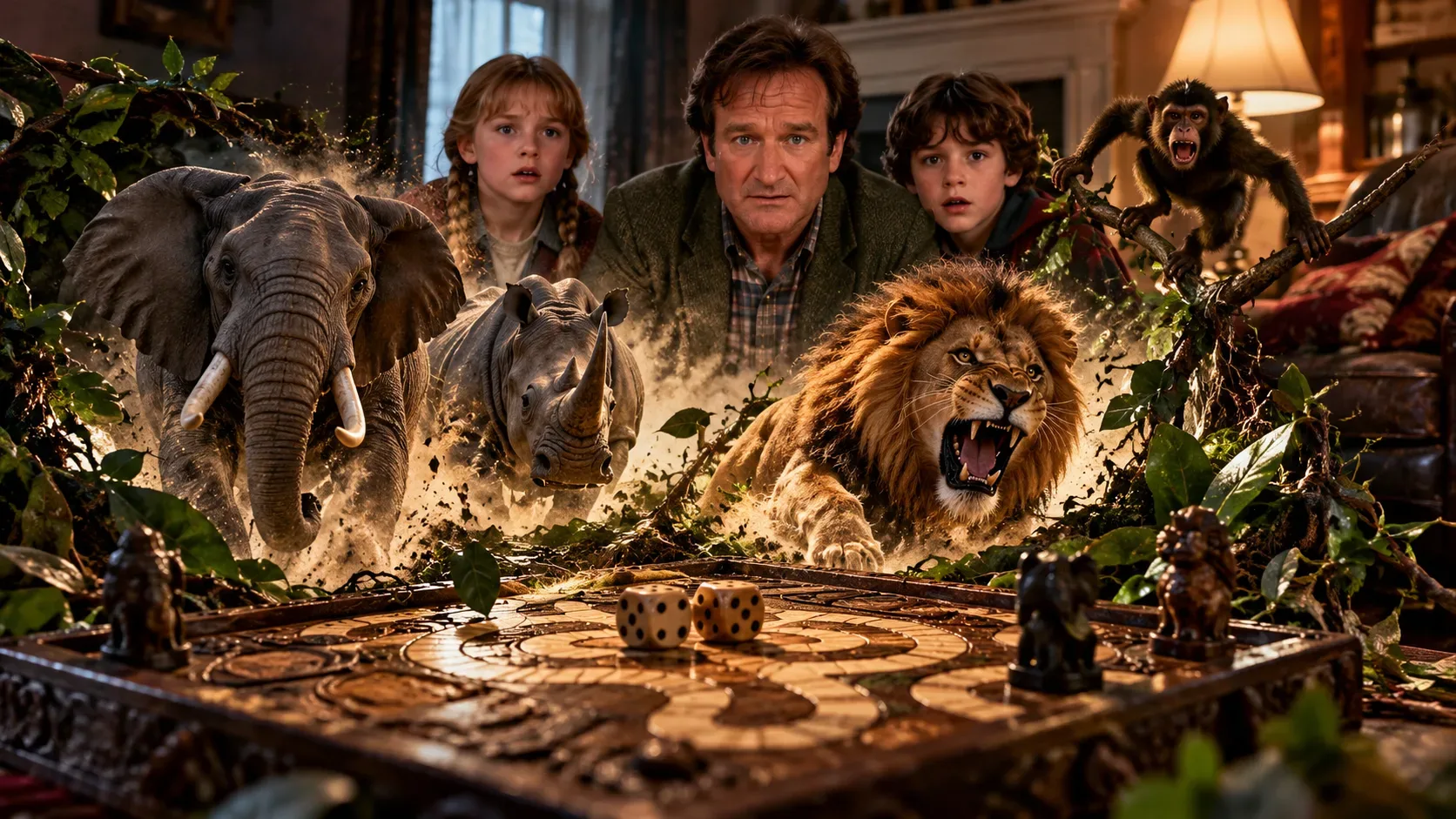
Its supernatural effects do not wait for the players to accept each consequence. Threats spill into the real world during the game and disappear only when it is completed.
- Each participant moves a personal token by rolling the dice; doubles grant another turn.
- Each move reveals a riddle at the center of the board and triggers a matching danger, from animals and plants to natural phenomena.
- The specific condition for releasing Alan is a roll of five or eight after he is trapped in the jungle.
- All four players linked to the ongoing game must resume it. Hiding the board or running away does not solve anything.
- Cheating carries a penalty: Peter tries to manipulate the dice and begins to take on monkey-like features.
- When a token reaches the center and the winner says Jumanji, the game’s manifestations are undone.
Every major stage of the game, in order
The sequence below tracks the events and their visible consequences. It follows the narrative stages without assigning unnecessary or unverified numerical dice results to every turn.
| Stage | Event and its effect on the game |
|---|---|
| 1. 1969: Alan and Sarah | Bats appear; Alan is sent into the Jumanji jungle and Sarah abandons the board. The game remains unfinished. |
| 2. 1995: Judy | After moving into the former Parrish home with Peter and their aunt Nora, Judy finds the board and unleashes enormous mosquitoes. |
| 3. Peter and an extra turn | Destructive monkeys appear. Peter’s following turn brings a lion and, with the required roll, releases a now-adult Alan. |
| 4. The four reunite | Alan seeks out the adult Sarah, who is still affected by his 1969 disappearance. She agrees to take her turn so they can finish. |
| 5. Carnivorous plants | Sarah’s turn brings aggressive plants and vines, including growths with poisonous thorns. |
| 6. Van Pelt | Alan’s turn unleashes the armed hunter who pursued him in the jungle. He begins hunting Alan through Brantford. |
| 7. Stampede and pelicans | Judy’s turn sets rhinoceroses and other animals stampeding, while a pelican takes the board. Chaos spreads across town. |
| 8. An attempt to cheat | Once the game is recovered, Peter tries to force a result. The penalty begins turning him into a monkey and sets his token back. |
| 9. The hunter takes the board | Van Pelt gets hold of the game. Alan, Sarah, Judy and Peter must recover it in a store, with crucial help from Carl. |
| 10. Monsoon and crocodile | Back at the mansion, the next round unleashes a severe flood, and a crocodile attacks the group inside the house. |
| 11. Quicksand and spiders | The floor traps Alan and Sarah; another turn sends a token backwards, and Peter releases giant spiders. A poisonous plant strikes Judy. |
| 12. Earthquake and victory | A turn tears the house apart with an earthquake. At gunpoint from Van Pelt, Alan reaches the final space, says Jumanji and ends the threats. |
Why do Van Pelt and Carl matter?
Van Pelt is a personal danger to Alan: rather than simply roaming the town, he is focused on capturing one player. Jonathan Hyde plays both the hunter and Sam Parrish, Alan’s father. That casting supports an interpretation in which the hunter mirrors Alan’s fear and his father’s demands. This is a reading of the film’s staging, not a rule explicitly stated by the board game.
Carl Bentley connects the two periods. In 1969, he loses his job after taking responsibility for the damaged shoe prototype; in 1995, he is a police officer who crosses paths with Alan. Their recognition helps Alan escape Van Pelt and anticipates the wrong Alan will put right upon returning to the past.
How does Alan win, and what happens in the ending?
In the final confrontation, the mansion has been devastated and Van Pelt aims his gun at Alan. Instead of running again, Alan completes his last turn. When his token reaches its destination and he says Jumanji, the hunter’s shot cannot carry through: Van Pelt, the animals, plants and other effects are drawn back into the game.
Alan and Sarah reappear as children in the Parrish house in 1969, shortly after their first game began. Both retain memories of the 26 years that no longer pass for them. Alan seeks out Sam, reconciles with his father and admits that he, not Carl, caused the factory accident. The disagreement over boarding school is also reconsidered.
Alan and Sarah put the board in a chest and throw it into a river. In the new version of 1995, they are married and expecting a baby. Sam is alive, the family business has not suffered the same decline and Carl remains connected to the company. At a Christmas party, Alan and Sarah meet Judy and Peter again, this time with their parents. Alan offers the children’s father a job and prevents the ski trip that ended in the couple’s deaths in the previous timeline.
The epilogue does not show the game being destroyed. On a beach, two girls hear its drums and approach the partly buried board. Alan’s ordeal is over, but Jumanji may still attract new players.
The original timeline versus the revised timeline
The ending rewrites events beginning in 1969 rather than simply returning everyone to 1995. That distinction explains why the characters have different futures.
| Moment | Before the win | After the win |
|---|---|---|
| 1869 | The board game is buried in a chest. | The origin shown in the film is unchanged. |
| 1969 | Alan disappears; Sarah is left without an explanation. | Alan and Sarah return as children, remember the game and discard it in a river. |
| 1995 | Adult Alan returns to a town altered by his absence; Judy and Peter have lost their parents. | Alan and Sarah grew up together and built a family; Judy and Peter’s parents are alive. |
| Final scene | The original game has been completed. | The board reappears on a beach, still able to summon potential players. |
This does not mean Judy and Peter were never born. They exist in the revised reality but did not experience that same game and show no recognition of it at the party. Alan and Sarah retain their memories. Preventing the skiing trip is a tangible consequence of their decisions after the reset.
This is the 1995 Jumanji, not the later adventures
Directed by Joe Johnston and starring Robin Williams, Bonnie Hunt, Kirsten Dunst and Bradley Pierce, this adaptation of Chris Van Allsburg’s book centers on a physical board game. The explanation above covers only events depicted in the 1995 film. It does not import avatars, video-game rules or timelines from subsequent installments to explain the original ending.