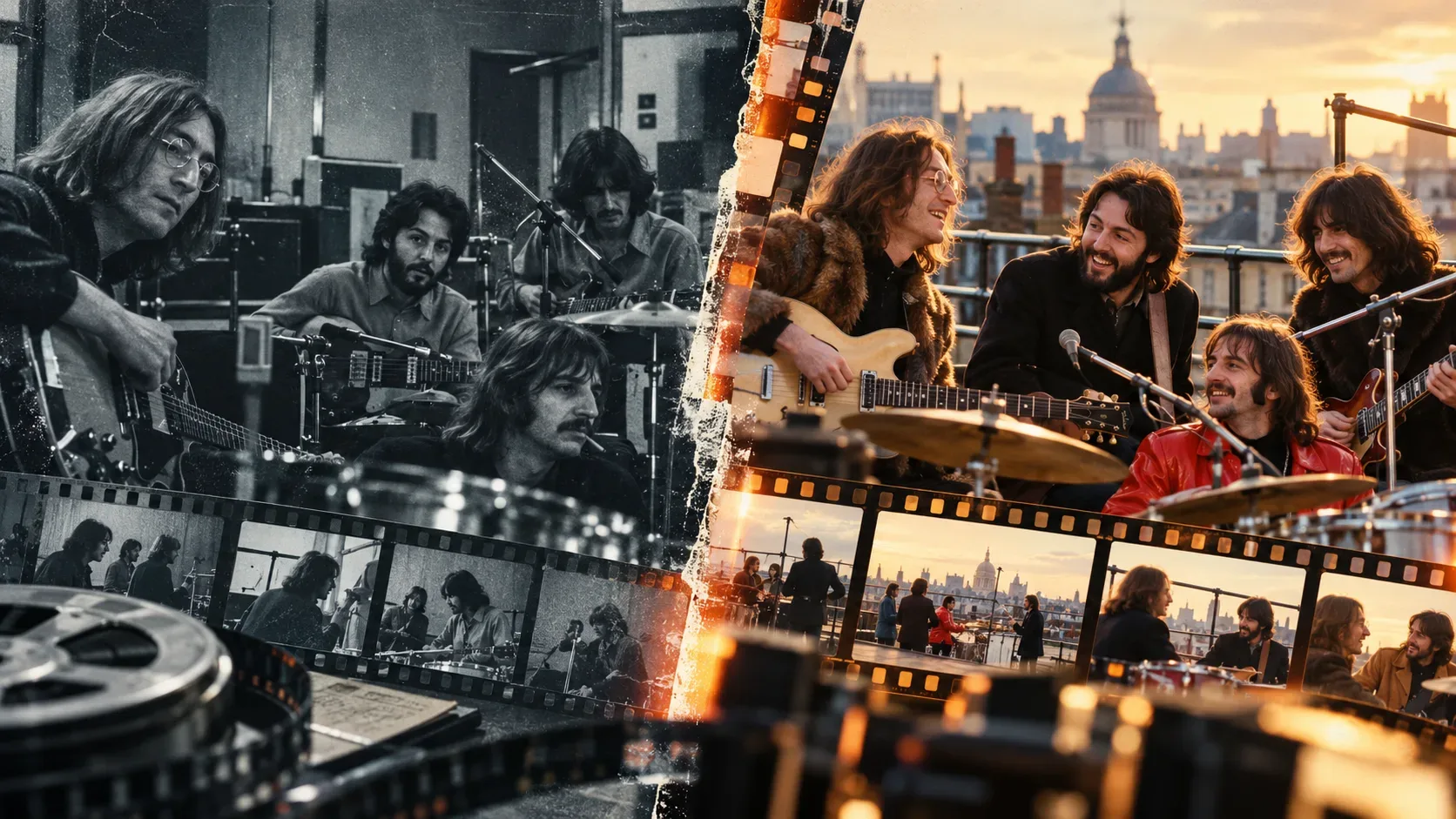
Let It Be (1970) and The Beatles: Get Back (2021) tell different stories because they draw on footage of the same Beatles sessions, filmed in January 1969, but use different selections, edits, and running times. Michael Lindsay-Hogg shaped a feature film focused on the musical experience; Peter Jackson revisited the archive and assembled a three-part series that gives events far more context. The two documentaries complement each other: neither replaces the other.
The distinction is not that one account is true and the other false. It is a matter of editorial perspective, footage included or excluded, and the historical moment at which each production reached viewers. The feature was released after news of the band’s breakup; the series arrived more than five decades later.
Note: the following sections discuss events shown in the documentaries.
The same original footage, two different films
Lindsay-Hogg’s cameras recorded rehearsals, sessions, conversations, and the performance on the rooftop of Apple headquarters. According to the official documentation, Jackson had access to approximately 60 hours of film and more than 150 hours of audio from that project. The scale of the archive allowed him to follow developments that could not fit into the original feature.
| Aspect | Let It Be (1970) | The Beatles: Get Back (2021) |
|---|---|---|
| Director | Michael Lindsay-Hogg | Peter Jackson, working from footage filmed by Lindsay-Hogg |
| Format | Feature documentary of about 81 minutes | Three-part documentary series with lengthy episodes |
| Emphasis | Condensed selection of rehearsals, recording sessions, and performance | More extensive account of the sessions and the relationships within the group |
| Rooftop concert | Part of the film’s closing sequence | Entire performance shown, according to the filmmakers |
| Release | May 1970, in cinemas | November 25, 26 and 27, 2021, on Disney+ |
What happened in January 1969
The historical timeline explains why both works share settings yet leave different impressions:
- First half of the month: the Beatles rehearse at Twickenham Film Studios in London under the working title Get Back. The original plan involves preparing new music and returning to live performance. Lindsay-Hogg’s crew films the process.
- From January 22: the group works at the studio in Apple’s headquarters, 3 Savile Row. Billy Preston joins the recording sessions, while the looming deadline affects the musical dynamic and decisions about the proposed show.
- January 30: John Lennon, Paul McCartney, George Harrison, and Ringo Starr, joined by Billy Preston, play on the building’s roof. Both productions include the performance, but give it different amounts of time and different treatments.
The footage belongs to a project originally called Get Back. The resulting film and album were eventually retitled Let It Be; the history of that project should not be confused with the chronological release order of the band’s albums.
What Lindsay-Hogg and Jackson chose to show
The 1970 feature has just over an hour to foreground songs taking shape, daily interactions in the studio, and the final concert. There are playful, cooperative moments alongside disagreements. Describing it solely as a bleak film about the Beatles breaking up therefore erases an important part of its content. Writing in The New Yorker, Richard Brody similarly argues that the documentary’s gloomy reputation does not capture its musical vitality.
Jackson takes a longer and more chronological approach. The series makes room for jokes, disagreements, production decisions, and songs developing over time. It also includes George Harrison temporarily leaving the band during rehearsals, an event omitted from the film released in 1970. In an interview with Whitney Friedlander, Peter Jackson said Lindsay-Hogg had filmed the episode but could not include it in his original feature because the band objected at the time.
The Get Back director tried to avoid repeating exactly the same shots whenever alternatives existed. Michael Lindsay-Hogg confirmed in an interview with Rob Sheffield for Rolling Stone UK that the productions cover shared events but were not designed as a straightforward duplication of scenes. The rooftop concert is an unavoidable point of overlap, although the series presents the complete performance.
Did the Beatles break up during these sessions?
No. The documented sessions took place in January 1969, while the band’s public breakup unfolded in 1970, shortly before Let It Be opened in cinemas that May. In between, the Beatles still worked on Abbey Road, released in 1969. Treating footage from early 1969 as a literal record of the day the band split merges separate moments in history.
Lindsay-Hogg attributes part of the melancholy reception of Let It Be to the timing of its release. That is the director’s own explanation, not proof that every viewer interpreted the film in the same way. Get Back reveals more conflict and more affection without erasing the tensions between the musicians.
Did the 2024 restoration turn Let It Be into a new documentary?
No. On May 8, 2024, Disney+ released a restoration of Michael Lindsay-Hogg’s feature. Peter Jackson’s Park Road Post Production team worked from the original 16 mm film negative and restored picture and sound with technology also used on Get Back. Official materials presented it as a revival of the 1970 film, not a new edit replacing the series.
The restoration makes it easier to compare the two approaches using improved picture and audio. It does not remove the central distinction: Let It Be remains Lindsay-Hogg’s cut, including sequences absent from Get Back.
Which documentary should you watch first?
For viewers who want to follow the events of January 1969 and understand the context of the disagreements, the most practical order is The Beatles: Get Back (2021) first, followed by Let It Be (1970), preferably in its 2024 restoration. Seen this way, the feature becomes the finished film whose making the series follows.
- Get Back first: best for following the timeline, the creative process, and the tensions in detail before comparing the original edit.
- Let It Be first: best for experiencing the perspective of 1970 and noticing how much context Jackson later added.
Both titles have been released on Disney+, but availability and access conditions can vary by country and date. The suggested order is an editorial recommendation, not a mandatory chronology. And the Let It Be documentary should not be confused with the album of the same name: one is a film, the other a record, although both are linked to the same project.
Sources and references
- The Beatles: Let It Be, restored in 2024
- The Beatles: The Beatles: Get Back, official film page
- The Beatles: Anthology, 1969 timeline
- Disney+: Get Back 2021 launch announcement
- Disney+: Let It Be (2024) press kit
- Rotten Tomatoes: Whitney Friedlander interviews Peter Jackson
- Rolling Stone UK: Rob Sheffield interviews Michael Lindsay-Hogg
- The New Yorker: Richard Brody on Let It Be