Spoiler warning: this article reveals Diana’s origin in Absolute Wonder Woman and details from its first story arc. It is not a recap of every issue.
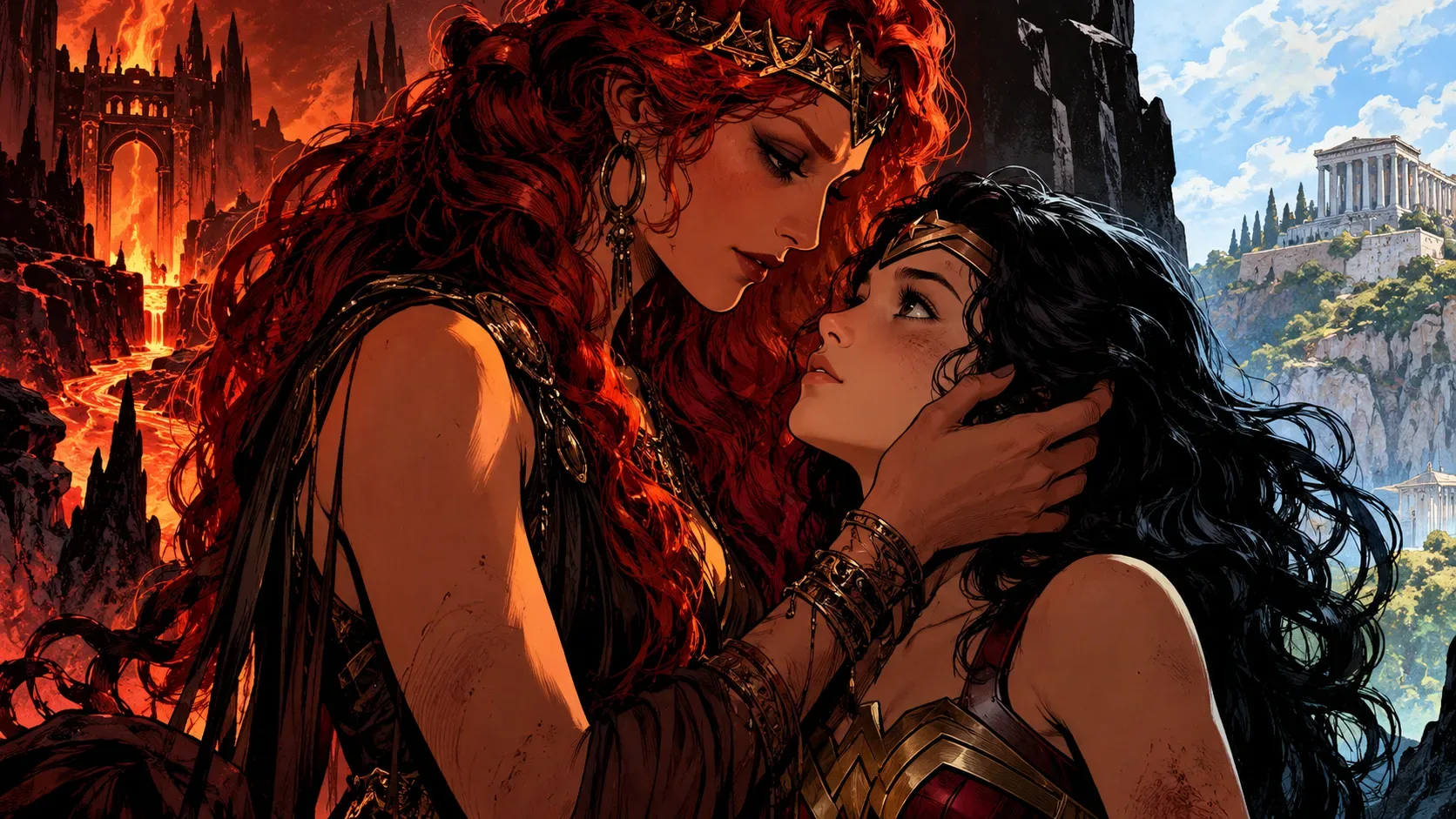
Circe becomes Diana’s adoptive mother in Absolute Wonder Woman because writer Kelly Thompson wanted to reverse a familiar rivalry and test what still makes Diana Wonder Woman when Themyscira and her Amazon upbringing are taken away. In the Absolute Universe, the witch raises the child in Hell; in the traditional continuity, Circe is her adversary. This does not replace the classic history. These are different versions of the character.
How does Circe end up raising Diana in Hell?
In the debut issue, published in October 2024, Apollo delivers infant Diana to Circe, who is confined to an infernal realm. As ComicBook.com’s breakdown explains, the gods have taken the child from her people to punish the Amazons, even forbidding their name from being spoken. They are not entrusting Diana to a lovingly chosen guardian. Their purpose is to sever her from her heritage.
At first, Circe has no intention of becoming her mother. Living together changes that. Hayden Sherman’s panels follow the passing years as a hostile setting becomes a home and the two form a family bond. This is motherhood built through care, protection and teaching, not a claim that Circe is Diana’s biological mother.
The change also reshapes Diana’s education. Without growing up among the Amazons of Themyscira, she learns spells and becomes familiar with creatures of the underworld. That upbringing influences her weapons and magic, but it does not make her a moral duplicate of Circe.
What changes compared with the classic Wonder Woman?
Traditional Wonder Woman stories associate Diana with Queen Hippolyta, the island of Themyscira and an Amazon education that prizes peace even when confrontation becomes necessary. DC’s character profile emphasizes her role as the Amazons’ ambassador to the outside world. Diana’s precise birth origin has varied across publishing eras, so it would be misleading to present every classic continuity as having one identical account of her birth.
Circe, meanwhile, has a long history as a sorceress and an antagonist to Diana. DC has even described her as Wonder Woman’s archenemy in a feature on the heroine’s legacy. That does not make every Circe appearance across decades of comics identical, but it establishes the contrast: they generally stand against each other, whereas the relationship that shapes Absolute Diana begins as family.
The Absolute series does not reveal that the Circe of the mainline stories was secretly Diana’s mother all along. Nor does it erase Hippolyta or retroactively rewrite their previous encounters. It offers a separate continuity in which Diana is denied her Amazon heritage during childhood.
Why did Kelly Thompson choose a former enemy?
Thompson has explained the creative decision directly. In an interview with FreakSugar, she said Circe’s history as an enemy made her an especially fertile choice: the expected clash between hero and witch could become a story about how both characters change. She also pointed to the contrast between Circe’s inclination toward vengeance and Diana’s commitment to justice and compassion.
In a separate interview published by DC, Thompson said earlier attempts at reinventing Diana no longer felt like Wonder Woman. Her solution was to strip away recognizable parts of the origin while protecting a core trait: Diana’s ability to change the people around her for the better. Sherman described how the quiet pages of Diana’s childhood needed to show, simply, two people becoming a family.
Thompson’s idea goes beyond Circe teaching Diana witchcraft. In the writer’s view, Diana’s compassion changes Circe more deeply than Circe changes Diana. That is the creator’s stated intention, not a theory that depends on discovering some hidden continuity.
Is the Diana raised in Hell still Wonder Woman?
Yes, and that is the question the reinvention brings to the foreground. Despite carrying an enormous sword and using spells and artifacts associated with Circe, Diana still protects strangers. A DC feature highlights childhood scenes in which she treats dangerous creatures with care, even after they hurt her.
The opening arc also places her against monsters threatening Gateway City. The useful distinction is not to call Hell good or pretend Circe has no darker history. It is to recognize that Diana’s choices are not dictated solely by where she was raised. That thematic reading is supported by the documented story moments and the creators’ own explanations.
Ultimately, Absolute Wonder Woman replaces a hero-versus-witch rivalry with a mother-daughter bond to ask whether Diana could remain herself without her original paradise. The opening arc suggests she can: her upbringing changes dramatically, but her compassion endures. This describes Absolute Diana, not every version of Wonder Woman.
Sources and references
- DC: interview with Kelly Thompson and Hayden Sherman
- FreakSugar: Kelly Thompson interview
- DC: analysis of Absolute Wonder Woman #1
- DC: guide to volume one, The Last Amazon
- DC: Wonder Woman character profile
- DC: feature on Diana’s lineage and adversaries
- ComicBook.com: Absolute Wonder Woman #1 origin explained
- DC: Absolute Wonder Woman Vol. 1: The Last Amazon listing