Spoiler warning: this article reveals the robbery, deaths, and final twist of O Homem que Copiava (2003).
In O Homem que Copiava (The Man Who Copied), André starts counterfeiting banknotes to get closer to Sílvia, robs a bank-related cash delivery with Cardoso’s help, wins the lottery, and then faces two blackmailers. In the ending, Feitosa dies while chasing André on a bridge, Antunes is killed in an explosion arranged by the group, and André leaves for Rio de Janeiro with Sílvia, Cardoso, and Marinês. The crucial revelation is that Sílvia had also been watching André and helped bring them together. Jorge Furtado wrote and directed the 2003 Brazilian film, starring Lázaro Ramos and Leandra Leal.
Who is André, and why do 38 reais matter?
André lives with his mother in Porto Alegre, draws in his spare time, and operates a photocopier at a stationery shop. From afar, he follows the daily routine of Sílvia, a saleswoman in a women’s clothing store, and pretends to shop for a gift to meet her. A 38-real dressing gown becomes a seemingly modest goal that his wages cannot immediately cover. That frustration sets off a sequence of decisions taking him from a petty offense into far more serious crimes.
Marinês works with André at the stationery shop. Cardoso, a shopkeeper who appears wealthier than he actually is, enters their circle. What begin as chance acquaintances turn into active accomplices, each driven in part by the desire for a different life.
How does André counterfeit money, and why involve Cardoso?
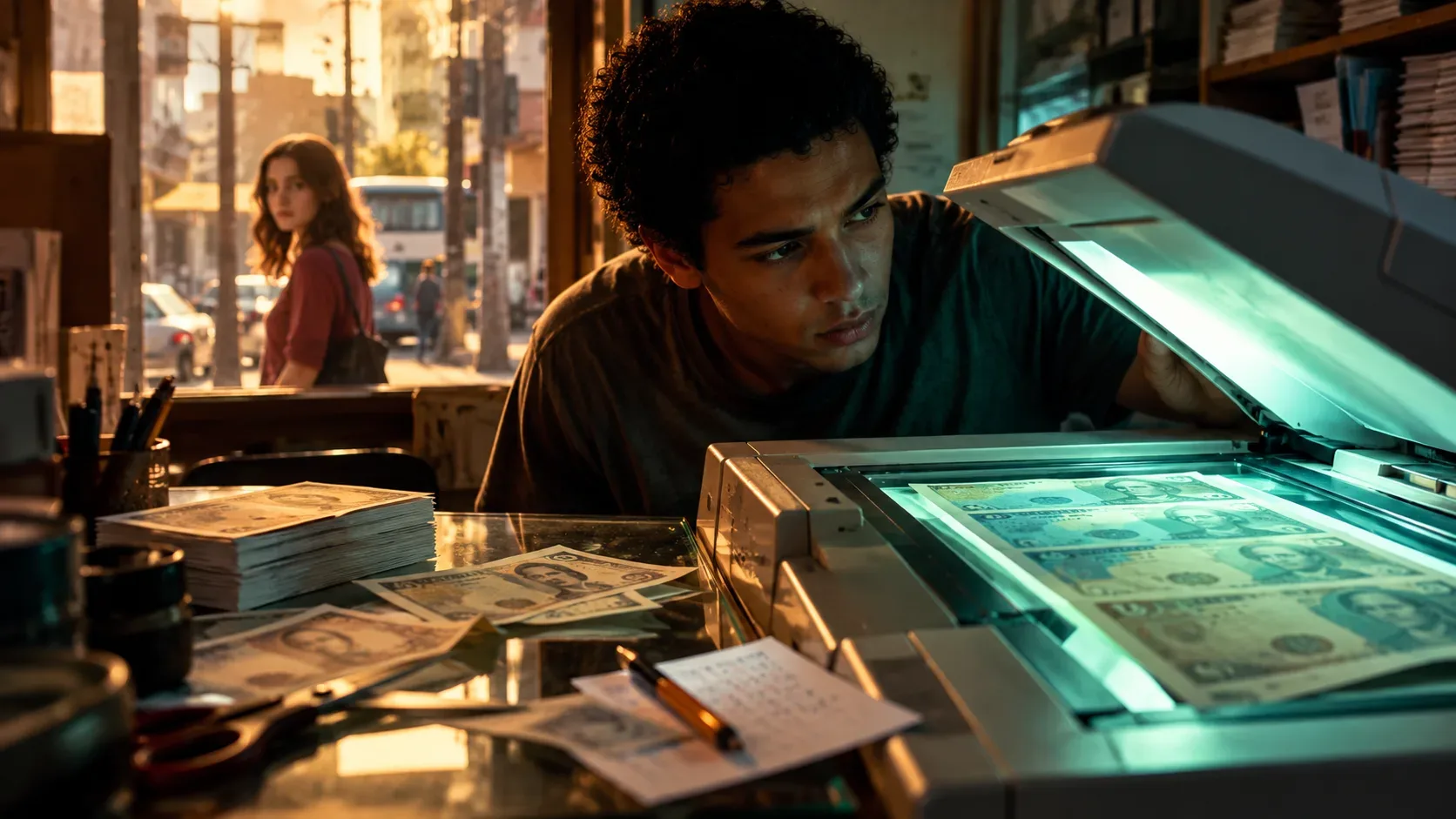
When the shop acquires a color copier, André realizes he can reproduce a 50-real banknote. His first attempt enables him to obtain genuine cash through transactions and purchases, including bets placed at a lottery outlet. The apparent ease is deceptive: producing convincing notes takes materials and care, copies of copies deteriorate, and spending counterfeit money creates the risk of detection.
André even passes a fake note to Cardoso while buying a small box marketed as an antique. When the trick is uncovered, Cardoso does not end their friendship. He sees an opportunity to profit and helps expand the circulation of the fakes. At that point the lottery outlet is no longer just a place to exchange money: André submits the numbers that will later become unexpectedly important.
Why does counterfeiting lead to the bank robbery?
André gives Sílvia a Japanese-style curtain and continues watching her window. He discovers that Antunes, the man she lives with and regards as her father, violates her privacy. This strengthens André’s desire to get her out of the household. He concludes that counterfeiting cannot fund a rapid, safe escape; he needs a large amount of genuine money.
He buys a gun from Feitosa, an acquaintance involved in crime, and plans to attack the movement of cash connected to a bank branch. Cardoso reluctantly agrees to drive the getaway car. During the robbery, André confronts an armed guard, shoots him in the leg, and escapes. The coincidence André has not yet recognized proves pivotal: the wounded guard is Antunes.
How does André win the lottery, and why does Marinês collect?
After the robbery, the newspaper carries two stories that change everything. Feitosa has been arrested after circulating counterfeit notes, and the number sequence André entered at the lottery has won. The producer’s final text mentions a four-million-real prize. The windfall does not eliminate the danger: appearing publicly as the winner could expose André while police are still investigating the robbery and the wounded guard.
André and Cardoso ask Marinês to claim the prize on their behalf. She controls access to the money and demands to know what they have done. Cardoso and Marinês begin enjoying their new wealth, but the robbery and the counterfeit notes remain serious liabilities. Three sources of money must be distinguished: the fake notes were used in transactions, the robbery produced stolen cash, and the lottery awarded a legitimate prize to the ticket holder.
What do Antunes and Feitosa discover?
During a meeting with André, Antunes reveals that he recognized him as the robber who shot him. He uses this knowledge to demand a share of the money. Feitosa is also free again, links André to the robbery, and threatens Sílvia and André’s mother unless he receives a large sum. Their blackmail works differently: Antunes can identify André as a firsthand witness, whereas Feitosa threatens physical violence.
When Sílvia learns what happened, she rejects the idea of repeatedly paying Antunes. She explains that her mother previously had a relationship with Paulo, an artist living in Rio, and believes Antunes may not be her biological father. No test or definitive confirmation settles the issue. Sílvia explains her fear and hostility toward the man she lives with and proposes killing him so that she and André can leave.
What happens to Feitosa on the bridge?
André arranges to hand Feitosa a bag of money on a movable bridge. The meeting is a trap: Feitosa questions the contents, chases André, jumps from the bridge, and dies in the fall. The June 2001 screenplay explicitly describes concealed wooden stakes in the landing area; the December 2002 final text retains the chase and André’s callous justification that no one forced Feitosa to jump. An independent account of the ending likewise identifies the fatal fall as a trap. The visible detail of the stakes is therefore attributed to the screenplay that describes it, without assuming every planned shot appears unchanged in the released edit.
How does the group arrange Antunes’s death?
André, Sílvia, Cardoso, and Marinês then plan to eliminate Antunes while diverting suspicion about the bank robbery. Their scheme combines a letter made to look as if it was mailed from Rio, some of the stolen cash planted in Sílvia’s apartment, and a setup intended to cause an explosion involving gas and the refrigerator. Marinês keeps Antunes occupied while the others arrange the scene.
A mishap forces the group back into the apartment after Antunes has returned. They invent an excuse to retrieve belongings and interfere with the refrigerator. On leaving, Sílvia reveals she has plugged the appliance back in. The explosion kills Antunes. Investigators subsequently find part of the bank’s stolen money at the scene, creating incriminating evidence against the dead man. A chicken hidden inside the apartment survives and becomes news, a piece of dark comedy juxtaposed with the killing.
What does Sílvia reveal at the end, and who is Paulo?
The final section changes perspective: Sílvia’s voice retells incidents that André had presented from his own point of view. She knew he was watching her through the window, followed him to his workplace, and engineered or took advantage of seemingly chance encounters, including changes of bus and lunch location. This does not establish that she knew about every crime from the beginning. It shows that their relationship was less one-sided than André’s narration implied.
Sílvia writes to Paulo, a former partner of her mother, and meets him on Corcovado near Christ the Redeemer, with André, Cardoso, and Marinês joining the Rio trip. Paulo greets her warmly. The scene establishes their meeting, not biological paternity. A postscript in Sílvia’s narration admits she has omitted details or chosen not to tell them. The film therefore ends without showing immediate punishment for the four travelers, while leaving open how reliable their own account of events really is.
What changes between the 2001 screenplay and the final text?
Casa de Cinema provides two different documents: a scene-numbered screenplay dated June 2001 and a final text identified as December 2002. Jorge Furtado himself wrote in 2023 that the project had earlier notes and that the screenplay was only finished in 2002. It would be a mistake to regard the two files as identical or to treat the preliminary script as an automatic transcript of the 2003 theatrical film.
A particularly revealing difference concerns Sílvia’s final narration. In the 2001 script she explicitly mentions the bank robbery and Antunes being shot when looking back on her changed circumstances. In the final text, the letter addressed to Paulo offers a much more discreet version: André got a job, earned money, and proposed marriage. This change makes the letter a selective account, consistent with her postscript about not telling everything. Another documentary difference concerns the return to Antunes’s apartment: the early screenplay revolves around a forgotten bag, while the final text mentions a coat and beer. These are comparisons between the consulted written documents, not independent proof of how individual shots were edited.
The film’s central events were checked against the producer’s listing and an independent description of the ending. Where only a screenplay documents a specific visual action, the wording above retains that limitation.
Sources and references
- Casa de Cinema de Porto Alegre: film credits and synopsis
- Casa de Cinema de Porto Alegre: O Homem que Copiava, final text (December 2002)
- Casa de Cinema de Porto Alegre: O Homem que Copiava, June 2001 screenplay
- Jorge Furtado, Casa de Cinema: early screenplay notes (2023)
- Henry Braga, HQs com Café: account of the film ending (2024)