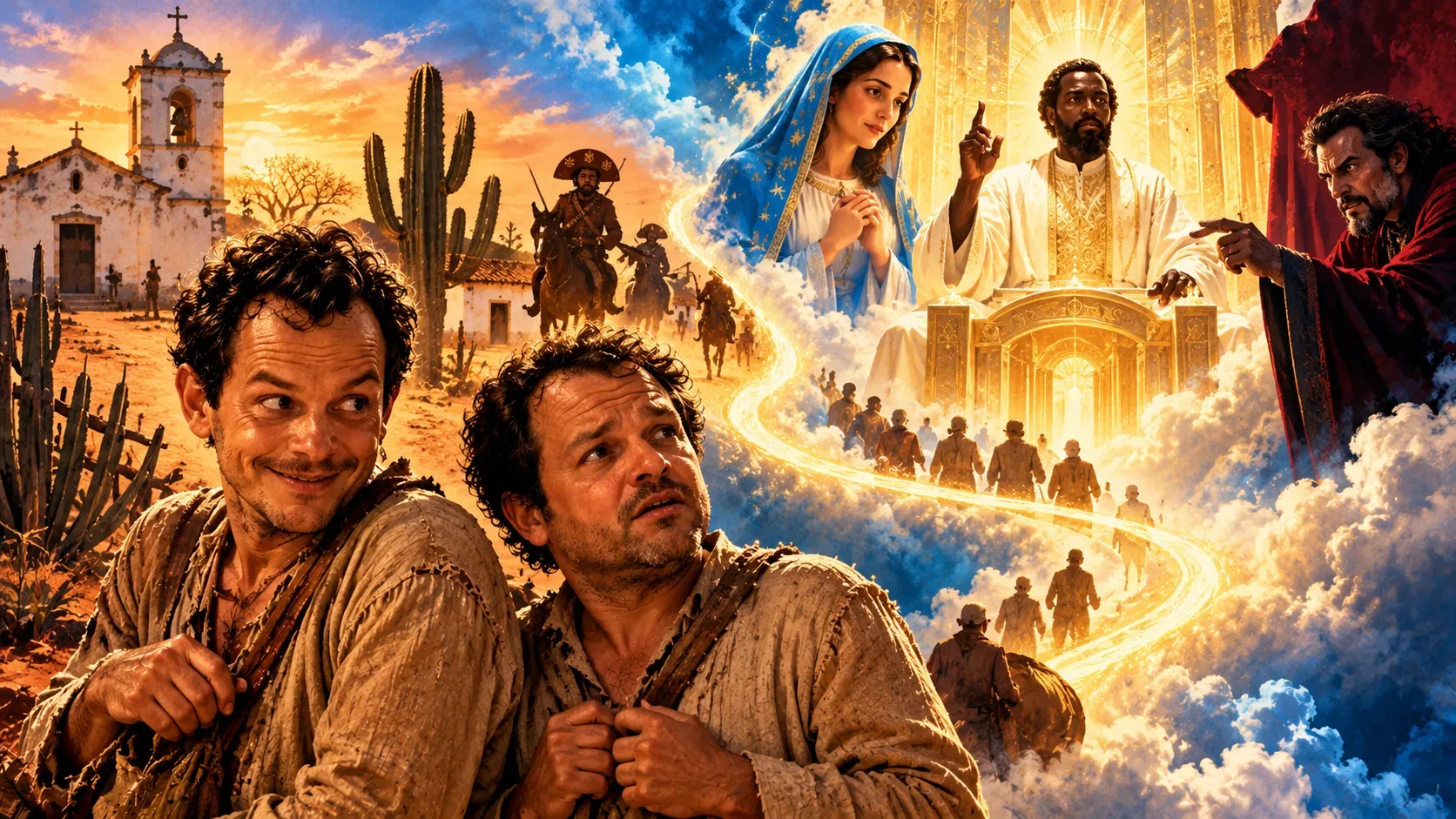
Spoiler warning: this article reveals deaths, the Tribunal of Souls and the ending of O Auto da Compadecida (2000).
In O Auto da Compadecida (2000), João Grilo and Chicó get by through schemes and improvisation in Taperoá until the bandit Severino arrives. João is killed, but the Compadecida intercedes for him at the Tribunal of Souls and he returns to life. Severino goes to heaven; Father João, the bishop, Eurico and Dora go to purgatory. In the end, Chicó marries Rosinha, and the three leave together without the fortune they had expected.
The 2000 film is not the complete 1999 miniseries
This recap concerns Guel Arraes’s feature film, released in Brazil in 2000, with Matheus Nachtergaele as João, Selton Mello as Chicó, Marco Nanini as Severino, Maurício Gonçalves as Jesus and Fernanda Montenegro as Our Lady. The story adapts Ariano Suassuna’s stage play without reproducing it word for word.
Globo had broadcast a four-episode miniseries in January 1999. The film condenses and rearranges material from the television production. The people listed as defendants here therefore belong to the screen version, not the original play, whose judgment also involves a sacristan.
Chronological recap: João Grilo’s tricks and the bandit raid
- João Grilo and Chicó arrive in Taperoá, in the Brazilian state of Paraíba, hoping to make money from a screening of The Passion of Christ. They take jobs at Eurico’s bakery. João thinks quickly and schemes to cope with poverty and exploitation; his frightened friend follows along and tells fantastic stories.
- Dora, the baker’s wife, loses her pet dog. She demands a religious funeral, and João invents a will supposedly leaving money to the priest. When the bishop hears of the proposal, he too wants a share. The fraud exposes greed among men meant to represent religious faith.
- In another scheme, João sells his employer’s wife a cat that supposedly produces money. The trick appeals to the desire for easy riches, but leads to further disputes when the victims realize they have been fooled.
- Rosinha, daughter of Major Antônio Morais, arrives in town and captures Chicó’s heart. The romance faces her father’s authority and competition from Corporal Setenta and Vicentão. João devises ways to help his friend, also eyeing a possible dowry held in a clay pig.
- Deceptions and debts mount until Severino and his henchman raid Taperoá. The violence interrupts the friends’ plans and kills Father João, the bishop, Eurico and Dora.
- To escape, João displays a harmonica that he claims Padre Cícero blessed with the power to revive the dead. Chicó hides a pouch of blood, pretends to be wounded and falls down. When the harmonica sounds, he rises, staging a miracle for the bandits.
- Severino believes the hoax and orders his henchman to kill him so he can visit Padre Cícero and then be revived with the instrument. Nothing happens. The henchman realizes the deception, kills João and flees. Chicó survives; João leaves his life of cons behind for the Tribunal of Souls.
How does the judgment of souls work?
At the tribunal, João meets Severino, Eurico, Dora, Father João and the bishop. The Devil serves as prosecutor and demands that they be condemned to hell. Jesus Christ, also called Manuel and portrayed as a Black man, hears their cases. His presence challenges prejudices and social hierarchies the characters held in life.
Clever talk alone cannot save João, so he calls on Our Lady, the Compadecida. Her intervention considers both wrongdoing and circumstances, including poverty, the abuses of the powerful and the violence Severino suffered. Mercy does not mean that nobody committed sins, but it prevents the Devil from determining everyone’s fate on his own.
Tribunal of Souls chart: every character’s fate
The chart distinguishes the six dead people who stand trial from characters who remain alive. It does not import the sacristan or the henchman’s fate from the stage play.
| Character | What happens | Outcome in the film |
|---|---|---|
| João Grilo | Is killed by Severino’s henchman and judged. | Receives a second chance and returns to life through the Compadecida’s intervention. |
| Severino | Dies after believing the miraculous harmonica trick. | Goes to heaven; his history of suffering and violence informs the assessment of his responsibility. |
| Father João | Dies during the raid after pursuing self-interested deals. | Goes to purgatory, not hell. |
| The bishop | Dies in the massacre after showing greed. | Goes to purgatory. |
| Eurico | The bakery owner dies in the attack. | Goes to purgatory. |
| Dora | Eurico’s wife dies in the attack. | Goes to purgatory. |
| Chicó | Fakes his death in the harmonica demonstration but survives. | Stays alive; he is not on trial. |
| Rosinha | Takes no part in the massacre or tribunal. | Stays alive and marries Chicó. |
| Severino’s henchman | Kills João after the death of his boss and flees. | Is not among the souls judged in the feature film. |
What happens after João Grilo comes back to life?
João wakes as Chicó prepares to bury him. Happy to see his friend alive, Chicó remembers that he promised to give all his money to Our Lady if João survived. Both hesitate to surrender the cash, but they honor the vow.
Chicó and Rosinha marry despite Major Antônio Morais’s objections. The inheritance kept in the clay pig appears to solve their money troubles until they discover the old coins are worthless. The major threatens to take a strip of Chicó’s skin as punishment, but João and Rosinha argue that their agreement does not allow blood to be spilled. All three flee the powerful landowner’s anger.
On the road, Rosinha shares food with a poor traveler who resembles Manuel. The resemblance suggests a test of compassion in everyday life, without requiring the audience to treat the man’s identity as an explicitly stated fact. The trio continues its journey, still poor but together.
Ending explained: what does the second chance mean?
The Compadecida never declares João innocent. He lies, deceives people and pursues personal gain, but his actions are judged in the context of hunger, inequality and powerlessness. Resurrection means an opportunity to change, not a financial reward for his schemes.
The contrast between heaven for Severino and purgatory for socially respectable figures challenges a concept of justice based only on status and appearances. Giving away the money, losing the hoped-for fortune and Rosinha’s kindness to the traveler tie the ending to solidarity. Guel Arraes’s adaptation adds the couple’s love story while preserving the social criticism in Suassuna’s work.