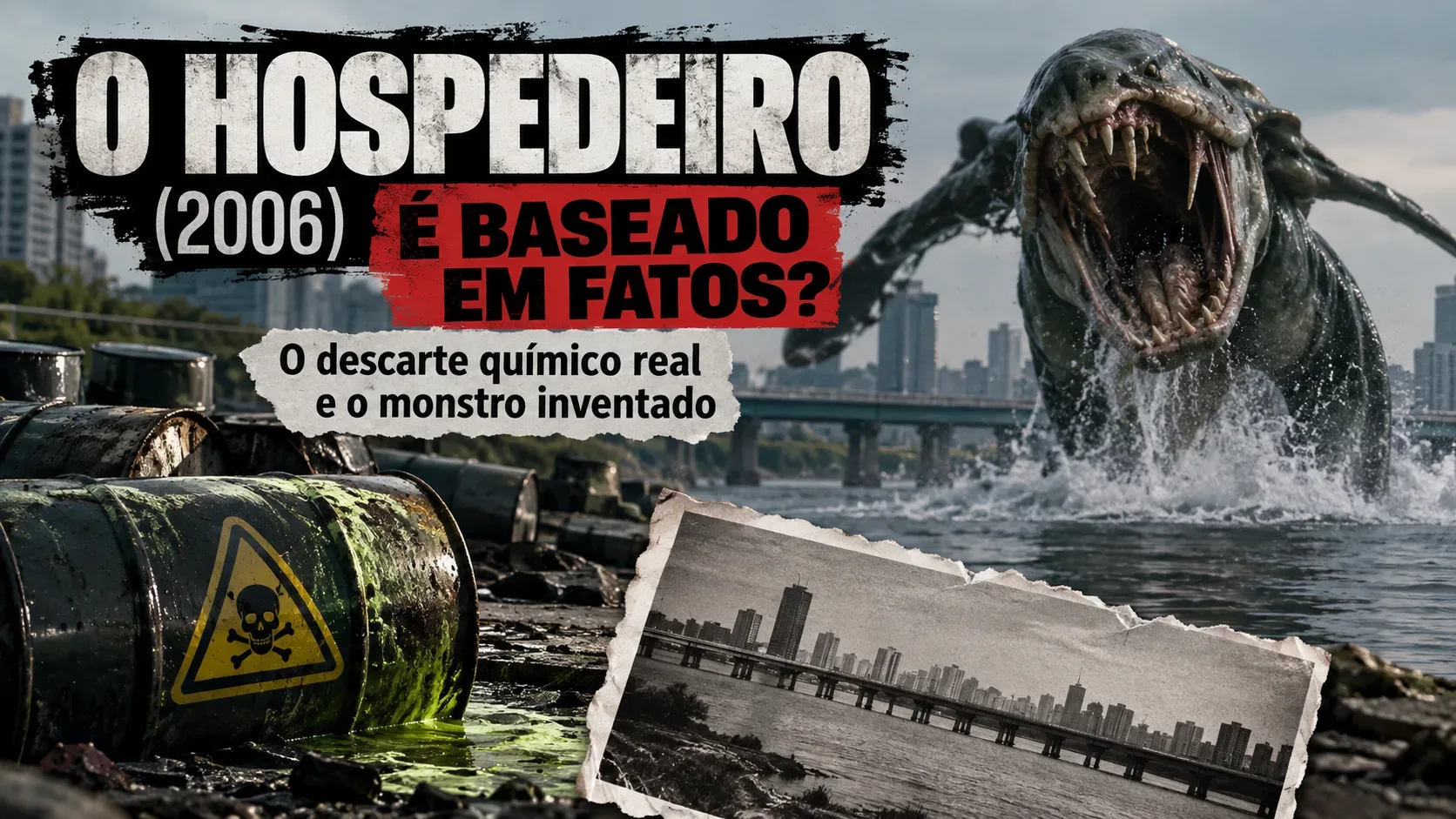
The Host (2006) does not retell a true story about a monster. Bong Joon-ho's film draws on a real environmental incident: on February 9, 2000, embalming chemicals were poured down a drain at a U.S. military facility in Yongsan, Seoul, into a drainage system connected to the Han River watershed. The mutant creature, its attacks on civilians and the family's struggle are fictional.
This connection was not an interpretation invented after the film became successful. In a July 2006 interview with the Korea JoongAng Daily, before the South Korean premiere, Bong identified the Albert McFarland case as an inspiration. The distinction matters: the film turns a documented environmental offense into a fantastic premise rather than depicting events that literally occurred.
Minor spoiler notice: the comparison discusses the opening and central premise, but not the ending.
What actually happened around the Han River?
The case centered on the mortuary at the U.S. military's Yongsan Garrison. According to contemporary investigative reporting and coverage of the court decisions, Albert McFarland, a civilian employee associated with U.S. forces in South Korea, ordered a subordinate to pour a body-preservation solution containing formaldehyde down a sink. The drain fed into the Han River water system. This was not a sighting of a monster in the river, but an improper disposal of a toxic chemical.
The incident took place on February 9, 2000. Environmental organizations disclosed the case on July 13 that year, as recorded in an archive maintained by the National Institute of Korean History. Yonhap reported on the investigation in September 2000. The ensuing proceedings also raised a dispute over South Korea's jurisdiction to try an American civilian employee.
From the disclosure to the film's release: a documented timeline
| Date | Historical or film record |
|---|---|
| February 9, 2000 | The chemical disposal at the Yongsan mortuary takes place, later becoming the subject of an investigation. |
| July 13, 2000 | Environmental organizations publicize the incident, which is preserved in a South Korean historical archive. |
| September 9, 2000 | Yonhap reports the investigation and conflicting accounts of the quantity disposed of. |
| January 9, 2004 | A South Korean court initially sentences McFarland to six months in prison in a ruling delivered in his absence. |
| January 18, 2005 | The six-month sentence is suspended for two years on appeal, according to the Korea JoongAng Daily. |
| July 27, 2006 | The Host opens in South Korea, according to the release schedule reported by Yonhap in 2006. |
Was it 470 bottles or 227 liters? Why the figures differ
The reported amount should not be treated as a single figure agreed upon by every source. An archived environmental complaint from July 2000 refers to 480 bottles. In September, Yonhap described a dispute in the investigation: 192 bottles, or about 91 liters, according to McFarland and military representatives, versus 470 bottles, about 228 liters, according to the employee ordered to dispose of the solution.
Yonhap's 2006 report on the film gives a figure of 227 liters, while Bong mentioned 470 bottles in his July 2006 Korea JoongAng Daily interview. Those numbers come from different accounts, documents and points in time. They should not be blended into one supposedly undisputed measurement. The unlawful disposal and the court proceedings, however, are well-documented events.
How did Bong Joon-ho use the real incident?
In the interview published on July 16, 2006, the director explained that the McFarland case gave him a starting point for the creature's origin. He also said the idea of something monstrous emerging from the Han had stayed with him since his teenage years, when he lived near the river. The chemical dumping gave that earlier idea a narrative connection to the film's opening.
But Bong made an essential distinction: he wanted the family to remain the heart of the story. Speaking to KPBS in an interview published in March 2007, he revisited the environmental inspiration and described ordinary people fighting both a monster and institutions that failed to help them. The opening thus has a specific historical source, but the film is not a comprehensive reenactment of real events.
Fact, dramatization or fantasy: what did the film invent?
| Element in The Host | Classification | What the evidence supports |
|---|---|---|
| Dumping of a formaldehyde-containing substance at Yongsan in 2000 | Documented fact | The dumping led to an investigation, public disclosure and a criminal conviction. |
| An American superior ordering bottles emptied into a drain | Dramatization grounded in fact | The order parallels the real case, but the dialogue, staging and people depicted on screen are screenplay choices. |
| The chemical creating an enormous creature in the Han | Fantasy | It is the monster's fictional origin story. The actual case provides no evidence of such a mutation. |
| The creature attacking people and abducting a family's daughter | Fiction | This is the film's horror and family-drama premise, not an event documented in connection with the dumping. |
| Fear of a possible virus and officials' reactions | Fiction and institutional satire | These are part of the plot and its social commentary, not proven consequences of the 2000 incident. |
Why does the distinction matter?
Calling The Host simply a film based on true events risks suggesting that the creature and its attacks have historical counterparts. A more precise description is: the opening draws on a documented chemical dumping; the monster and the survival story are invented. McFarland's prosecution also gives context to the film's criticism of environmental responsibility, institutional authority and relations between South Korea and the United States.
The initial conviction in 2004 and the suspended sentence on appeal in 2005 belong to the history of the real case. The family's fate and the creature's fate belong solely to the film. Keeping those strands separate respects both the seriousness of the pollution incident and Bong Joon-ho's creative choices.
Sources and references
- Korea JoongAng Daily, Bong Joon-ho interview, July 16, 2006
- Yonhap, report on The Host and the incident, July 4, 2006
- National Institute of Korean History, July 13, 2000 disclosure archive
- Yonhap, investigation and disputed quantities, September 9, 2000
- Korea JoongAng Daily, original conviction, January 10, 2004
- Korea JoongAng Daily, suspended sentence on appeal, January 18, 2005
- KPBS, Bong Joon-ho interview, March 9, 2007