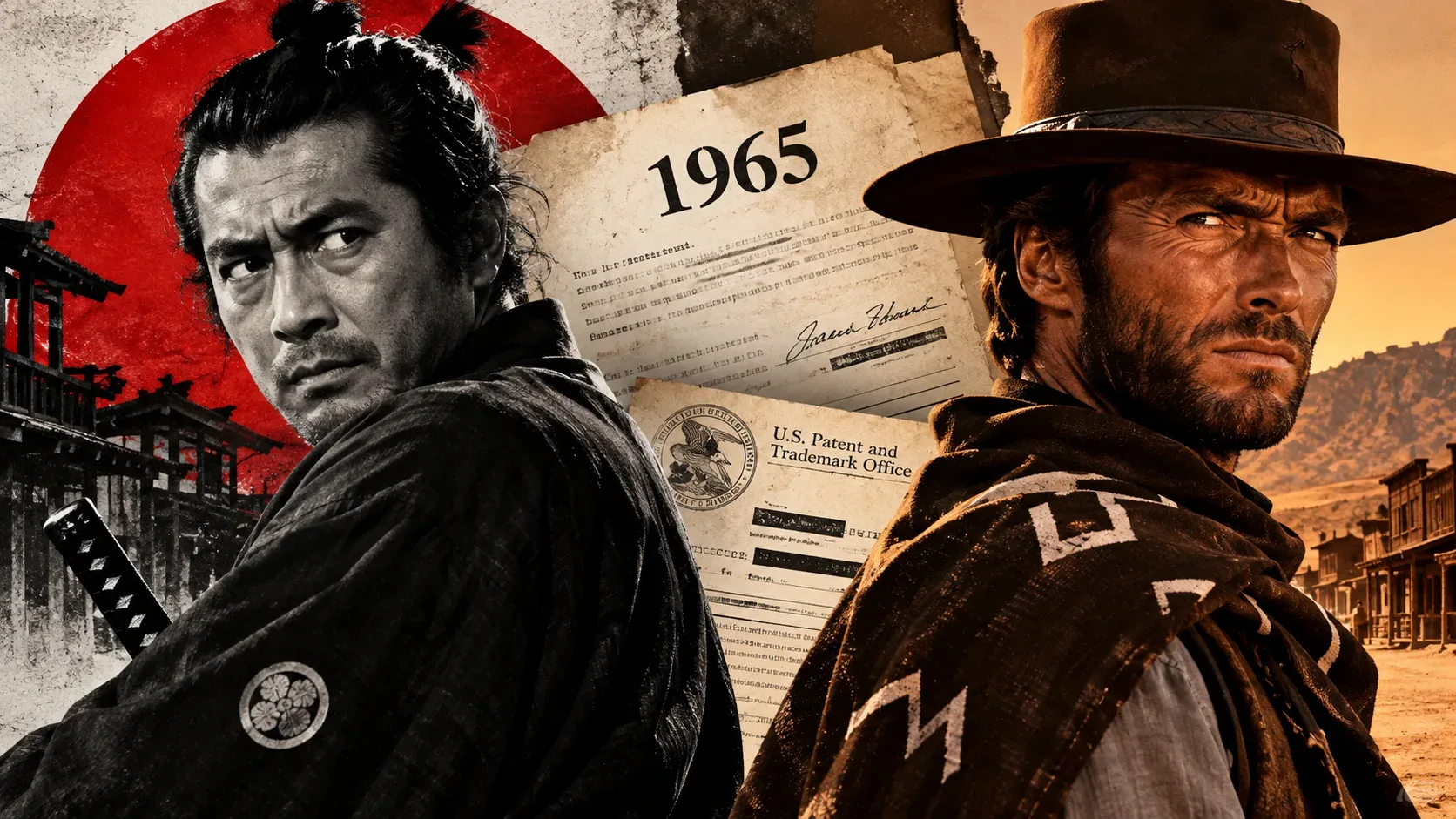
The available document is not the 1965 settlement agreement itself. It is a letter signed by Hisao Kurosawa on June 17, 2016, in which Kurosawa Production says that Yojimbo (1961) was adapted without permission as A Fistful of Dollars (1964), that the parties reached a settlement on October 14, 1965, and that the Italian production company received authorization limited to ten years. The letter documents the rights holder’s account; it does not replace the original contract or an independent court ruling.
That distinction matters because the dispute is often reduced to a sentence about plagiarism and compensation. The 2016 filing is more specific about the alleged settlement date and license term, but it is less definitive than it may appear regarding the legal scope of the arrangement and the sums actually paid.
From Yojimbo to Sergio Leone’s western
Yojimbo, directed by Akira Kurosawa and co-written with Ryūzō Kikushima, follows a wandering samurai exploiting a feud between factions in a Japanese town. Three years later, Sergio Leone moved the structure of an outsider caught between rival groups into a western setting, with Clint Eastwood starring in A Fistful of Dollars. Alexander Sesonske’s essay for The Criterion Collection explicitly describes the Italian film as a very close reproduction of Kurosawa’s picture.
That cinematic comparison explains where the complaint originated, but it cannot by itself settle the contract, trademark ownership, or rights to future productions. Similarities between films and the terms of an agreement are separate questions.
What the 2016 letter says about 1965
The letter appears as Exhibit C to a submission filed on August 8, 2016, before the Trademark Trial and Appeal Board (TTAB), the administrative tribunal associated with the United States trademark office. It bears Hisao Kurosawa’s signature and the date June 17, 2016. It was submitted by an interested party in a later dispute involving exploitation rights and the name The Man With No Name.
| Issue | Kurosawa Production’s assertion | What the document cannot establish alone |
|---|---|---|
| Settlement date | The parties allegedly reached an agreement on October 14, 1965. | The date appears in a 2016 statement, not in the complete 1965 instrument. |
| Unauthorized adaptation | The letter contends that the makers of A Fistful of Dollars copied protected elements of Yojimbo and acknowledged infringement. | This is the company’s account, not a reproduced judgment or independent TTAB finding. |
| Duration | According to the letter, Jolly, later referred to as Unidis, received remake rights for ten years, a term said to have expired by 2016. | The letter does not supply all the clauses or independently establish the precise territorial and contractual scope. |
| Later rights | The company says Yojimbo’s creative rights remained on the Japanese side and refers to remake options involving Opus 7 and Junction Films. | Later claims do not automatically establish ownership of every trademark, character, or derivative right. |
The letter also asserts rights over elements including the story, characters, and the designation Man With No Name. Context matters here: that designation was itself part of the 2016 trademark dispute. Reporting the assertion does not mean it was legally upheld in every jurisdiction.
Why a USPTO filing is not a 1965 court judgment
The August 8, 2016 submission was filed by Take 3 Productions and Junction Films against Unidis Jolly Film in administrative proceedings over the mark The Man With No Name. Their lawyers argued that the old settlement permitted exploitation of A Fistful of Dollars without freely assigning sequels, characters, or new adaptations. Yet the same filing attaches the letter describing a ten-year remake license. Without the full 1965 agreement, those formulations cannot be conclusively reconciled, nor can the precise conditions accepted by the parties be reconstructed.
The procedural record also contains an opposing position. In a June 29, 2016 filing in a related proceeding, Unidis itself asserted production and distribution rights relating to the films associated with The Man With No Name and challenged its opponents’ claims. This too is a litigant’s position, not independent proof that all of its assertions were correct.
The document’s presence in a USPTO case file establishes that it was submitted with the 2016 pleading. It does not automatically turn every statement into a fact found by the agency, much less turn the later trademark dispute into the original copyright judgment from the 1960s.
What about 15%, $100,000, and screen credits?
An AdoroCinema article published on August 26, 2026, reports that the settlement allegedly gave the Japanese side exploitation rights in Asia, 15% of receipts in other markets, and approximately $100,000 more. Those figures are reported by the outlet, but they are neither itemized nor independently verifiable from Hisao Kurosawa’s letter. They should not be presented as payments proven by the 2016 document, or as a confirmed total actually received.
The same article notes that Kurosawa and Kikushima were not credited on the Italian film as writers of the original story. Missing credits do not, on their own, reveal every contractual obligation. Likewise, calling the picture an unofficial remake does not erase the subsequent settlement described by the parties.
What can be concluded reliably
Yojimbo and A Fistful of Dollars are connected by a widely acknowledged cinematic adaptation, and an identifiable 2016 letter attributes both an October 14, 1965 settlement and a ten-year license to that dispute. The material reviewed does not establish the full wording of the settlement, an independent judicial ruling confirming every assertion in the letter, or definitive accounts proving the percentages often repeated elsewhere. That is the boundary between an archived document, a party’s allegation, and a legally established fact.