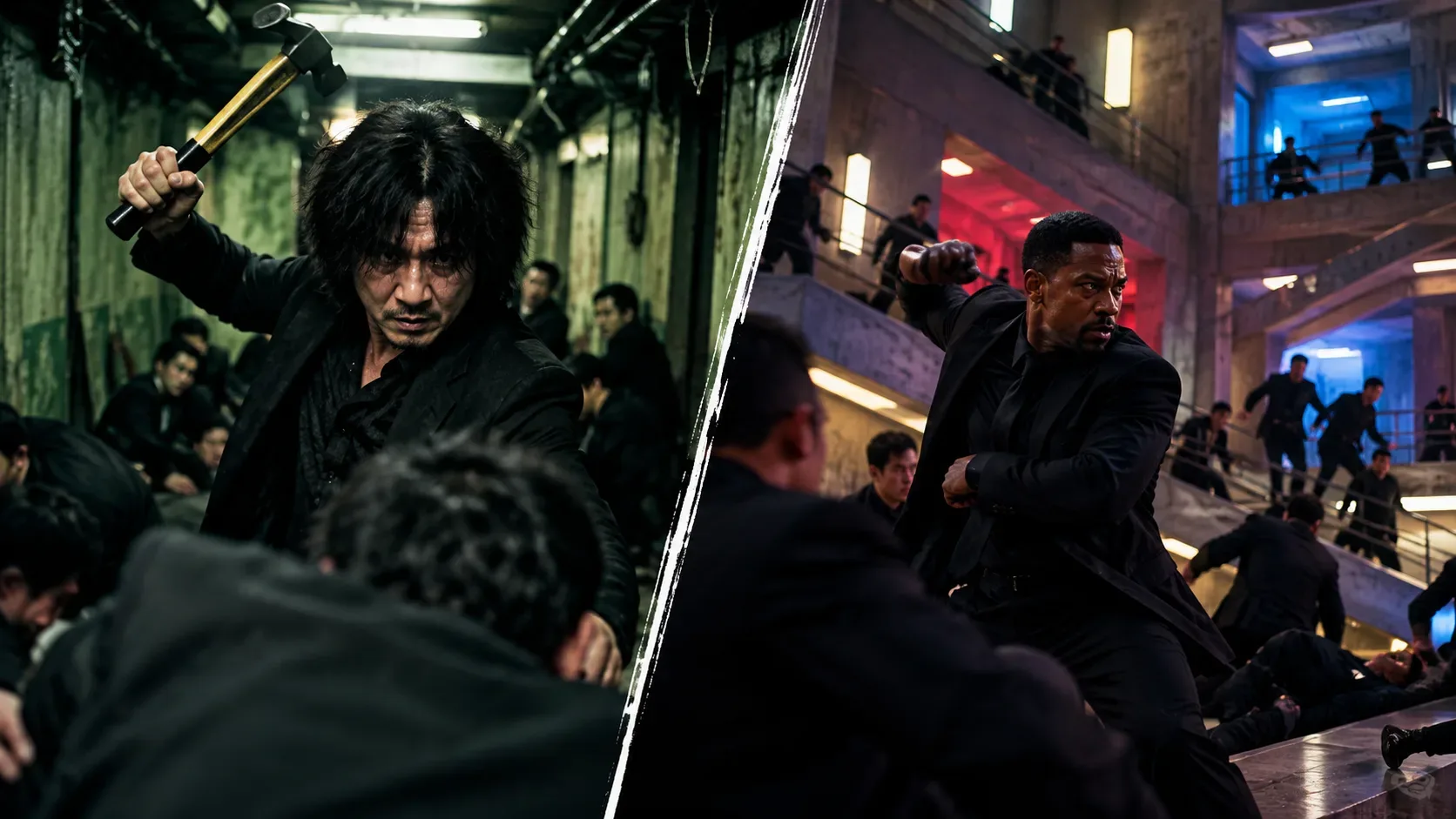
The hallway fight changed between Oldboy (2003) and Oldboy (2013) because the directors approached screen violence through different visual designs. Park Chan-wook kept the confrontation in a narrow corridor, following it laterally in an extended shot. Spike Lee retained the premise of one man facing a crowd, but spread the action across three levels and moved the camera with a crane. This is more than a change of set: it changes how we register physical exhaustion and the fight's progression.
The strongest evidence comes from the filmmakers themselves. Park told the BFI why he abandoned visual effects and fragmented coverage; Lee explained to Esquire why he did not want to repeat a fight confined to one level. This comparison focuses on documented production choices rather than claiming to offer a licensed shot-by-shot analysis of the finished films.
2003: one corridor, lateral movement and mounting fatigue
In the 2003 South Korean film, Oh Dae-su, played by Choi Min-sik, takes on a group of attackers with a hammer. The camera follows the encounter in profile, keeping the length of the corridor as the dominant spatial axis. The image works almost like a tableau viewed from a distance: blows, falls, pauses and the protagonist's resistance all occupy the same composition.
In an interview for Sight and Sound, republished by the BFI in 2022 from its October 2004 issue, Park recalled considering digital effects, including an X-ray-style device inspired by films featuring Sonny Chiba. He abandoned those references and chose to present the sequence as a continuous shot. He also gave the attackers long sticks to evoke spears in medieval warfare. His stated goal was to convey the brutality and repetition of a fight that can feel exhausting, rather than stage the violence as an elegant dance.
A further production detail matters. Speaking to LA Weekly in 2005, Park said his initial plans involved much more fragmented coverage. In the end, he favored a wide master shot that had been intended as the basis for later editing. This separates the final stylistic decision from the earlier plan, without turning reports of filming into an unquestionable count of takes seen on screen.
2013: the camera climbs through a three-level space
In the American version directed by Spike Lee, the protagonist is Joe Doucett, played by Josh Brolin. The reference to the original hallway fight remains, but the location is no longer limited to a horizontal passage. In a November 2013 interview with Esquire, Lee said the sequence could not stay on one level and specified that the team used three levels, filming with a Technocrane, a camera crane suited to broad movements.
That vertical layout requires a different coordination of actor, stunt performers, concurrent action and camera travel. Lee credited weeks of work by Brolin and the stunt team and described the camera movement as intricate. In a separate interview with The Boston Globe, he added that they had to choreograph both the fighting and the crane movement. These are accounts of production, not technical certification of every edit in the released cut.
Lee also preferred to call his film a reinterpretation rather than a literal reproduction of Park's work. As he explained to Esquire, the aim was to respect the source while making something distinct. The fight's vertical expansion is a clear example of that approach.
What changed, element by element
| Element | Oldboy (2003) | Oldboy (2013) |
|---|---|---|
| Spatial design | Narrow corridor with a predominantly horizontal axis. | Three-level structure, including vertical movement. |
| Camera | Profile view following the confrontation laterally. | Technocrane movement coordinated across the levels. |
| Choreography | Strikes and resistance sustained in continuity, exposing fatigue. | Combat and camera travel planned together with Brolin and stunt performers. |
| Stated intention | Park stresses repetitive violence and its effects on the fighter. | Lee seeks a spatial reinterpretation rather than repeating the same level. |
| What sources establish | Design choices and the decision to use a long shot. | Three levels, camera equipment and stunt preparation. |
Why does the dramatic effect feel different?
In the original, remaining near a single visual axis leaves fewer opportunities to escape Oh Dae-su's exertion through constant viewpoint changes. That reading of the staging fits Park's explanation: the violence is repetitive, uncomfortable and affects the person carrying it out. The side-on organization also lets the audience follow resistance and exhaustion within one shared space.
In the 2013 film, multiple levels give the action a more vertical geography. The eye follows changes in height and new spatial relationships among the groups on screen. The Technocrane turns that journey into a visible part of the choreography. Calling the result more spatially expansive is a defensible interpretation; claiming that Lee set out to surpass Park in intensity or realism would go beyond what the interviews establish.
What the interviews cannot settle on their own
A long take describes the continuous presentation of an action, while the number of attempts made during filming describes work on the set. Those facts are not interchangeable. The interviews explain the sequences' design and execution, but do not, without independent verification of the released edits, justify an exact tally of takes or a blanket assertion that both finished sequences contain absolutely no cuts.
The strongest contrast therefore lies in the purpose of the staging. Park simplified the visual language to sustain repetition and exhaustion; Lee redesigned the space and the camera's route to reinterpret the situation through vertical movement. Understanding that distinction does not require declaring either fight superior.