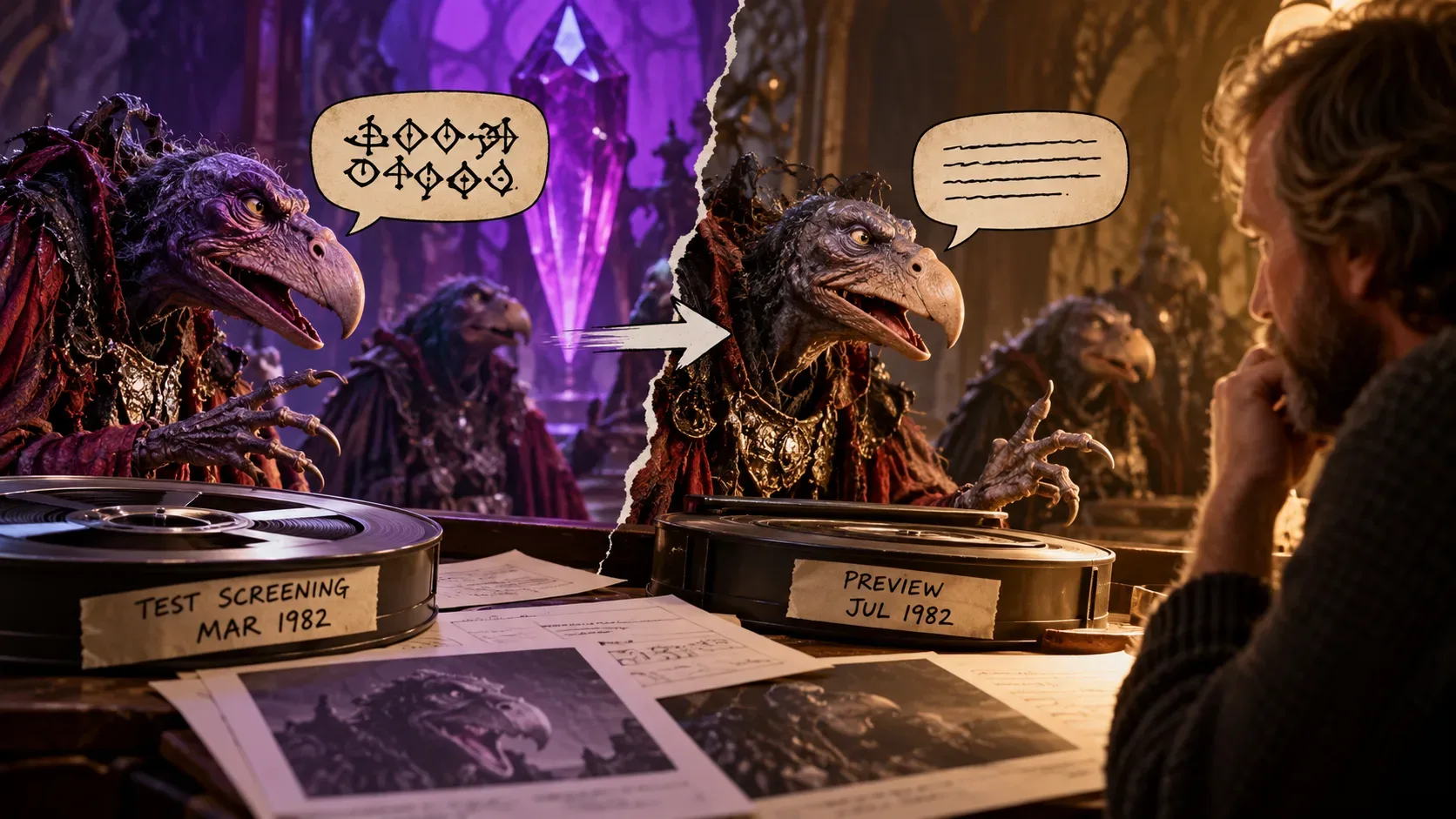
Alan Smithee and Judas Booth appear in the credits of the television version of Dune (1984) because David Lynch had his name removed from that re-edit. Smithee replaced his directing credit, while Booth replaced his screenwriting credit. These are not two filmmakers officially taking over the picture, and the broadcast edit is not a director-approved cut: MCA TV reassembled the film without Lynch taking part.
Chris Willman’s Los Angeles Times report, published on June 5, 1988, is a crucial contemporary account. It identifies the person responsible for the new assembly, separates the television broadcast from the 1984 release, and records Lynch’s response through a representative.
What do Alan Smithee and Judas Booth mean?
Alan Smithee was a conventional pseudonym associated with the Directors Guild of America (DGA), used when a director was permitted to remove their credit after rejecting a particular final version. The Brazilian publication Papo de Cinema explains the procedure and its connection to lost creative control. In Dune’s case, Willman reported that Lynch received permission to remove his name from the television edition.
Judas Booth appears as the screenplay credit on the same cut. In his 1988 article, Willman raised the possibility, explicitly as a question, that the name combines Judas Iscariot, associated with betrayal, and John Wilkes Booth, Abraham Lincoln’s assassin. The symbolism is plausible, but the article does not document Lynch directly explaining his choice of that name. It should not be presented as a confirmed statement from the filmmaker.
The AFI Catalog corroborates both credit substitutions in the broadcast. Its entry for the 1984 theatrical film, by contrast, credits David Lynch as writer and director. These pseudonyms mark a rejection of one particular version, not the erasure of Lynch’s original work.
Who re-edited Dune for television in 1988?
The documented figure is Harry Tatelman, then MCA TV’s vice president for special projects. According to the contemporary Los Angeles Times report, Tatelman returned to the material originally shot and assembled a new edit using an earlier editing script as his guide. He said he had been told Lynch was unavailable to collaborate.
That does not mean Tatelman directed an entirely new adaptation of Dune. His documented task was rearranging existing footage for a different presentation. The same report notes that many scenes became longer while material absent from the theatrical release appeared. Lynch’s active participation in that reconstruction is not documented; the 1988 account indicates the opposite.
Drawing on a May 26, 1988 Daily Variety report, the American Film Institute also records cuts, the return of previously omitted footage, and new voice-over narration written by Francesca Turner. The television edition was therefore more complex than simply adding every deleted scene back into the theatrical film.
What changed between the theatrical film and the TV broadcast?
The most clearly documented changes are different scene assembly, a longer runtime and additional narration. At the time of the KTLA broadcast, the Los Angeles Times estimated that the film had gained roughly 50 minutes over its 1984 release. That figure describes the newspaper’s comparison in 1988; it is not a universal running time for every later DVD or file labelled extended.
The credits are another substantial difference. The theatrical version remains catalogued under Lynch’s directing and writing credits, whereas the television version uses replacements. The sources establish changes in editing and presentation, but they do not justify claiming that every removed scene was restored or that Lynch completed a longer definitive cut himself.
Theatrical cut, television edit and later releases compared
| Version or record | What the sources establish | How to read it |
|---|---|---|
| Theatrical film, 1984 | 137 minutes in both the AFI Catalog and Universal’s official listing; directed by David Lynch. | The theatrical presentation identified as the 1984 film. |
| Television, 1988 | MCA TV re-edit broadcast on KTLA; about 50 additional minutes according to the Los Angeles Times; Alan Smithee and Judas Booth credits. | A separate broadcast version, not a new author-approved Lynch cut. |
| Extended DVD and other formats | Giedi Prime’s disc guide lists the Extended Edition at 177 minutes; the BBFC records a British physical-media edition at 176 min 39 sec, classified in 2000. | Runtime and presentation vary by release; do not treat every disc as identical to the 1988 broadcast. |
This distinction helps explain the different figures found in searches and on packaging. The BBFC also has a 136-minute British cinema classification, while Universal Pictures At Home gives the film’s duration as 2 hours 17 minutes. These are distribution and classification records for specific releases, not evidence of an authorised new director’s cut.
Likewise, a rerelease or image restoration is not necessarily an alternate edit. Arrow Films, for example, describes a 4K edition running approximately 137 minutes; that identifies the product’s runtime, not the presence of the television re-edit.
Why is the longer edition not a director’s cut?
A director’s cut implies that the filmmaker can stand behind that particular editorial arrangement as their own. The documented history here points the other way: Lynch sought to remove his credit, and Tatelman’s revision was prepared for television. The Alan Smithee credit signals the break between the original authorship and the broadcast version.
The 1988 report does not establish who made every individual alteration or Lynch’s personal intention in choosing Judas Booth. What it and the AFI do establish is enough to answer the question: Lynch was credited on the theatrical Dune, disavowed association with the television revision, and MCA TV undertook the re-edit.
Sources and references
- Los Angeles Times: Chris Willman, 'Dune II: The Re-edit' (5 June 1988)
- AFI Catalog: Dune (1984), history, credits and 1988 television edit
- Papo de Cinema: Marcelo Müller, 'Por que David Lynch não assina uma das versões do seu Duna?'
- Universal Pictures At Home: Dune (1984), official film listing
- BBFC: Dune (1984), cinema and home-video classification records
- Giedi Prime / Duneinfo: Dune DVD and Blu-ray disc editions
- Arrow Films: Dune Limited Edition 4K UHD, product specifications