Spoiler warning: this article reveals the killers, their motive, and the ending of Scream (1996).
In Scream (1996), Ghostface is a disguise used by Billy Loomis and Stu Macher. Together they orchestrate attacks in Woodsboro, steer suspicion toward other people, and intend to frame Sidney Prescott’s father, Neil, for the murders. Their identities are exposed at Stu’s house party: Sidney survives, Stu is killed when a television falls onto him, and Sidney ends Billy’s life with a gunshot.
Directed by Wes Craven and written by Kevin Williamson, the first film builds its mystery around characters who each possess incomplete information. This account concerns the 1996 story alone and does not import revelations from its sequels.
How the Woodsboro murders begin
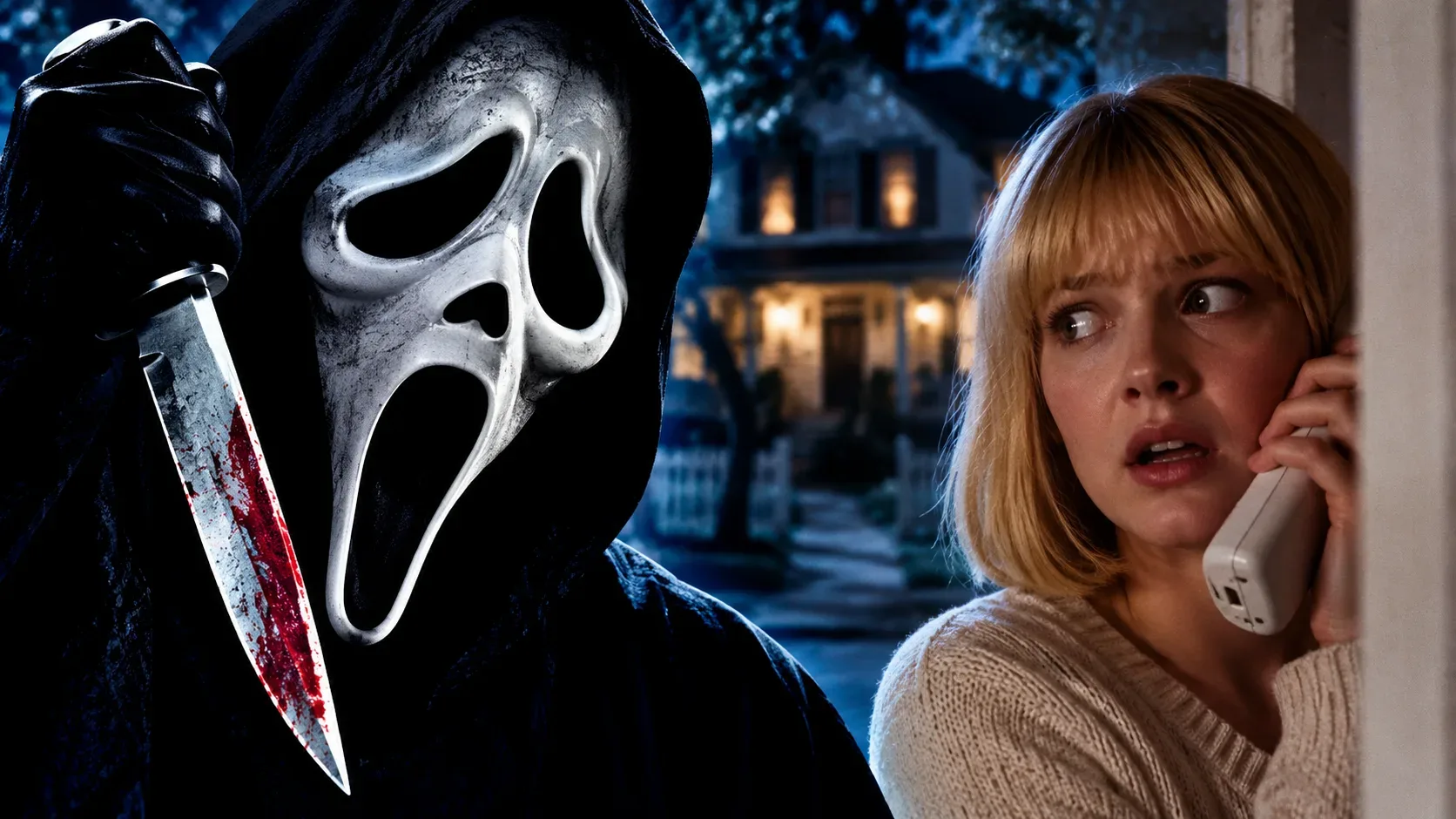
The opening follows Casey Becker, home alone, when a caller starts an apparently casual conversation about horror movies. He turns threatening, reveals that he is holding her boyfriend Steve captive, and makes horror trivia part of a deadly trap. Steve is murdered, then a figure in a black robe and mask kills Casey. This establishes the killer’s method: threatening calls, horror-film knowledge used as intimidation, and the anonymity of the costume.
The murders dominate conversations at Sidney Prescott’s school. The first anniversary of her mother Maureen’s murder is approaching. Cotton Weary was convicted of that crime, but reporter Gale Weathers questions the verdict. For Sidney, family trauma and the present threat overlap; for Gale, Woodsboro’s accepted account may be wrong.
Clues and suspects: what is known at each stage
- The first attack on Sidney: after a threatening call, Sidney is attacked at home. Billy climbs through her window soon afterward and drops a mobile phone. What Sidney knows: he was near the scene and possessed a means of making calls. What she does not know: who wore the mask, or that more than one person is involved.
- Arrest and another call: police arrest Billy, but he is released and the threats continue. A call made while he is in custody undermines the theory that Billy alone could be responsible. It does not establish his innocence: an accomplice remains possible.
- Neil’s phone: threatening calls are traced to the missing father’s phone. To investigators: Neil looks suspicious. Only the ending reveals: Billy and Stu have held him captive to make him their scapegoat.
- Maureen, Cotton, and Gale: Gale argues that Cotton Weary’s conviction is questionable. Sidney has personal reasons to resist that conclusion. What the reveal adds: the present killers say they killed Maureen and framed Cotton.
- Billy and Stu’s behavior: Billy knows and invokes horror-movie formulas; Stu mixes jokes, inappropriate remarks, and apparent normality. These details become suggestive in retrospect but cannot independently prove guilt.
The central misdirection is structural: both Sidney and the audience are encouraged to imagine just one person beneath the mask. Two perpetrators explain why one attack can occur while a suspect seems elsewhere, without identifying exactly which accomplice was responsible for every call or assault.
Stu’s house party: the events in order
- School closes: classes are suspended after further killings. Principal Himbry is murdered in his office, and Stu invites classmates to his home.
- Tatum is killed: Sidney’s friend is cornered in the garage and killed by the masked attacker when she becomes trapped in the automatic garage door. The other partygoers do not yet know what happened.
- Gale and Dewey keep watch: Gale arrives to cover a possible development; Deputy Dewey Riley, Tatum’s brother, remains nearby. Gale sets up recording equipment, but it does not give her a complete view of the murders.
- Randy’s rules: horror enthusiast Randy Meeks describes familiar slasher survival conventions. Meanwhile, Sidney and Billy reconcile and have sex.
- The house empties: news that Himbry’s body has been found draws many guests away, leaving fewer people in the house.
- Billy’s apparent death: Ghostface seems to stab him in front of Sidney. In her eyes, Billy briefly changes from suspect to possible victim.
- More violence: Sidney flees; cameraman Kenny is murdered, Dewey is stabbed, and Gale crashes her van. The discovery of Neil’s car reinforces a mistaken suspicion.
- Stu versus Randy: both accuse each other in front of Sidney, who shuts the door on them. Unable to tell whom to trust, she tries to protect herself.
- The truth surfaces: a seemingly injured Billy returns, takes Sidney’s gun, and shoots Randy. Stu is exposed as his accomplice. The danger was never restricted to one attacker.
Why do Billy and Stu kill, and what is their plan?
Billy explains his grievance against Maureen: she had an affair with his father, Hank Loomis, and he blames that relationship for his mother leaving. Billy and Stu also admit to murdering Maureen earlier and framing Cotton. That is Billy’s stated motive, not an ethical justification for the deaths of Casey, Steve, Himbry, and their other victims.
Stu joins in the killings and the cover-up, but the film gives him no family-based explanation as specific as Billy’s. His enthusiasm for staging a real-life horror movie and his partnership with Billy are part of his portrayal. It is more accurate to distinguish his attitude from Billy’s explicit grievance than to pretend they share one clearly articulated motive.
At the party, the pair reveal that they abducted Neil. Their intention is to pin the murders on him while portraying themselves as survivors after Sidney is killed. To make the scene convincing, Billy and Stu wound each other. This staged victimhood echoes Billy’s earlier fake stabbing.
Ending explained: how Sidney defeats Ghostface
Their plan begins to unravel when Gale returns and interrupts them. Sidney fights back, turns the logic of the disguise against the attackers, and kills Stu by pushing a television onto his head. Billy remains dangerous: Gale shoots him, but he rises for one final attack, echoing Randy’s horror-movie warning. Sidney then shoots Billy in the head, ending the confrontation.
Randy and Dewey are confirmed to have survived despite their injuries. Neil is found alive and freed; at dawn, Dewey is taken away in an ambulance and Gale reports the events. The revelation also reframes Cotton’s conviction: the killers’ confession establishes that the previous account of Maureen’s death was false.
What Randy’s rules mean at the end
Randy’s rules are commentary on slasher conventions, not literal laws governing Woodsboro. The supposed virginity rule is contradicted when Sidney survives after having sex with Billy. The idea that a killer comes back for one last scare, by contrast, plays out when Billy gets up despite being shot. The film uses both audiences’ familiarity with these conventions and their unreliability.
That tension explains the mystery’s false leads. Billy’s phone, Neil’s disappearance, Cotton’s conviction, and Billy’s apparent death are all real story elements, but characters interpret them provisionally before they know the full scheme. Learning that there are two killers does not erase those clues; it changes how they fit together.