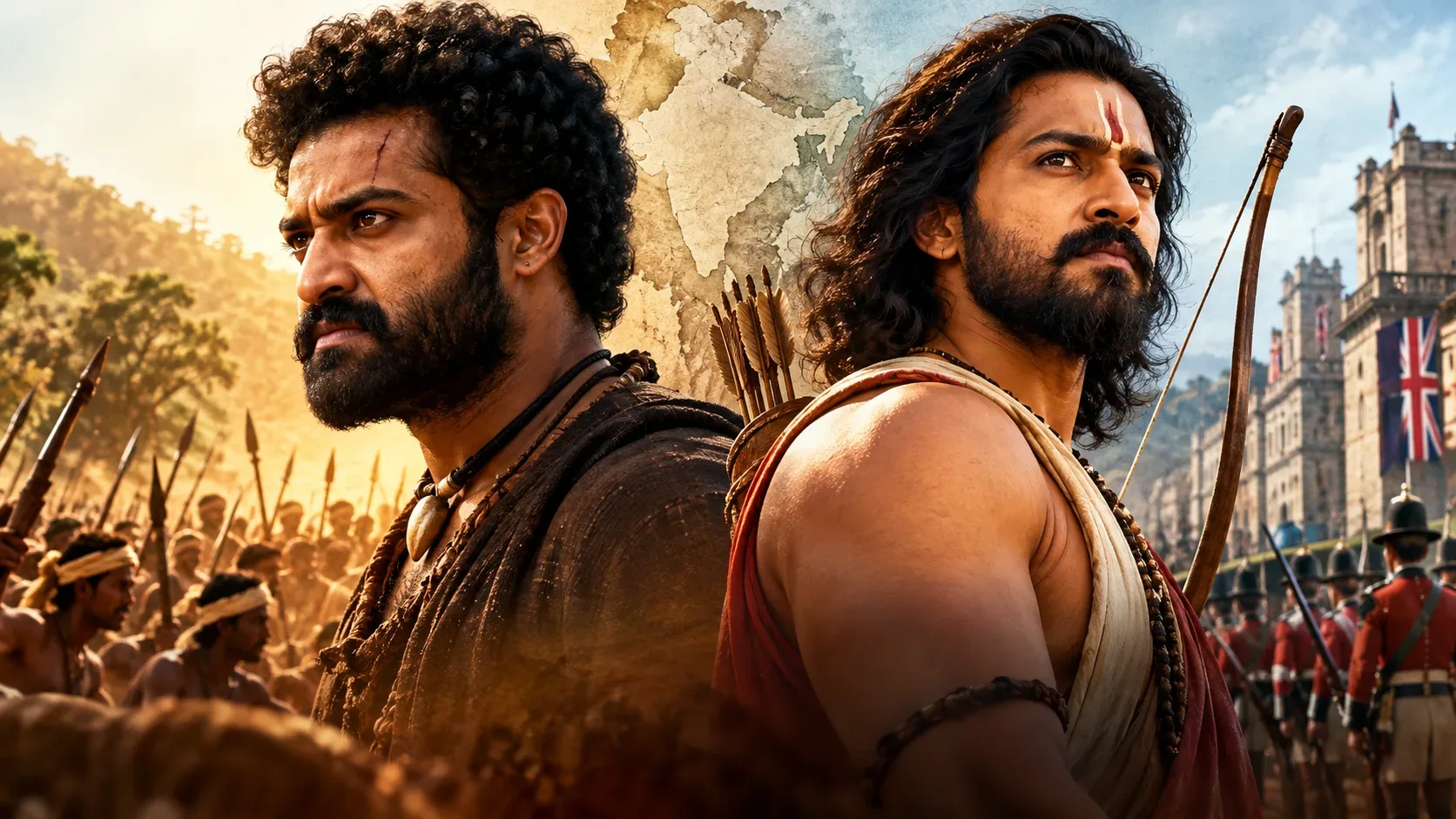
No. RRR (2022) draws on two real people, Komaram Bheem and Alluri Sitarama Raju, but the protagonists’ meeting, friendship, and shared adventure are fictional. Both resisted forms of oppression in India before independence; director S. S. Rajamouli and story writer K. V. Vijayendra Prasad have acknowledged imagining a connection for which no historical record exists.
The Telugu-language film is set mainly in the 1920s and features Bheem, played by N. T. Rama Rao Jr. (Jr NTR), and Raju, portrayed by Ram Charan. The São Paulo International Film Festival also lists it in Brazil under the title RRR: Revolta, Rebelião, Revolução.
What the creators confirmed was invented
In an interview with Cinema Express in December 2021, Rajamouli said he had imagined what a meeting between two men with similarly resistant trajectories might have been like. In March 2022, he told the same outlet again that RRR was neither a biopic nor an account of the actual events of their lives.
Vijayendra Prasad explained to Bollywood Hungama in July 2020 that the two historical figures existed but, as far as was known, neither met nor fought together. Their partnership came from his imagination. The plot involving a Gond girl taken away by British soldiers, described by distributor Variance Films, should be understood as part of that invented screenplay, not as a verified event from either biography.
Who was the real Komaram Bheem?
Komaram Bheem, also spelled Kumuram or Komram Bheem, belonged to the Indigenous Gond community in what is now Telangana. His struggle concerned the protection of land, forests, and livelihoods among communities facing taxes and restrictions imposed by the princely state of Hyderabad, ruled by the Nizam. This is not the same as saying he fought only a directly administered British authority: Hyderabad had its own government, although it operated within the British imperial order.
According to the historical account in The Indian Express, Bheem organized armed resistance around Adilabad, with participants from Gond and Koya communities. His legacy is associated with the demand Jal, Jangal, Zameen, meaning water, forest, and land. He was killed during the crackdown at Jodeghat in 1940, after the period in which the main story of RRR is set. The Telangana government also recognizes him as a fighter against the Nizam.
Who was the real Alluri Sitarama Raju?
Alluri Sitarama Raju was born in 1897 in the region now known as Andhra Pradesh. Unlike Bheem, he was neither Gond nor Indigenous, but became a leader of hill communities resisting British colonial rule. Restrictions on movement and traditional cultivation in forests, particularly in the context of the 1882 forest legislation, were central to the uprising.
Raju led the Rampa Rebellion, also called the Manyam Rebellion, from 1922 to 1924. His followers raided police stations for weapons, including at Chintapalli, and used guerrilla tactics. He was captured and killed by British forces on May 7, 1924, according to a historical article published by the Indian government’s Press Information Bureau.
RRR: documented history versus invention, side by side
| Aspect | What the historical record supports | What the film does |
|---|---|---|
| Protagonists | Bheem and Raju existed and led separate resistance movements. | Uses their names and symbolic elements of their lives as the basis for two fictionalized heroes. |
| Opponents and regions | Bheem resisted the Nizam of Hyderabad in present-day Telangana; Raju fought the British administration in present-day Andhra Pradesh. | Brings these struggles together in an adventure focused on confronting British officials. |
| Timeline | Raju’s uprising ran from 1922 to 1924; Bheem died in 1940, after resistance in the 1930s. | Brings both characters into a story set mainly in the 1920s. |
| Friendship and joint action | There is no historical record of the two meeting or waging a joint military campaign. | Invents their encounter, personal bond, and shared operations. |
| Rescue of the Gond girl | The biographies consulted do not present it as a documented event in either leader’s life. | Makes the child’s abduction a catalyst for the plot, according to the distributor’s synopsis. |
Why does this distinction matter when interpreting the film?
Keeping the two trajectories separate prevents two misconceptions. The first is chronological: Raju’s documented struggle ended in 1924, whereas Bheem’s resistance extended into the 1930s. The second is political: the authorities they faced were not identical, and reducing different communities and demands to a single fight against the British erases aspects of Hyderabad’s history and Indigenous peoples’ struggles.
RRR may encourage interest in these leaders, but its friendship and action scenes are not evidence of real events. To understand Bheem and Raju, the starting point is the historical record of their resistance, rather than the imagined shared biography created for the film.
Sources and references
- Variance Films, distributor film page
- São Paulo International Film Festival, film listing
- Cinema Express, S. S. Rajamouli interview (2021)
- Cinema Express, S. S. Rajamouli interview (2022)
- Bollywood Hungama, K. V. Vijayendra Prasad interview
- The Indian Express, historical account of Bheem and Raju
- Press Information Bureau, Government of India, on Raju
- Government of Telangana, Kumuram Bheem Asifabad district
- The Indian Express, context of the 1940 killings