Full spoilers ahead for episode 10 of Shōgun (2024), A Dream of a Dream, including the revelation about Blackthorne's ship.
Yes. In the television series Shōgun, Toranaga admits that he ordered the destruction of John Blackthorne's ship, the Erasmus. But the finale's twist is fictional. His historical counterpart, Tokugawa Ieyasu, did not set fire to the Liefde, the vessel that brought William Adams to Japan in 1600. The real ship was already badly damaged and later fell into disrepair, while Adams built a different life in Japan.
Who ordered the Erasmus destroyed in episode 10?
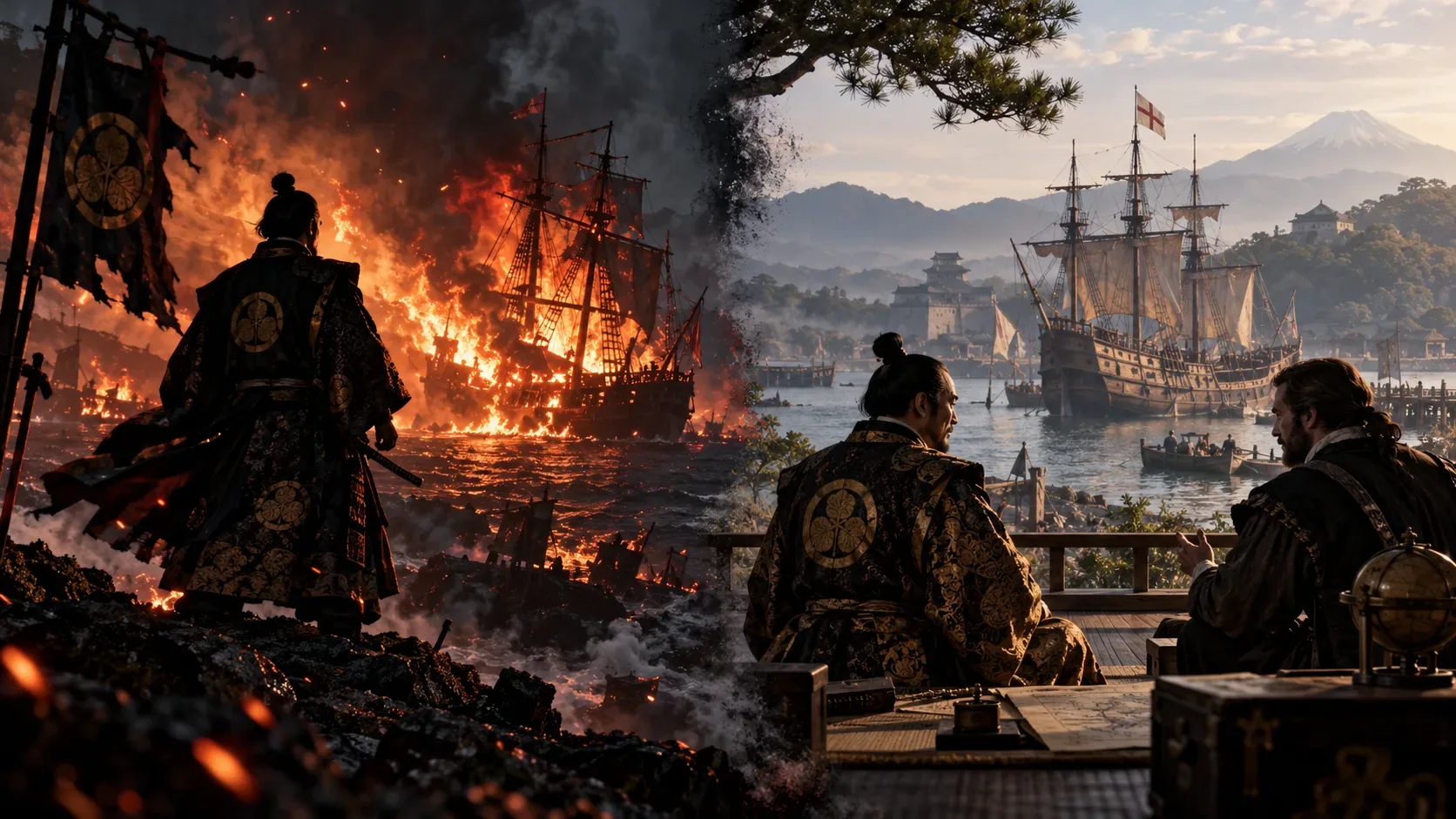
After Mariko's death in Osaka, Blackthorne returns to Ajiro and discovers that the Erasmus has been destroyed. At first, the attack appears to have been carried out by the navigator's Catholic enemies. Father Alvito has already explained that Mariko negotiated with the Church to spare Blackthorne's life, so Blackthorne concludes that his ship was the price of the bargain. To him, this explanation makes sense: losing the vessel would also remove a naval threat to the Portuguese and Catholic interests.
The episode complicates that assumption when Toranaga orders a brutal search for supposed accomplices among the villagers. Hoping to end the punishments, Blackthorne offers his own life and attempts suicide in front of the warlord. Toranaga stops him, then instructs him to rebuild the ship and help create a fleet.
The decisive confirmation comes in a separate conversation. Shortly before assisting in Yabushige's ritual death, Toranaga tells him that he ordered the Erasmus destroyed as a test of the anjin, the name used for Blackthorne. Mariko's negotiated agreement and Toranaga's order are not mutually exclusive explanations: the Church wanted the ship neutralized, while Toranaga used its destruction to test the pilot's loyalty and keep him tied to his plans. Blackthorne is absent from this revelation, so he never hears the full truth on screen.
Why is the ship so important to Toranaga?
The Erasmus is Blackthorne's main means of leaving Japan, as well as a weapon with the potential to affect commercial and religious rivalries. By taking it out of action, Toranaga limits the Englishman's options without losing his expertise in navigation and shipbuilding. His order to assemble a new fleet exposes that mixture of dependence and usefulness.
In the official podcast for episode 10, showrunner Justin Marks explains that Mariko negotiated for Blackthorne's life in exchange for access to the ship and its destruction. Marks also interprets the ending as a break from the ambitions that had trapped the navigator. That is the adaptation's creator explaining a dramatic choice, not an account of events documented in William Adams's life.
Who were William Adams and Tokugawa Ieyasu?
Blackthorne was inspired by William Adams, an English navigator who sailed with a Dutch expedition and arrived in Japan aboard the Liefde in 1600. Toranaga draws on Tokugawa Ieyasu, the Japanese leader who took Adams into his service as an associate and adviser. Neither fictional character is a direct biography: Shōgun uses real historical figures as the basis for a dramatized narrative.
The British Library, drawing on records linked to the English East India Company, documents Adams's life under Ieyasu's patronage, his assistance with foreign trading posts in Hirado and his death in Japan on May 16, 1620. Historian Frederik Cryns, who researches Adams's life, likewise emphasizes the Englishman's contribution to Western-style shipbuilding and trade relations under Ieyasu.
What really happened to the Liefde?
The historical section of FX's own episode 10 guide explicitly states that Ieyasu did not burn Adams's ship. The Liefde had arrived in poor condition and deteriorated without adequate repairs, eventually becoming unusable to its crew. Ieyasu restricted the survivors' ability to leave, and they ultimately abandoned the vessel and pursued separate lives in Japan.
The verifiable parallel, then, is not an act of arson but Adams's difficulty leaving Japan and the ruler's interest in his skills. Adams helped build Western-style ships for Ieyasu and became an adviser. He was eventually allowed to leave the country but never returned to England. None of this turns the fictional fate of the Erasmus into a historical event.
What did the series change, and why?
The dramatization brings three of Blackthorne's conflicts into a single material loss: the Church's threat, his dependence on Toranaga and the possibility of returning home. The delayed revelation also shows how far Toranaga is prepared to go in manipulating his own allies. The historical sources consulted describe Adams staying in Japan, the Liefde's deterioration and his work as an expert, but not an Ieyasu conspiracy to burn the ship.
That difference resolves the central question: Toranaga orders the ship destroyed in the fiction; Tokugawa Ieyasu did not do the same in the documented history. The fire explains the balance of power between the characters, not the real cause of William Adams's fate.