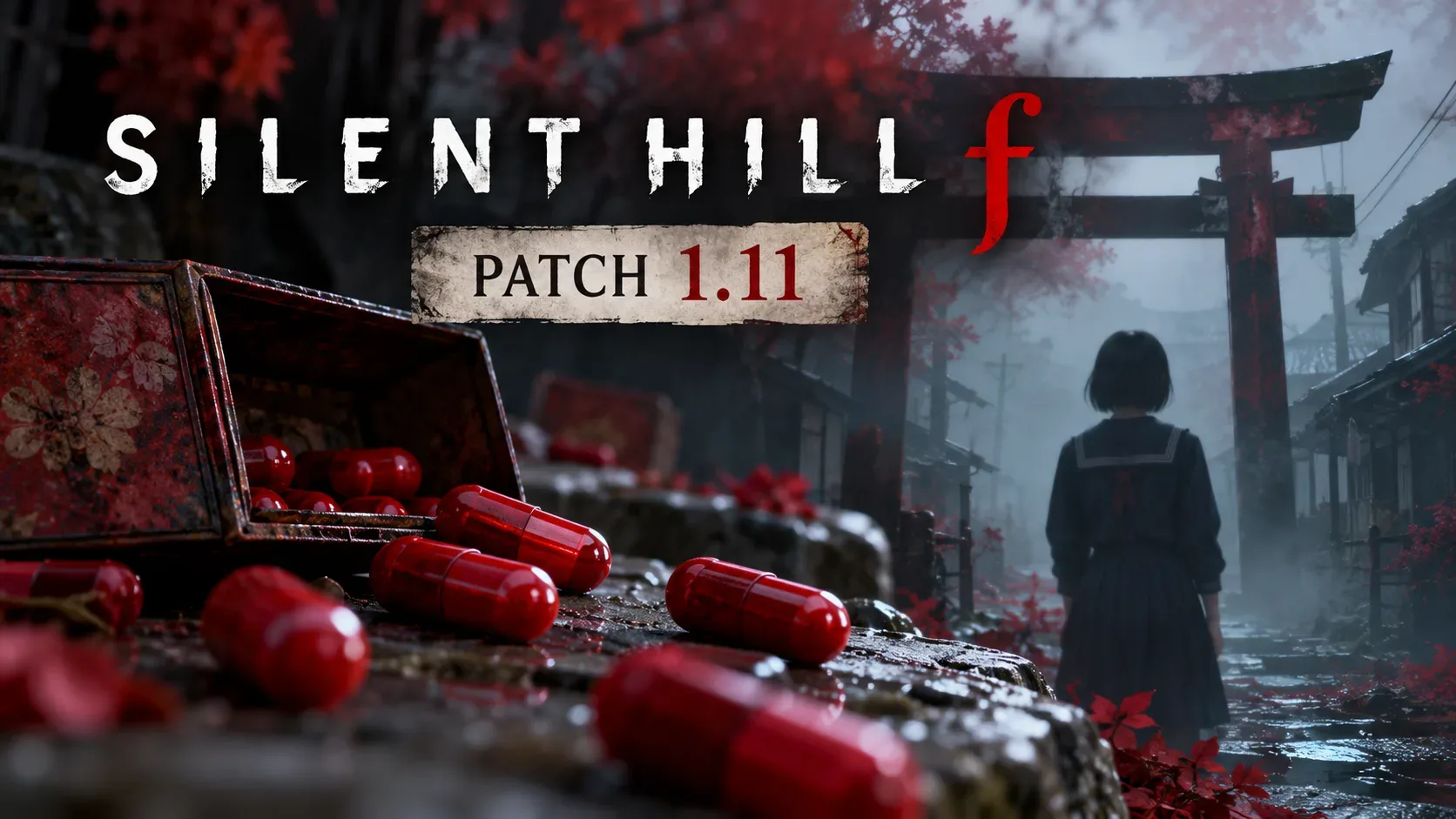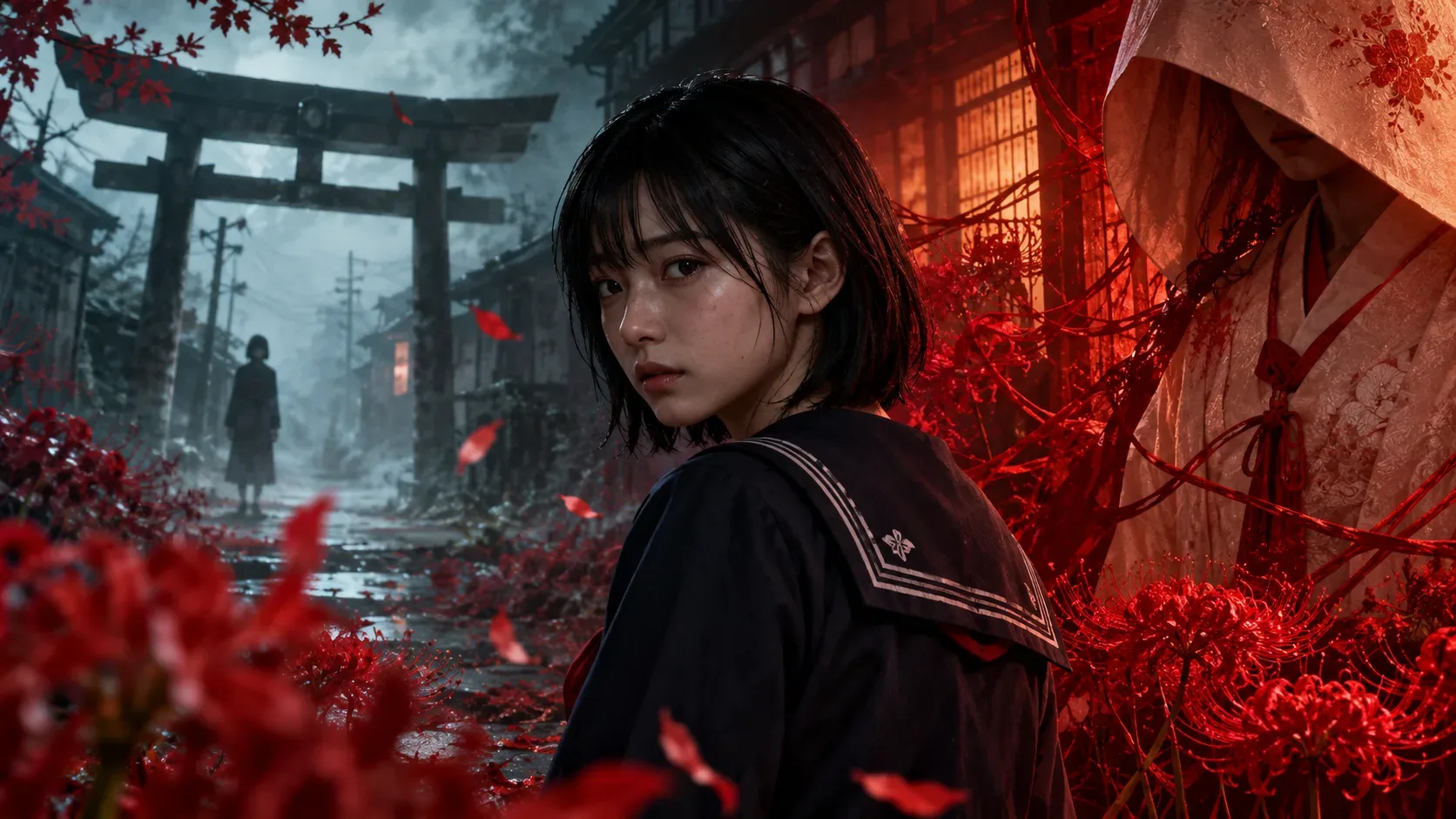
Light spoiler warning: this article reveals the central theme and the existence of alternate paths, without describing their outcomes. Silent Hill f was built around marriage because writer Ryukishi07 proposed exploring that commitment as a source of horror in a story about social expectations and the loss of autonomy. The team also chose not to declare any ending morally correct, aiming to offer different responses to Hinako’s conflict rather than impose a single judgment on players. Producer Motoi Okamoto discussed both decisions in interviews published in October 2026.
Who came up with marriage as a horror theme?
The proposal came from Ryukishi07, who wrote the scenario. In a discussion with Motoi Okamoto published by Dengeki Online and covered by AUTOMATON WEST on October 13, 2026, the producer said he was surprised when marriage was suggested. That surprise did not mean the project was rejected. He came to see the historical setting as a way of making the premise understandable within the game’s world.
The story follows Hinako Shimizu in the fictional town of Ebisugaoka, Japan, during the 1960s. That setting, confirmed by Konami, creates a contrast between family traditions, expectations for a young woman’s future, and a changing society. According to Okamoto, this period suited the story because arranged marriages still had a recognizable social presence. This is the producer’s rationale for the setting, not a claim that every Japanese marriage in that decade worked the same way.
In the same discussion, Okamoto connected the era both to the lingering presence of folk beliefs and legends and to growing debates over women’s rights. Marriage thus brings together two tensions within the game: the weight of tradition and the wish to decide one’s own future. Describing that contrast is an editorial interpretation grounded in the creators’ remarks, not a meaning that players are required to accept.
Why did the team keep marriage secret before release?
In an interview with Risa Unai published by Futaman Plus on October 4, 2026, Okamoto explained that Ryukishi07 did not want to reveal the marriage theme early. The plan was for players to recognize it as the story unfolded. Promotional descriptions and trailers were therefore deliberately restrained, even if that made parts of the premise seem vague.
Okamoto linked that decision to the pleasure of speculation associated with Ryukishi07’s writing. This did not mean the marketing concealed the game’s identity. Konami had already described a psychological horror adventure set in 1960s Japan, following Hinako through a fog-covered town. What remained concealed was mainly the nature of the conflict holding the story together.
Why is no ending declared the right one?
In the October 4 interview, Okamoto said he and Ryukishi07 discussed the importance of not forcing their own values onto audiences when addressing marriage. They therefore created several endings without identifying one as the obligatory moral answer. That statement concerns how to interpret the protagonist’s choices. By itself, it does not determine which outcome, if any, is canonical within the franchise.
Ryukishi07 had already expressed a similar intention in an October 2025 interview published by the Epic Games Store: he wanted repeated playthroughs to matter and sought to avoid a straightforward division between good and bad endings. The report identifies five endings, including the series’ traditional humorous UFO ending. That number does not mean every conclusion has the same tone or dramatic weight, nor does it mean a first playthrough tells the entire story.
There is a meaningful distinction between calling an ending more complete, satisfying, or personally preferable and claiming the creators officially designated it as the only correct one. The former is a player’s possible judgment. The latter would require an official statement that these interviews do not provide.
Does the marriage imagery make the game an argument against marriage?
That is not an automatic conclusion from the interviews. The theme opens discussion of family pressure, identity, desire, and consent without reducing every situation to a choice between marrying and not marrying. The creators do not dictate a ready-made moral answer, although that does not erase the story’s criticism of repression and power structures.
The decision also fits the series’ broader approach. In its launch announcement, Konami described Hinako as a young woman under pressure from social expectations and facing traumatic decisions. Making marriage the organizing theme gave those conflicts a particular shape: the fear comes not only from monsters, but from what may happen when other people try to decide who Hinako should become.
What did the interview reveal about the game’s symbolism?
Moderate spoiler warning about story structure and symbolism, without revealing any ending. In the second part of the Futaman Plus interview, Okamoto suggested that the sequence of rituals at the Dark Shrine can be read alongside the stages of a wedding ceremony. He presented that connection as a possible interpretation, not a definitive account of what occurred in the story’s real world.
The producer also said the team debated how far a reconciliation between Hinako and her father should go, noting that she never explicitly offers forgiveness. It is another example of avoiding an easy verdict on a complicated emotional conflict. The alternate routes therefore need not be treated as a pass-or-fail answer key for marriage, but as different perspectives on a protagonist caught between competing expectations.
Sources and references
- Futaman Plus, Risa Unai interview with Motoi Okamoto, part 1, October 4, 2026
- Futaman Plus, Risa Unai interview with Motoi Okamoto, part 2, October 4, 2026
- Dengeki Online, conversation between Motoi Okamoto and Makoto Shibata
- AUTOMATON WEST, October 13, 2026 report
- Konami, official launch announcement, September 25, 2025
- Epic Games Store, interviews with Ryukishi07 and the team, October 7, 2025