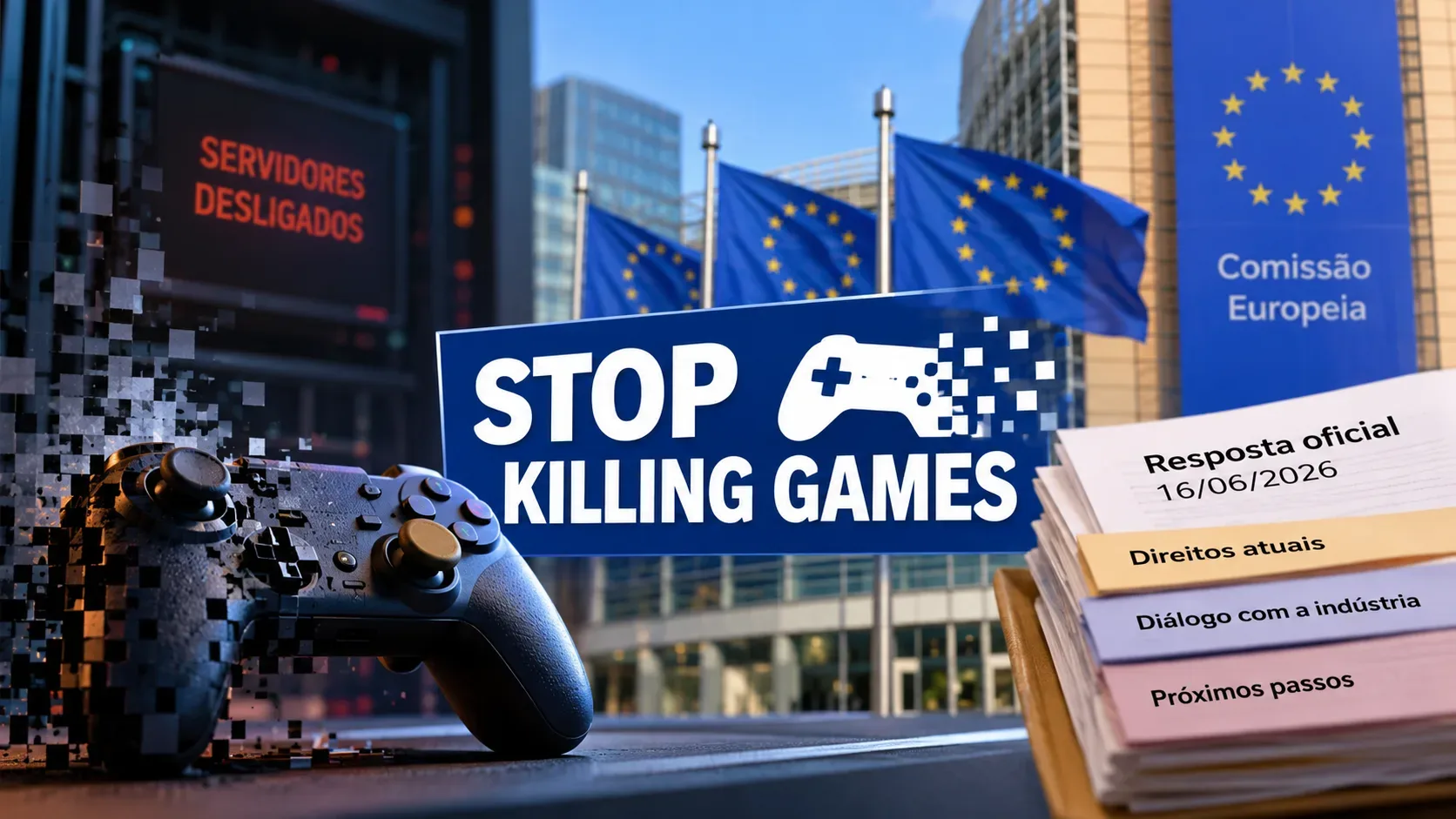
No, Stop Killing Games has not become law in the European Union. On 16 June 2026, the European Commission formally replied to the European citizens' initiative Stop Destroying Videogames and decided not to put forward, at this stage, a proposal requiring companies to leave all games playable after commercial support ends. The reply also created no general obligation to keep servers running forever.
That does not mean companies can discontinue services without regard for consumers. The Commission identified rights that already exist in the EU and announced discussions with the industry about how games reach the end of their lives. These are three separate matters: what the campaign seeks, what current law protects, and what may still be discussed.
What did Stop Killing Games actually ask for?
Stop Killing Games is the familiar name of the wider campaign that includes the European citizens' initiative officially registered as Stop Destroying Videogames. It sought to stop publishers from remotely disabling games sold or licensed to consumers in the EU without providing reasonable means to keep them playable after commercial support ends.
The document submitted to the Commission makes a crucial distinction: the initiative did not demand that publishers maintain servers, staff or updates indefinitely. It sought to leave a product in a functioning state that would no longer depend on the company's intervention. At the 2026 hearings, organisers also specified that they intended the measure to target future games, rather than force retroactive changes to every title already on the market.
This was a request to change the rules, not a rule automatically created by collecting signatures. The initiative obtained 1,294,188 verified statements of support and entered the formal EU process, which requires the Commission to examine and answer it but does not compel the institution to introduce legislation.
What did the European Commission decide on 16 June?
In Communication C(2026) 4110 final, the Commission concluded that proposing a general obligation to keep video games playable after commercial exploitation ends would not be proportionate. Its assessment considered copyright and other intellectual property rights, third-party licences, engineering costs, and potential safety risks when a game is no longer under the publisher's operational control.
The decision was not to advance the requested obligation as a legislative proposal. It was not a vote banning game preservation, nor a law authorising every shutdown. The Commission acknowledged the issue but chose to point to existing consumer safeguards and explore voluntary standards with the industry.
Reuters reported one illustration of the dispute surrounding The Crew, from Ubisoft: after its servers were shut down, a French consumer organisation took allegations about buyer information and contract terms to court. The existence of the lawsuit does not amount to a final judicial ruling on its merits.
What rights do EU players already have?
The Communication identifies EU instruments that already govern contracts and commercial practices involving digital content. How they apply depends on the contract, the information given to consumers, reasonable expectations about duration, the circumstances and the competent authorities.
| Issue | Existing protection | What it does not guarantee |
|---|---|---|
| Information before purchase | Duties to disclose relevant features, functionality, contract duration and termination conditions, as applicable. | An unlimited lifespan for every game. |
| Commercial practices and terms | Rules addressing misleading omissions and unfair contract terms, assessed case by case. | That every shutdown clause is automatically invalid. |
| Early termination or a service that fails to meet the contract | Directive (EU) 2019/770 provides remedies when a service falls short of the contract and what consumers could reasonably expect; a proportionate refund may apply. | An automatic full refund whenever servers close. |
| Server shutdown | A closure may be challenged if it breaches protected contractual expectations or other applicable rules. | A general duty to provide offline modes, community servers or source code. |
According to the Commission, the Digital Content Directive has applied since 1 January 2022. Its Communication explains that a proportionate refund may cover amounts prepaid and, subject to the relevant conditions, ancillary contracts and purchased but unused in-game currency. Each situation requires assessment; the shutdown of a server alone does not settle the outcome.
How did the initiative reach the official reply?
- 19 June 2024: the European Commission registered the initiative.
- 31 July 2024 to 31 July 2025: statements of support were collected.
- 26 January 2026: the initiative was formally submitted, with 1,294,188 verified supporters.
- 16 April 2026: a public hearing took place at the European Parliament.
- 21 May 2026: the European Parliament held a plenary debate.
- 16 June 2026: the European Commission adopted its official reply.
The parliamentary hearing and debate were not the passage of a law. The Commission's reply is a formal step in the citizens' initiative process, but it does not itself establish the obligations sought by the organisers.
What is planned, and what is not yet law?
The Commission announced plans to begin exchanges by the end of 2026 with publishers, consumer representatives and other stakeholders to explore a voluntary industry code of conduct for game shutdowns. Ideas mentioned include clearer storefront warnings about possible discontinuation and preservation partnerships with cultural institutions. These are options for discussion, not measures already imposed on companies.
Also planned for the end of 2026 is a report on how Directive (EU) 2019/770 is applied, including to the discontinuation of digital content and services. The Commission said it would work with consumer organisations and authorities to improve awareness of existing rights. None of these commitments, by itself, means the campaign's original proposed requirement has been approved.
What does this mean for someone who bought a game?
For EU players, the June reply does not create a universal right to demand that every game remain functional after its servers are disabled. However, the terms disclosed at purchase and the way a service ends may matter when assessing rights that already exist. EU law does not automatically turn every digital purchase into a guarantee of perpetual access.
The scope is the European Union. The reply does not establish a worldwide rule or automatically change the rights of consumers purchasing games in Brazil. As of 22 October 2026, the confirmed documentary milestones for this article are the 16 June reply and plans for dialogue and a report by year-end. Future measures must be assessed once their own contents and official status are established.