Spoiler warning: this article reveals how the sixth episode of The Bear Season 2, “Fishes,” ends.
The Christmas dinner and the damage to the house in “Fishes” were filmed through a combination of a real location in Evanston, outside Chicago, a dining-room set rebuilt on a soundstage, carefully prepared props, and multiple cameras recording at once. The crew did not need to destroy the location house: prop master Laura Roeper said the rebuilt room made it possible to capture the car crashing through the wall. Long takes, picture editing, and sound work intensified the sequence. The account below draws on published interviews with the people involved, not firsthand access to the shoot.
The house was real, but the damaged dining room was a set
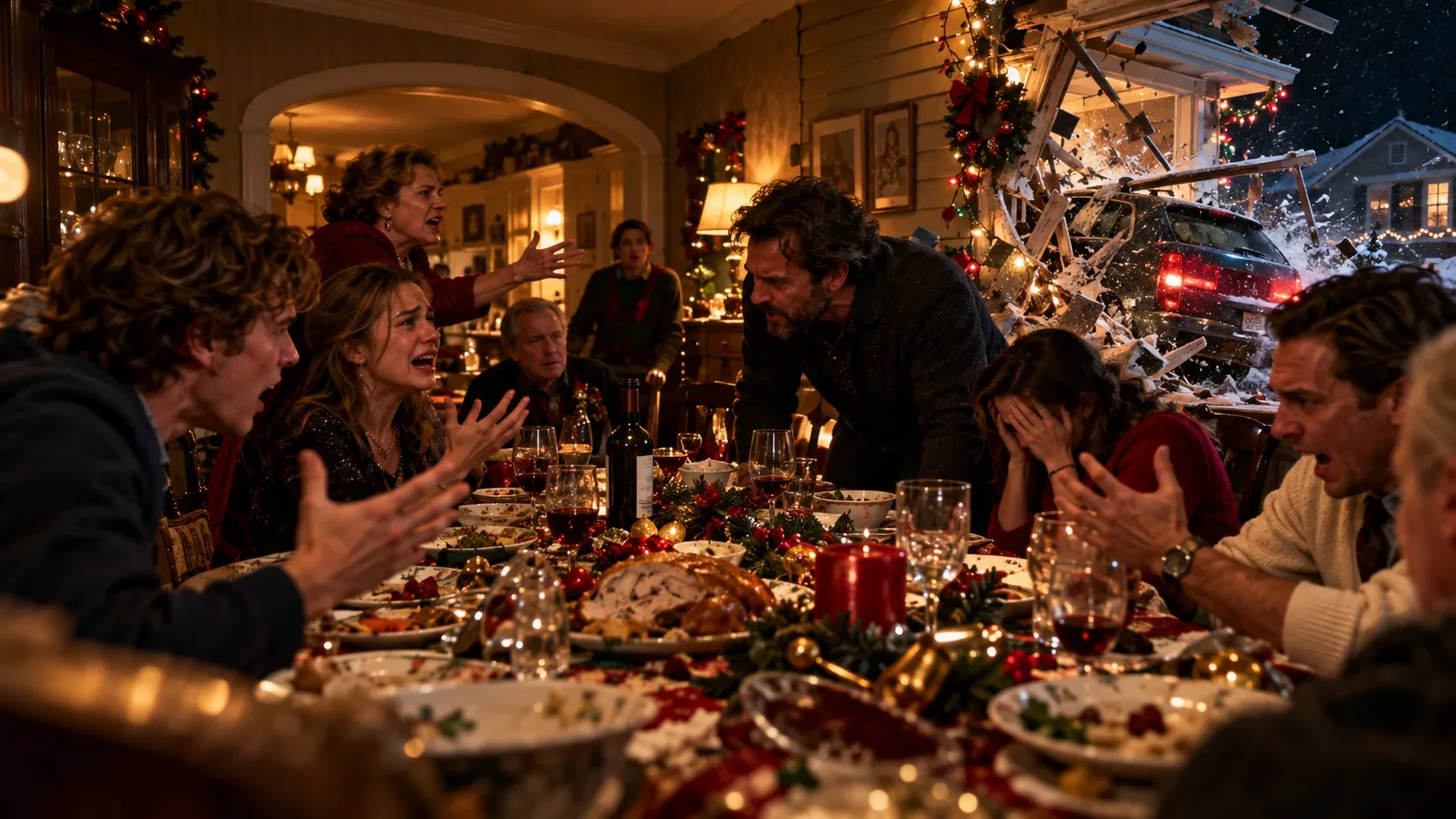
The episode jumps back roughly five years to a Christmas Eve gathering of the Berzatto family, as Donna, played by Jamie Lee Curtis, prepares the Feast of the Seven Fishes. The production did not simply use a studio façade. Roeper told VICE in December 2023 that the crew found a location house in Evanston. The dining room, however, was recreated on the production stages so the car could go through the wall in the closing sequence.
Cinematographer Andrew Wehde confirmed the distinction between the Evanston house and the dinner set in a 2024 Los Angeles Times oral history. He explained that the rebuilt, prelit space gave performers freedom to move. Both oversimplifications are misleading: the episode was not filmed entirely inside a real home, and its interiors were not all manufactured on a stage.
Keeping a full Christmas feast running
The challenge went beyond fitting a large cast into a house. Food had to be cooked, supplied, and maintained so the gathering felt as if it were happening continuously. Roeper said the production rented two more nearby properties: one across the street as a support space for the actors, and another nearby for cooking. The series culinary producer, Courtney Storer, oversaw meal preparation across this small neighborhood operation.
Christopher Storer told the Los Angeles Times in 2023 that Courtney coached Curtis on where to put the fish and sauces and how to work within the kitchen. Food served the drama while also functioning as a practical on-camera element. Roeper described tomato sauce being thrown around the room to make the environment look more disordered. She also noted that the team did not precisely refill every dish between takes, although props critical to continuity received closer attention.
Three cameras tracked the confrontation at the table
For the long confrontation between Mikey, played by Jon Bernthal, and Uncle Lee, played by Bob Odenkirk, the solution was not a single locked-off camera in the middle of the table. Christopher Storer described three cameras fitted with long lenses, moving their viewpoints around the group. As the exchange becomes more hostile, the frames tighten around the two men. Camera position and framing make the space feel as though it is closing in before anything physically collapses.
According to the director, “Fishes” took five days to shoot, and the dinner-table scene accounted for roughly half a day. Editor Joanna Naugle confirmed in a 2024 Immersive Media interview that the three-camera setup was unusual for a show that generally covered such material with two cameras. The editors did not have limitless angles or scores of takes to choose from: the material came from relatively few takes and three primary camera viewpoints.
Long takes also allowed reactions to develop within a continuous performance. That does not mean the entire dinner was filmed as one uninterrupted shot. The final scene is assembled from simultaneous recordings and later editorial choices; a long kitchen take mentioned by actress Abby Elliott is a separate moment in the episode.
The flying forks were stunt props
Even something as small as throwing a fork required testing. Roeper told VICE she commissioned a specialist to make rigid rubber fork replicas, then tried them with the stunt and effects teams. Some broke during filming. Christopher Storer told the Los Angeles Times that a rubber fork did not give the desired image on camera, so the filmed solution used a plastic fork enhanced by sound in post-production. The accounts document different steps in preparing and selecting the object; they do not establish that every fork visible in the episode was made from the same material.
The car and the wall: what the interviews actually establish
The major damage to the house is part of the story: Donna drives a car into the residence. The production team built a duplicate dining room in a controlled environment to stage that moment. This is the behind-the-scenes detail directly supported by Roeper and the cinematographer, and it explains why the shoot was split between the house and a set. The destruction on screen is not evidence that the actual Evanston house was demolished.
The sources consulted here do not provide a complete technical breakdown of the vehicle speed, driving rig, stunt team, number of crash takes, or any digital finishing. Without that documentation, it would be misleading to label the scene entirely computer-generated or to describe unverified safety mechanisms and practical effects. The supported conclusion is that the rebuilt room made the impact possible.
Editing and sound turned a crowded room into mounting tension
The chaos was also shaped after filming. Joanna Naugle explained that the edit placed brief stretches of comedy throughout the episode while preserving a nearly unbroken rise in tension. She said the final dinner scene has no background music, unlike much of the episode. That decision gives overlapping voices, silences, and competing arguments more space instead of letting a score dictate the audience’s response.
Speaking to The Credits, the Motion Picture Association publication, dialogue editor Evan Benjamin described the difficulty of separating voices that collided with one another. Production sound mixer Scott Smith also collected dialogue and incidental sounds during rehearsals and recording, leaving material for the edit. Supervising sound editor Steve Giammaria discussed the treatment of the fork sound and the way the commotion builds. The feeling that arguments are erupting from every direction is therefore rooted both in what was captured on set and in deliberate post-production decisions.
The production method behind “Fishes” is the combination of these choices: a house selected for the way its rooms connect, a second environment built for the collision, food and props designed to withstand repeated filming, performers given room to sustain the argument, and an edit that shapes disorder without making it look tidy. This is a documented reconstruction of the process, not an eyewitness account from the set.