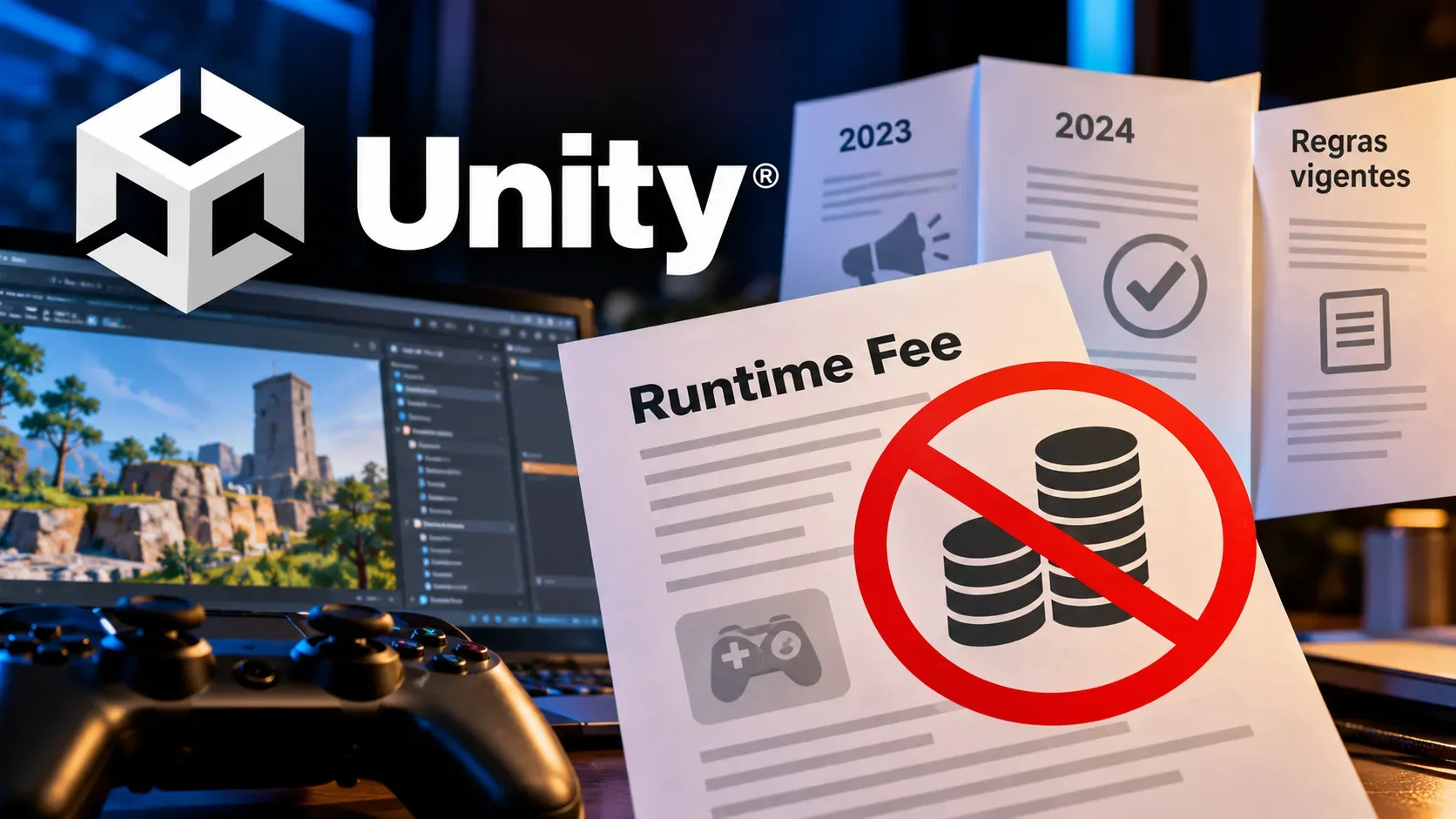
The Unity Runtime Fee was canceled on September 12, 2024, and there is no per-installation charge for games made with Unity. According to Unity itself, the fee was never implemented: no existing or new game was ever subject to it. What remains is licensing for the editor, with plans, financial eligibility rules, and prices that may change. The reversal followed the backlash against the 2023 proposal and Unity’s attempt to rebuild developers’ trust.
That is why older guides describing payments per download should be read as records of an abandoned proposal, not as current instructions. The information below reflects official materials checked on October 21, 2026, and concerns games rather than industrial contracts for other kinds of applications.
How the proposed charge began, changed, and ended
- September 2023: Unity introduces a fee tied to game installations, planned for 2024 and subject to installation and revenue thresholds. The announcement raises questions about cost predictability, what counts as an installation, and how games are distributed.
- September 22, 2023: after criticism, Unity apologizes and revises the proposal. Under the revised policy, Unity Personal would be exempt, as would games earning less than US$1 million in the preceding 12 months. Other qualifying games would be able to choose between a 2.5% revenue share and a calculation based on new users, paying the lower amount.
- September 12, 2024: then-president and CEO Matt Bromberg announces the immediate cancellation of the Runtime Fee for games customers, including future Unity 6 users, and a return to seat-based subscriptions.
- October 10, 2024: Unity updates the Editor terms and removes the fee provisions; it also clarifies plan eligibility and the ability to retain terms for earlier editor versions.
- January 1, 2025: the revised eligibility thresholds for Pro and Enterprise take effect under the stated purchase, renewal, or upgrade conditions.
- January 12, 2026: Unity implements an announced 5% increase for Pro and Enterprise plans upon relevant purchase or renewal. This subscription price increase is not a return to the per-installation fee.
Why did Unity abandon the installation fee?
The problem was the combination of a cost tied to a game’s reach and uncertainties developers raised about measuring that reach. The original idea linked some payments to installations after certain thresholds, creating practical questions for games distributed through different stores, promotions, or access models. Unity’s own 2023 responses show that the company had to clarify reinstalls, fraudulent installations, and demos.
The backlash first prompted the September 2023 revision. By then the policy was no longer simply an automatic charge on every download: application would have depended on thresholds, editor version, and the more favorable of two calculations. Yet none of those proposals became an actual charge. In September 2024, Bromberg said Unity had listened to customers and partners, and that its relationship with developers had to be founded on trust. The business decision was to charge for software access under the subscribed plan rather than introduce that disputed charge tied to a game’s performance.
Which Unity licensing rules still apply?
For games and entertainment, Unity continues to offer Personal, Pro, and Enterprise plans. The thresholds below are those the company publishes for its 2026 plans. These are software eligibility criteria, not a share of game sales or an amount due whenever a player installs a game.
| Plan | Published position for 2026 | Practical effect |
|---|---|---|
| Unity Personal | Free for eligible users with revenue and funding of up to US$200,000. | A team within the threshold can use the free edition, subject to the plan’s other terms and features. |
| Unity Pro | Generally required for businesses with more than US$200,000 in annual revenue or funding; conditions also apply to people working for those businesses. | A seat-based subscription is paid regardless of how many times players install the game. |
| Unity Enterprise | Required for businesses with more than US$25 million in annual revenue, under the published eligibility requirements. | Pricing is customized to the agreement, rather than a blanket per-installation fee. |
The announced 5% increase for Pro and Enterprise began on January 12, 2026, for affected subscriptions and renewals. Unity also notes that totals can vary with currency, taxes, and region. There is therefore little value in freezing a price in Brazilian reais or assigning any studio a particular contract amount without examining its quote and purchasing conditions.
What about older games and projects upgraded to Unity 6?
No version of Unity became subject to the Runtime Fee. Unity’s FAQ states explicitly that because the fee was never implemented, no existing or future game had to pay it. Upgrading an older project to Unity 6 does not trigger the canceled fee either. The specific former concern about upgrading versions is therefore no longer relevant.
This does not make versions and contracts irrelevant. Unity says a developer may retain previously accepted terms while staying on the same named Editor version; using Unity 6 requires accepting the updated terms dated October 10, 2024. Subscription prices may still change upon purchase or renewal, even for developers using older versions. This is the distinction between editor software terms and subscription pricing.
Practical questions about Unity charges
- My game has had many installs. Do I owe anything for them? Not under the Runtime Fee. Installs alone do not create that canceled charge; check the applicable plan and any separately purchased services.
- My game launched before Unity 6. Is there an outstanding fee? Not under the Runtime Fee. Unity confirms that it was never implemented.
- Would a free game or a game offered through a subscription be charged per install? There is no Runtime Fee applicable to those distributions. Any other commercial obligations depend on specific contracts and services.
- Can Unity Personal be used at any revenue level? No. The free edition remains subject to financial eligibility requirements and current terms; being free does not remove those thresholds.
- Does the cancellation cover every industrial application? The September 2024 announcement expressly concerned games customers and said that non-gaming Unity Industry customers were not affected by that change. Industrial applications require their own license review.
The key distinction is simple: canceled installation fee does not mean Unity is entirely free. When choosing a plan, check revenue and funding, intended use, Editor version, renewal date, and additional services. None of these reinstates the Runtime Fee.
Sources and references
- Unity Discussions: 2023 pricing proposal and clarification history
- Unity: open letter to the community, September 22, 2023
- Unity: Runtime Fee cancellation, September 12, 2024
- Unity: terms update, October 10, 2024
- Unity: pricing updates, 2026 rules and Runtime Fee FAQ
- Unity: current plans and eligibility requirements