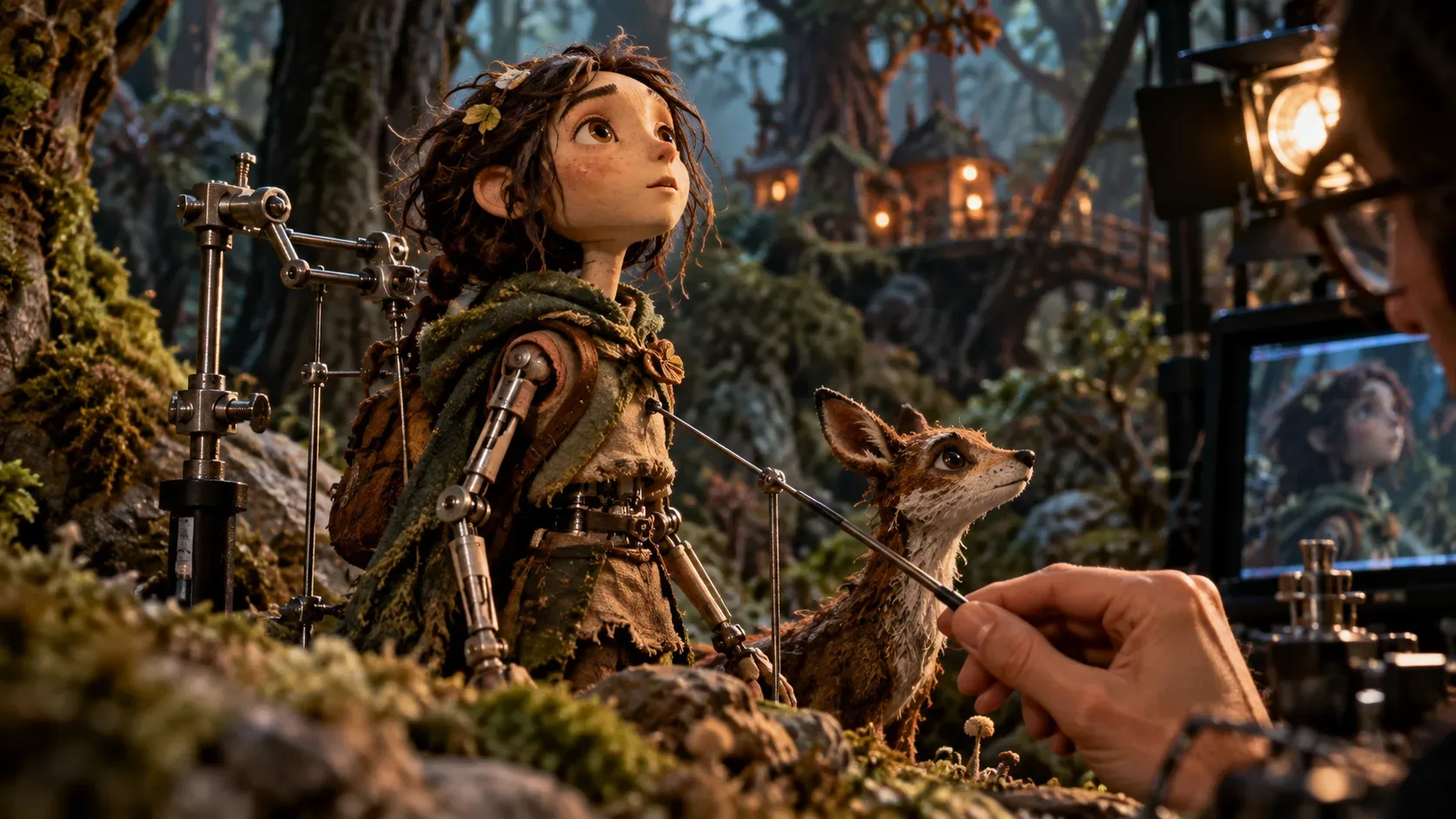
LAIKA made the puppets in Wildwood appear to breathe using a physical mechanism called a breather. By turning a key connected to the inside of a character, an animator moves a diaphragm-like device so the chest expands or contracts in tiny increments. Each position is photographed; the resulting sequence produces breathing on screen without the motion itself having to be drawn digitally.
The device was not invented for Wildwood. It debuted in Missing Link (2019) and was deployed far more widely in Travis Knight’s film. The process was explained by Oliver Jones, LAIKA’s head of character and practical effects, during demonstrations for journalists visiting the studio’s workshops.
What happens inside a puppet’s chest
In his JoBlo studio-visit report, Steve Seigh describes Jones demonstrating a key that activates the internal breathing mechanism. Turning it visibly changes the volume of the puppet’s chest. The Nerds of Color describes the same principle: the key moves the chest area inward and outward, creating the visual equivalent of inhalation and exhalation.
That does not mean the puppet draws in air, or that a motor automatically performs an entire breathing cycle during filming. The effect described in the reports is a change in shape controlled by the animator. The position of the key and the chest’s range of motion can be adjusted between frames to suit the intended performance.
According to Jones’s statement reported by The Nerds of Color, only three characters in Missing Link used this feature, while about 90% of the characters in Wildwood had breathers. That percentage is attributed to the studio professional during the visit, rather than an independent count of every puppet.
From steel armature to frame-by-frame photography
The effect begins before the camera rolls. According to Cartoon Brew, characters are first developed as three-dimensional models to establish silhouette and proportions. The team then builds the sculpt and its internal jointed framework, known as an armature, using steel components, joints, screws, and other parts that let the animator hold an exact pose.
The outer materials matter too. Jones told Cartoon Brew that LAIKA developed sponge-like forms of silicone for areas that need to flex over the framework, alongside firmer sections. A mechanism may push the chest from within, but the surface must follow that movement without looking rigid or deforming in an unwanted way.
On set, an animator positions the puppet, makes a tiny adjustment to the chest and the rest of the pose, takes a photograph, and repeats. LAIKA works at 24 frames per second, creating a new pose for each frame, an approach known as animating on ones. Digital cameras and frame-comparison systems, or frame grabbers, help artists compare the last image with the next. For the General eagle’s flight sequence, Cartoon Brew reports an average of just 20 animated frames a day, less than one second of footage.
Why breathing also depends on faces, clothing, and posture
A rising and falling chest alone cannot carry a convincing performance. Jones also showed visitors another device nicknamed the jetpack: mechanical adjusters that tilt the puppet by extremely small amounts. It controls the body’s position, while the breather changes the apparent volume of the chest. These are different functions that can contribute to one performance.
Facial acting comes from a separate production pipeline. Brian McLean, LAIKA’s director of rapid prototyping, explained to Cartoon Brew that faces are digitally modeled and 3D-printed as physical replacement parts. For certain shots, the team makes a different face for every frame; the report puts the total at approximately 142,000 printed faces for Wildwood. Animators can still make minute manual adjustments to eyes and eyelids on set.
Costumes and silhouettes must respond as well. In a report for That Shelf, costume designer Deborah Cook discussed wires and shapeable materials built into clothing so animators can control folds and the impression of movement. What reads as breathing is the combination of chest, body balance, facial expression, and fabric, not a single button that produces a complete performance.
The General eagle shows the challenge at a larger scale
The General, a giant eagle featured in the film, provides a concrete example. Cartoon Brew reports a filming puppet with a roughly five-foot (1.5-meter) wingspan, more than 3,000 attached feathers, and a chest breather. Its neck also has a mechanism allowing it to extend and contract.
Because the wings were too heavy for delicate adjustments by hand alone, the team installed motors in the shoulders. Head of animation Brad Schiff explained that animators operated those positions through dials while the remaining details were still moved manually. The wing motors should not be confused with the breathing device.
The example captures Wildwood’s underlying approach: different mechanisms solve different problems of scale, weight, and subtlety. What looks like a breathing animal relies on a mechanical diaphragm, flexible materials, and frame-by-frame decisions about the pose.
Where computers and digital effects fit in
The presence of breathers does not mean Wildwood avoids computers. Faces are digitally modeled, components are 3D-printed, and electronic tools help animators review their work. That Shelf also reports digital visual effects used to extend environments and create background elements, including crowds.
The crucial distinction is the source of the movement under discussion. The chest contracting in front of the camera is a physical part operated inside the puppet, while digital animation can complement other elements of an image. Calling this breathing a computer-generated effect would overlook the micro-engineering documented in the studio visits.
What the reports establish, and what they do not
The demonstrations reported by JoBlo, Cartoon Brew, The Nerds of Color, and That Shelf document the mechanism’s existence, key-based operation, use in Wildwood characters, and frame-by-frame filming. They are not complete engineering manuals, however: they do not specify the internal geometry of every model or the breathing timing planned for each character. This account is reconstructed from published reporting and makes no claim of a firsthand studio visit.
The film opened in U.S. theaters on October 23, 2026, as announced by LAIKA in a release carried by U.S. distributor Fathom Entertainment. In Brazil, Wildwood, released as O Bosque Selvagem, was scheduled to open on October 29, 2026, according to JWave. The explanation of the breathers remains useful beyond the film’s theatrical window.