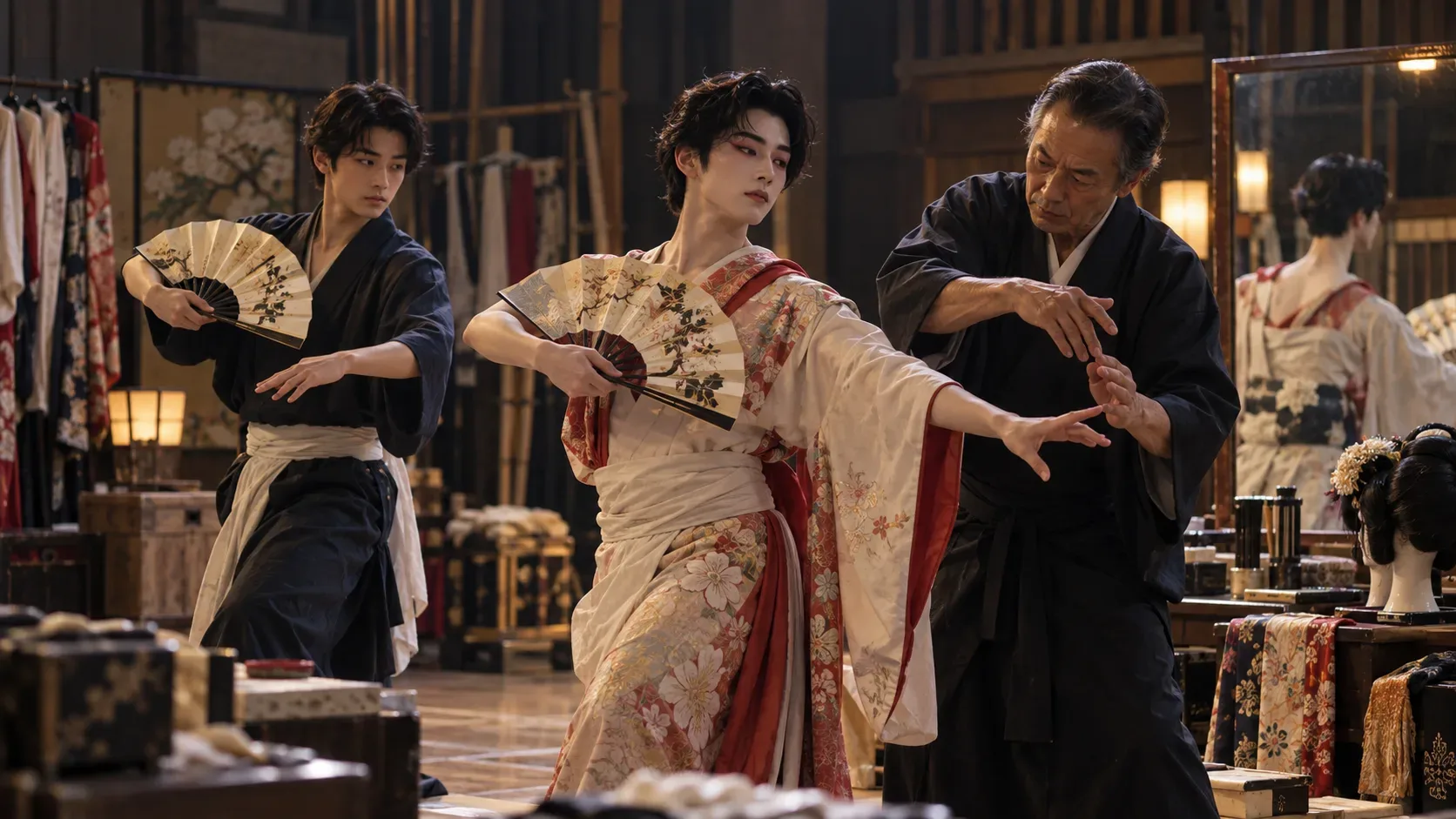
Ryo Yoshizawa and Ryusei Yokohama studied kabuki movement and traditional Japanese dance for more than a year to portray onnagata performers in Kokuho. They began with posture and walking, progressed to choreography and acting, and worked with kabuki performer Nakamura Ganjirō and dancer Hirokazu Taniguchi. The aim was to create convincing performances for the film, not to turn its leading actors into professional kabuki artists.
Directed by Lee Sang-il and released in Japan on June 6, 2025, Kokuho follows Kikuo, played by Yoshizawa, and Shunsuke, played by Yokohama, through friendship, rivalry, and devotion to the stage. The actors' preparation explains a central creative choice: portraying the discipline of a real theatrical tradition while preserving the emotional lives of the two fictional characters.
What is an onnagata, and why does movement matter?
In kabuki, an onnagata is a male performer specializing in female roles. The art is not simply a matter of wearing a kimono or copying women's everyday behavior. According to educational material from the Japan Arts Council, it is a stylized theatrical language shaped by conventions handed down over generations.
The entire body is involved. The educational guide describes lowered shoulders, arms held close to the torso, and walking with the knees together and toes turned inward. These are reference points from stage technique, not proof that every gesture appears in every scene of the movie. For performers trained in screen acting, learning these basics meant changing physical habits before memorizing a dance.
The first months were devoted to learning how to walk
In an interview with GQ Japan, Yoshizawa dated the start of rehearsals to January 2023, more than a year before filming, which took place from March to June 2024. Distributor GKIDS describes roughly 18 months of preparation for the lead actor. Yoshizawa clarified to Fan's Voice that this period also included filming, so it should not be described as 18 months spent exclusively in classes.
The first challenge was suriashi, a gliding style of walking. Lee recalled that training began with Yoshizawa wearing a yukata. Yoshizawa described spending three to four months concentrating on this movement, while other accounts refer to roughly two or three months of fundamentals. The recollections differ slightly but agree on the essential point: rehearsals began with an apparently simple foundation, practiced repeatedly.
Dance, acting, and gestures such as sitting, standing, and handling a fan came next. As for Yokohama, Lee told the Maeil Business Newspaper that he trained for approximately one year and two or three months, compared with around a year and a half for Yoshizawa. Those are the director's approximate figures, not a measurement of mastery. Both actors also told Japanese media that the experience deepened their respect for performers who begin studying kabuki as children.
Who taught the dancing, and who advised on kabuki?
The coaching had different areas of responsibility. Nakamura Ganjirō, a professional kabuki actor, advised on the tradition itself, including acting, backstage customs, and the details of the theatrical environment. Hirokazu Taniguchi oversaw Japanese dance and choreography. Taniguchi's own professional website confirms his work as choreographer and dance instructor on Lee Sang-il's film.
Ganjirō told the Japanese magazine Josei Jishin that he repeatedly corrected both actors' shoulder-blade positioning and the straightness of their backs. When fatigue caused their heads to tilt forward and their posture to slip, he would correct them again. The detail matters: convincing onnagata movement depended as much on maintaining bodily alignment as on performing striking choreography.
The consultation also covered what surrounds the stage: props, dressing-room behavior, and conventions familiar to kabuki audiences. The result therefore cannot be credited entirely to makeup, costumes, or film editing. Those contribute to the screen image, but the performers genuinely rehearsed its physical foundations.
Rehearsing selected works is not the same as mastering all of kabuki
Lee told Fan's Voice that teaching the whole of kabuki from scratch would have been far too broad a task. The team selected works that emphasized onnagata roles, while Yoshizawa attended live performances and watched recordings. The interview mentions pieces such as Sagi Musume and Sonezaki Shinju when discussing the film's stage sequences. They prepared for specific demands of the story rather than attempting to qualify the actors across the entire repertoire.
This distinction also helps explain the leads' own comments. Speaking to Eiga.com, Yoshizawa acknowledged that a year and a half could not equal the training of someone who had performed since childhood. Yokohama likewise described his encounter with onnagata artistry as an experience that deepened his admiration for the tradition. Recognizing those limits is part of the training story, not a dismissal of the work they did.
How did stage technique become screen acting?
A direction from Lee marked the turning point. Yoshizawa said he initially focused on dancing as beautifully as possible, but Lee asked him to remain Kikuo even when the character was performing a role onstage. Behind the dance in Sagi Musume or the acting in Sonezaki Shinju, the film still had to reveal the protagonist's conflicts and lived experience.
Lee confirmed that he wanted to connect the theatrical performances to the rest of the drama, rather than drawing a firm boundary between stage and private life. This is the crucial difference between studying a real theatrical language and applying it to a film narrative: the camera follows fictional performers whose personal stories must remain visible during traditional numbers. The director did not claim that the film reproduces an entire conventional kabuki performance.
There was also a documented physical challenge. Yoshizawa described spending whole days shooting theatrical numbers in heavy costumes and wigs. Rehearsals gave the actors their movement vocabulary; on set they also had to maintain stamina and dramatic intention across takes. The result is a screen performance prepared with expert guidance, not a certification that Yoshizawa and Yokohama became professional onnagata.
Sources and references
- GKIDS
- Japan Film Database (JFDB)
- GQ Japan, entrevista com Ryo Yoshizawa
- Fan's Voice, entrevista com Ryo Yoshizawa e Lee Sang-il
- Eiga.com, entrevista com Ryo Yoshizawa e Ryusei Yokohama
- Josei Jishin, entrevista com Nakamura Ganjirō
- Hirokazu Taniguchi, perfil profissional
- Japan Arts Council, Kabuki for Beginners
- Maeil Business Newspaper, entrevista com Lee Sang-il