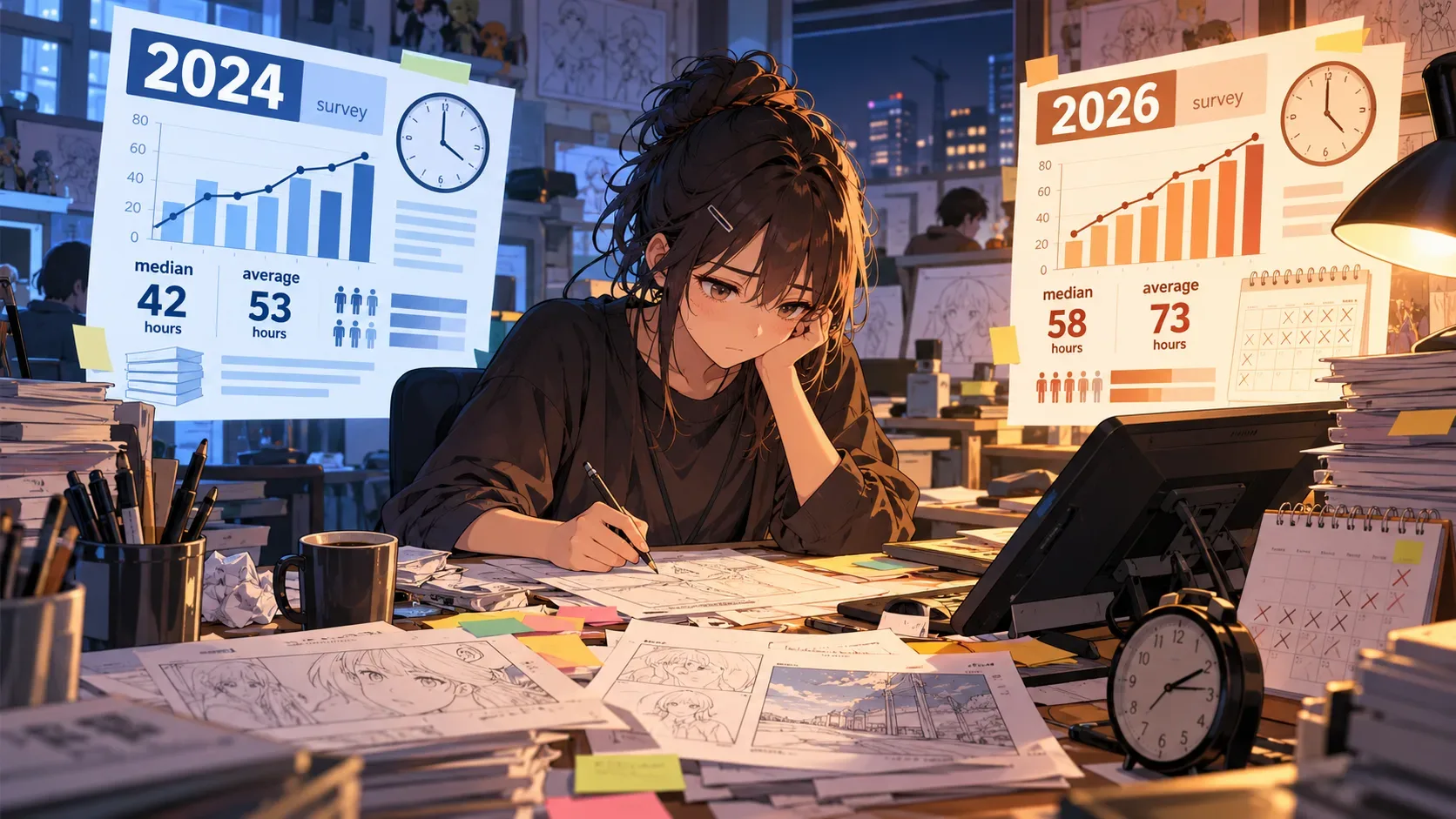
The two surveys do not establish that Japanese anime animators simply started working fewer hours in 2026. NAFCA reported a median of 225 working hours per month in 2024, whereas JAniCA's 2026 report gives a mean of 190.6 hours. Those figures come from different statistical measures, respondents, and procedures. The newer report suggests improvement within JAniCA's own historical series, not a drop from 225 to 190.6 hours among the same workers.
Two surveys, not the same group of workers
NAFCA gathered 323 responses between December 2023 and January 2024. Its sample covered animation, directing, production, design, and other occupations in the sector. Of those respondents, 191 listed animator as one of their roles. The 225-hour figure therefore should not be described as applying exclusively to people who draw animation.
JAniCA collected 983 valid responses between October and December 2025 for its report released in 2026. It covered different creative and technical functions in animation production and used several questionnaire distribution and response channels. Its participants were not a follow-up panel of NAFCA's 323 respondents.
What the two studies actually measured
| Measure | NAFCA, published in 2024 | JAniCA, 2026 report |
|---|---|---|
| Survey fieldwork | Dec. 4, 2023 to Jan. 31, 2024 | Oct. 6 to Dec. 10, 2025 |
| Overall participation | 323 responses; 191 listed animator among their roles | 983 valid survey responses |
| Respondents | Workers across several anime-industry occupations; online questionnaire sent to NAFCA members | Professionals across creative and technical production roles; questionnaires distributed through mail and digital channels |
| Monthly working time | Median: 225 hours; mean: 219 hours | Mean: 190.6 hours; median: 180 hours |
| Basis of monthly metric | Figures calculated by the organization using answers about work routines and days off | 763 responses to the monthly-hours question; missing responses and outliers excluded under the report's criteria |
The median is the middle value of an ordered distribution; the mean is total hours divided by the number of observations. In NAFCA's results, the 225-hour median was higher than the 219-hour mean. For JAniCA's monthly-hours question, the mean was 190.6 and the median was 180 hours. Sharing the same unit does not make these different statistics interchangeable.
Another detail is easy to miss: 983 is the total number of valid responses to JAniCA's survey, but the 190.6-hour mean is based on 763 responses to its monthly-hours question. The report explains that missing answers and outliers were excluded and provides the distribution in section 43. It would therefore be inaccurate to say that all 983 respondents averaged exactly 190.6 hours.
Does JAniCA's historical series point to an improvement?
Across JAniCA report editions, the published monthly means were 262.6 hours in 2015, 231.0 in 2019, 198.3 in 2023, and 190.6 in 2026. That pattern is consistent with shorter average hours among the respondents to those studies. However, the 2026 report explicitly cautions that survey conditions differed across editions. This is not a study following the same individuals, so it does not prove every animator had a lighter workload.
This distinction also matters when interpreting analyses of the rise in salaried employment and changing contractual arrangements. Shifts in the respondent mix, the proportion of freelancers, or employment types can change an average without indicating uniform improvements at every studio.
Do lower average hours mean working conditions are good?
Not necessarily. JAniCA recorded a mean of 8.93 working hours per day among 967 valid responses to that question and an average of 7.24 days off per month among 963 responses. Its monthly average of 190.6 hours remains above the indicative 160-hour reference shown in the report. That does not mean long working weeks have vanished.
In NAFCA's survey, 71.4% reported working at least eight hours a day, while 58.8% reported fewer than six days off in a typical month. These results concern a different sample and cannot be combined with JAniCA's figures to construct a time series. In December 2024, NAFCA itself reiterated that focusing on a single measure could understate long working hours.
What can we conclude in 2026?
The strongest supported conclusion is that JAniCA's published series indicates lower observed averages over time, while NAFCA documented long hours in another group of respondents. Neither the gap between 225 and 190.6 hours nor the change from a 2024 headline to a 2026 report measures how much less any given worker now works.
A robust industry-wide comparison would require comparable populations, reference periods, occupations, contracts, and statistical processing rules. Until then, the studies offer complementary views of unequal working conditions in Japan's anime industry, not competing results from a single measurement.