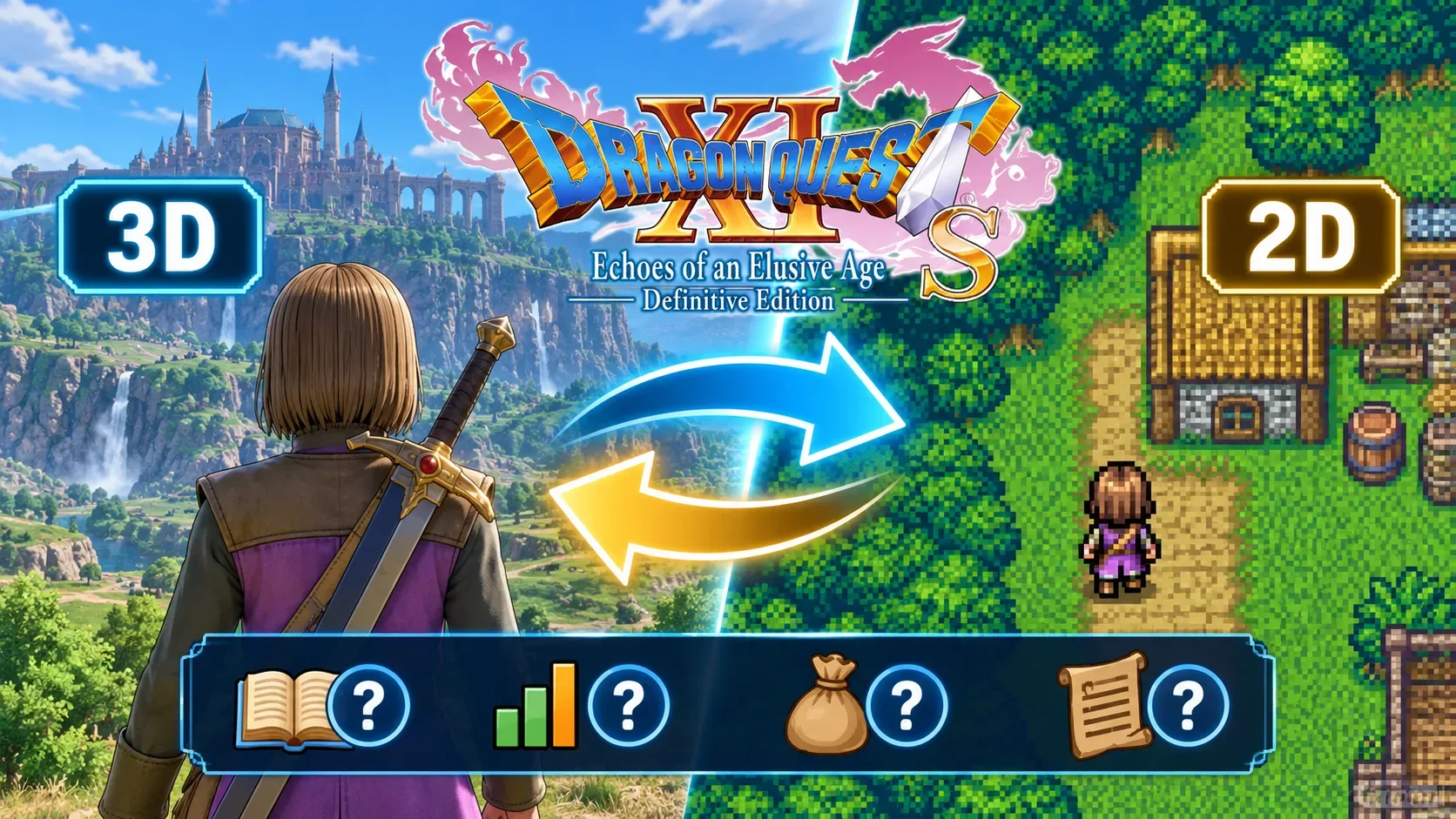
In Dragon Quest XI S, switching between 2D and 3D does not automatically erase your party's levels, equipment, or items. The risk concerns story position: when changing modes, the game asks you to choose the chapter where your adventure will resume. You may have to replay events you have already completed even though your characters retain their strength and inventory. Square Enix's FAQ also identifies exceptions for story-dependent data and progress through Drustan's Labyrinth.
Why can a visual-mode change force you to replay a chapter?
The S edition lets you switch between its 3D presentation and a classic RPG-inspired 2D style. Square Enix says this can be done at churches or campsites, but it is not a toggle that simply changes the appearance of your current scene. You must select the current chapter or an earlier one and resume the story from that starting point.
As a result, switching partway through a chapter may undo story advancement achieved since the chapter began. Deliberately choosing a much earlier chapter carries a greater risk: switching back to the other visual style does not automatically jump you forward to the furthest point you previously reached. In reporting published in September 2019, Nintenderos described this issue and recommended keeping a separate save before trying the feature.
What carries over, and what might be rolled back?
The crucial distinction is between player data and story advancement. Square Enix says most player information generally transfers between modes unless doing so would conflict with the story. That wording is not an unconditional guarantee for every item or event.
| Data or progress | What happens when switching 2D and 3D |
|---|---|
| Story chapter and main events | The story resumes at the selected chapter; later events may need to be replayed. |
| Party levels and attributes | Generally retained, according to the official FAQ. |
| Inventory, items, and equipment | Generally retained, subject to possible story-consistency exceptions. |
| Completed side quests | Completion records generally carry over, unless they conflict with the story state. |
| Objectives in unfinished quests | The FAQ does not guarantee that every unfinished step will remain exactly as it was. |
| Battle history, Draconian Quest restrictions, and accolades | Explicitly included among information that normally transfers. |
| Progress through Drustan's Labyrinth | An explicit exception: it does not transfer between modes. |
Calling this an operation that "deletes the save" is therefore misleading. It may roll back the narrative state without resetting character statistics. The situation becomes much harder to reverse if the player saves that new story state over their only copy of the later adventure.
How to try 2D or 3D without risking hours of story progress
- Save in a separate slot before switching modes. Leave an untouched copy of your furthest progression point.
- Check the chapter being offered on the selection screen. Do not assume you will return to the exact conversation, quest objective, or scene you just left.
- When practical, finish your current chapter first. Switching near the start of a new chapter reduces the amount of story you might have to replay.
- Avoid selecting an old chapter out of curiosity on your main save. It changes the story's starting point, and switching from 2D back to 3D does not automatically restore a later chapter.
- Check the result before overwriting any earlier backup. If the return point is not what you wanted, an intact save is safer than relying on another mode switch to skip ahead.
These are precautions, not a recovery guarantee. If your only available save has already been overwritten after a rollback, the consulted documentation does not establish any feature that instantly restores the lost story position.
What about the Drustan's Labyrinth exception?
The official FAQ specifically singles out Drustan's Labyrinth as progress that will not carry between modes. Even if your levels, inventory, and quest records are preserved, you should not assume your advancement in that activity will remain. Because Square Enix does not specify every affected room, reward, or stage in that answer, it would be inaccurate to turn this exception into a definitive item-by-item loss list.
The practical rule is to treat a switch from 2D to 3D, or vice versa, as restarting from a selected chapter with partial state transfer, not merely changing graphics. The official FAQ was temporarily unavailable for direct access during research; the specific rules cited here were checked against the page's indexed content and compared with the game's official presentation and specialist coverage.