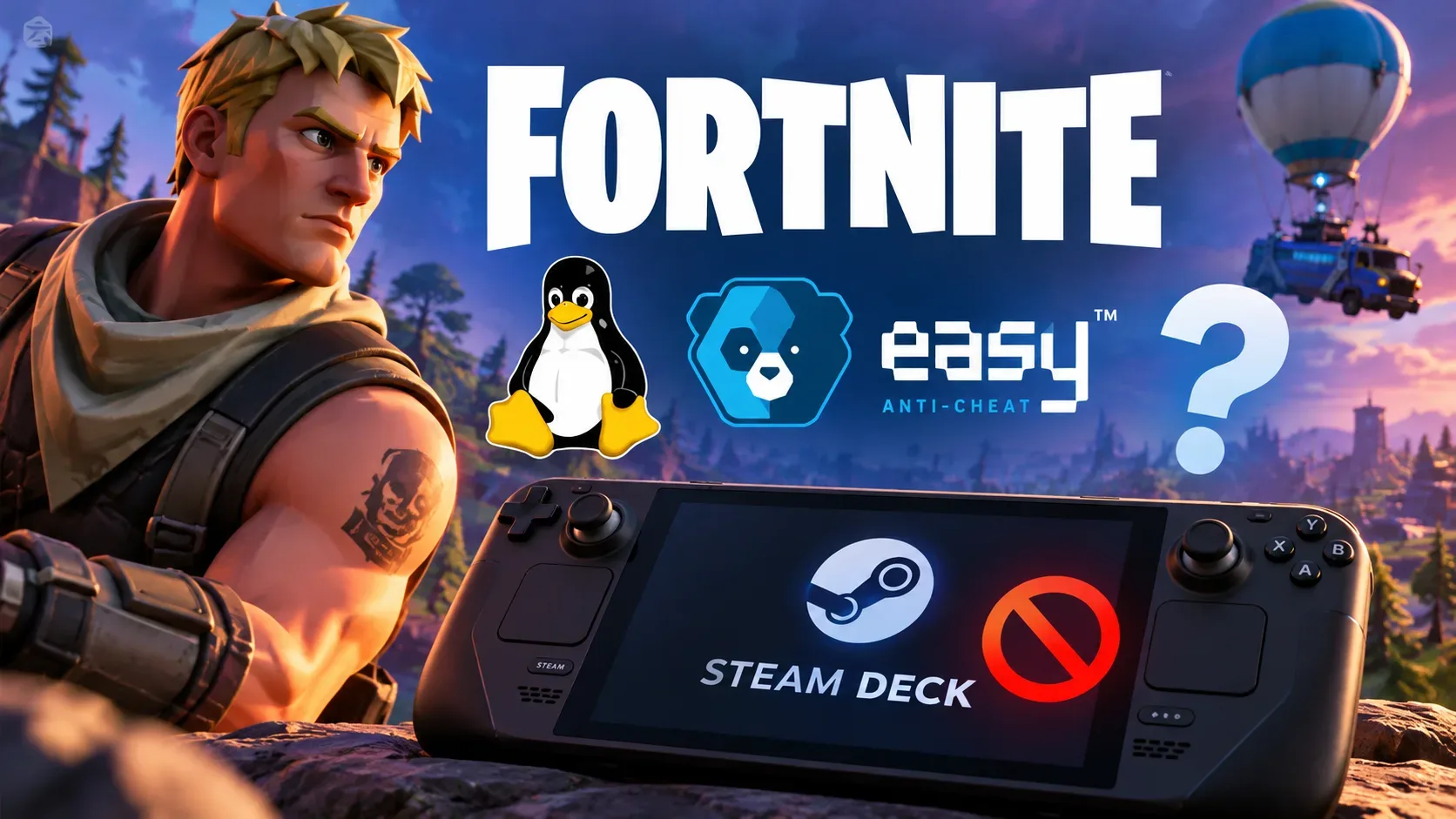
Fortnite still cannot run natively on Linux or the Steam Deck, despite Epic Games’ announcement on October 14, 2026. Epic is rebuilding Easy Anti-Cheat as EAC Linux v2 to make a Linux release possible, but it explicitly says the Steam Deck does not currently offer all the features its new system requires. As of October 25, there was no confirmed release date and no promise of compatibility with Valve’s handheld.
What Epic actually announced on October 14
Three distinct developments arrived together. Epic released a Preview of its new launcher with a native Linux version, announced work on a stronger anti-cheat system, and confirmed its intention to bring Fortnite to Linux once that technology has been validated. The storefront application is already in Preview, but neither a Linux game release nor Steam Deck compatibility was announced as complete.
Epic’s official support page says Fortnite will come to Linux through the Epic Games Launcher once EAC is working with a critical mass of Linux distribution maintainers. That statement supplies no month, SteamOS release, or public testing schedule. The planned first step for EAC Linux v2 is a Fortnite pilot; Epic intends to offer the implementation to other studios only after assessing how well it works.
| Product or scenario | Verified status | What it means |
|---|---|---|
| Epic Games Launcher on Linux | Preview available since October 14, 2026 | A store and library application, not the Linux release of Fortnite. |
| EAC Linux v2 | Redesign announced; Fortnite pilot planned | Requirements are published, while effectiveness and rollout still need testing. |
| Fortnite running on Linux | Planned; still unavailable on October 25, 2026 | No confirmed date; Epic links release to work with Linux distributions. |
| Locally running Fortnite on Steam Deck | No native support at present | Epic says the hardware lacks features required by EAC v2. |
| Cloud Fortnite on Steam Deck | Alternative identified by Epic Support | Xbox Cloud Gaming streams the game; this is not execution on SteamOS. |
Why Proton and the older Easy Anti-Cheat do not solve this
Linux, SteamOS, and Steam Deck are not interchangeable labels. Linux is an operating-system family; SteamOS is the distribution Valve uses on its handheld; and Steam Deck is a particular device with its own firmware and boot configuration. A future game supporting some Linux distributions therefore does not automatically work on every Linux-powered device.
EAC has supported native Linux game clients since 2014 and Windows games running through Wine or Proton since 2021. Support is opt-in for each title. Valve’s Steamworks documentation also specifies that developers must enable the appropriate EAC support in their game builds. Fortnite’s obstacle is not simply installing Proton, changing a compatibility setting, or opening the launcher Preview: Epic has not yet enabled local Linux gameplay with the security assurances it considers necessary.
What EAC Linux v2 will actually require
The redesigned architecture aims to move Linux cheat protection closer to its Windows counterpart without installing an equivalent Linux anti-cheat kernel module. Instead, it uses existing operating-system security features, eBPF programs, and a systemd service that starts when a protected game launches and stops when it exits. Not loading a proprietary kernel driver does not mean that the requirements are easy to meet or universal.
Epic has documented eight controls that may evolve during development. The following is its stated requirements matrix, not a certification that any device or distribution already meets every item:
| EAC Linux v2 requirement | Condition stated by Epic |
|---|---|
| Signed kernel and modules | Signatures from recognized keys, including for out-of-tree modules. |
| TPM 2.0 | An enabled security component used to record integrity measurements. |
| UEFI Secure Boot | Secure Boot enabled with recognized trusted keys. |
| Measured Boot | Verifiable measurements of the boot chain. |
| IOMMU | Enabled with passthrough off on non-handheld PCs; handheld devices are exempt from this requirement. |
| Kernel Lockdown | Integrity mode explicitly enabled at boot. |
| kexec disabled | Prevents a kernel replacement that could bypass boot measurements. |
| BPF LSM | Active BPF security module for access controls and monitoring. |
The IOMMU provision needs care: Epic requires enabled IOMMU with passthrough disabled on non-handheld computers, while explicitly exempting handheld devices. It would therefore be incorrect to identify the desktop IOMMU rule alone as the reason Steam Deck is blocked. The announcement offers no component-by-component diagnosis of the Deck’s shortcomings. Epic’s official conclusion concerns the required feature set as a whole.
The keys that verify boot and kernel-module signatures matter, too. Epic listed recognized authorities associated with Canonical, Fedora, Debian, Universal Blue, SUSE, Rocky Linux, AlmaLinux, and the Microsoft UEFI CA. Running one of these distributions does not automatically settle compatibility: Secure Boot state, boot measurements, loaded modules, and the other requirements still count.
What SteamOS and Valve still have to do
The launcher Preview officially lists Ubuntu 22.04 LTS or newer, Fedora 43 or newer, and Debian 12 or newer. Epic says other distributions may work but are not officially tested or supported. That list concerns the launcher, not Linux distributions on which Fortnite already runs. SteamOS is not among the explicitly supported systems in the Preview FAQ.
As for Steam Deck, Epic says it is actively talking with Valve and hopes to make support possible in the future. Epic game-security engineering director Rick Deist told PC Gamer that the company is investigating compatibility with Steam Deck and SteamOS devices. This establishes ongoing discussions, not a publicly committed firmware update, confirmed SteamOS modification, or release date. Changes to boot policies and operating-system integration might require cooperation among Epic, Valve, and maintainers, but no guaranteed technical fix has been announced.
Can you play Fortnite on Steam Deck today?
Not by running it directly on SteamOS. Epic’s Brazilian support page says Fortnite cannot be played locally on Steam Deck and identifies Xbox Cloud Gaming as a temporary alternative. In that setup the game streams from remote servers; it is not a local Fortnite installation, an EAC v2 workaround, or proof of native performance. Streaming quality depends on the service, connectivity, and regional availability.
Two separate milestones must be verified before the answer changes: Epic has to complete its EAC Linux v2 work and release Fortnite for eligible Linux distributions, and Epic and Valve must independently make and confirm Steam Deck support. Until then, Fortnite coming to Linux does not mean Fortnite working on Steam Deck.
Source status checked October 25, 2026. Requirements, distribution availability, and schedules may change as Epic and Valve develop the project.
Sources and references
- Epic Online Services: Awesome Gaming on Linux Without Cheating
- Epic Games Store: The new Epic Games Launcher is finally here in Preview
- Epic Games Launcher: Epic Games Launcher Preview FAQ
- Suporte da Epic Games: Can I play Fortnite on Linux?
- Suporte da Epic Games: Can I play Fortnite on a Steam Deck?
- Valve Steamworks: Steam Hardware and Proton
- Phoronix: Epic Games To Improve Easy Anti-Cheat On Linux
- PC Gamer: Fortnite is coming to Linux once Epic improves Easy Anti-Cheat