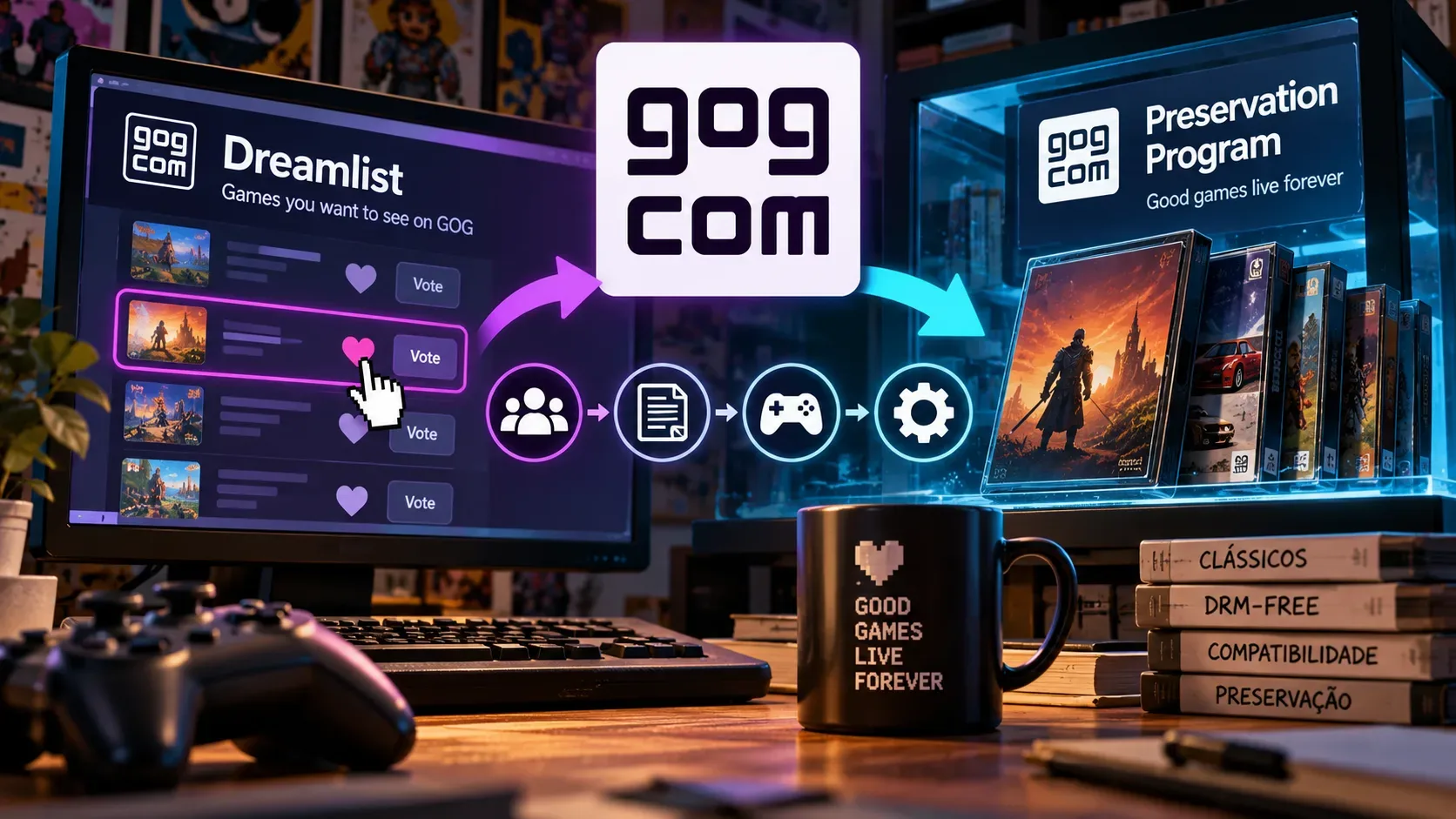
No. Voting for a game on GOG Dreamlist does not guarantee that it will return to sale, nor does it set a release date. Votes signal community interest and can help GOG in discussions with rights holders. The GOG Preservation Program addresses a different task: testing, improving, and maintaining selected games so they remain playable on modern computers. A game can arrive in the store without automatically receiving the preservation label.
How to request a game through GOG Dreamlist
Dreamlist is a free community request tool. Start by searching for the game's name on the official page. If it is already listed, you can vote from the main page or its individual entry; if not, GOG provides a form to suggest adding it to the list. You may vote for multiple titles, but only once per game.
Requests can also collect players' stories about what those games mean to them. These are signals of cultural and commercial interest, not preorders, signed agreements, or release confirmations. GOG's FAQ explicitly explains that a high vote count can influence discussions with intellectual property owners, but it does not ensure that the most-requested title will arrive first, or that it will reach the catalog at all.
From a request to a rerelease: what are the steps?
The sequence below organizes the roles described by GOG. It is not an automated queue that every game is guaranteed to complete.
- Community request: players find a title, suggest it for Dreamlist if necessary, and vote. This helps demonstrate interest.
- Discussions with rights holders: GOG can use that interest to make a case for offering a game. Where distribution requires third-party permission, negotiations remain separate from the vote itself.
- Possible store release: if the commercial and release work succeeds, the game may become available through GOG in DRM-free form, allowing customers to download and keep offline installers. A vote alone confirms neither the date, the edition, nor completion of this step.
- Possible Preservation Program entry: to receive the label, the edition must pass GOG's quality tests, with fixes applied when needed. The company then undertakes ongoing compatibility maintenance and technical support for that included game.
Two distinctions matter: a request may never lead to a release, and a GOG release does not require immediate entry into the Preservation Program. GOG also says it cannot disclose a game's commercial negotiation status before release because those discussions are complex and sensitive.
What is the difference between DRM-free and preservation?
DRM-free availability means providing a game without a mandatory digital license check to run it, allowing a purchaser to keep an offline installer. That reduces dependence on a store client, but it does not automatically resolve every future operating-system compatibility issue.
Joining the GOG Preservation Program adds an explicit technical commitment. GOG says it verifies the quality of the edition, makes adjustments where needed, and works to maintain compatibility with popular PC configurations as technology changes. Its FAQ tells customers who encounter problems to contact technical support so the team can investigate and address them.
| Status | What it means | What it does not guarantee |
|---|---|---|
| Game on Dreamlist | The community has requested and voted for it. | An agreement, a date, or a rerelease. |
| Game for sale on GOG | A DRM-free edition is available, with an offline installer that can be kept. | Automatic entry into the preservation program. |
| Game bearing the Preservation Program label | GOG commits to testing, compatibility maintenance, and support for that edition. | Operation on every system or the complete absence of problems. |
GOG describes the program as currently limited to Windows. This should not be read as a promise of program-level support for macOS or Linux. The company also explains that games outside the program are not necessarily inferior: some may be waiting for assessment despite already being sold in the store. It further says that titles delisted from sale remain covered by its preservation commitment, which does not mean new customers can still buy them.
Are there documented examples of games returning and being preserved?
Yes, but real successes do not turn voting into a guarantee. In a press release dated February 2, 2026, GOG said 312 games joined its catalog through Dreamlist during 2025. Separately, the company reported 267 games entering the Preservation Program across 2024 and 2025. Those figures use different timeframes and definitions, so they should not be treated as two totals for the same group.
The announcement names Dino Crisis 1 and 2 and Breath of Fire IV as examples of games that arrived on GOG and entered the program immediately. These are documented cases of the two initiatives coming together. They do not establish that any particular vote was decisive or that every pending request will have the same outcome. Vote figures published by GOG measure Dreamlist participation, not Google search volume.
How to check the status of the game you want
First, look up the title on Dreamlist to vote or suggest adding it. Next, check whether there is an actual purchase page on GOG rather than treating the number of votes as release confirmation. If an edition is for sale, consult the Preservation Program page to see whether it is among the labeled games. These are three distinct statuses: request recorded, game available for purchase, and maintenance certified under the program.
The practical answer remains unchanged: voting may help open the door, but it does not oblige GOG to rerelease the game. Preservation adds a compatibility commitment only for titles accepted into the program, under the criteria and limitations GOG has published.