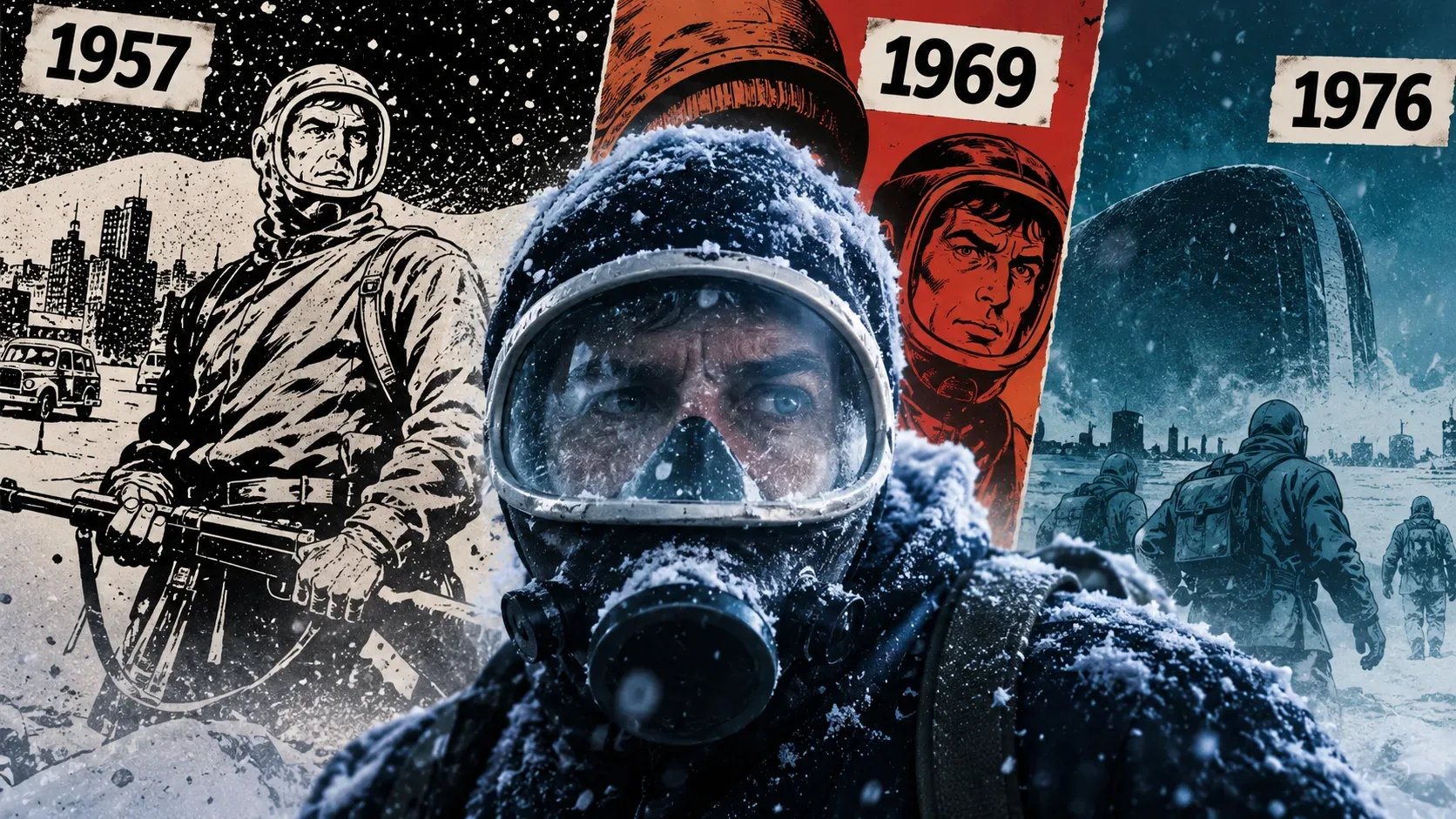
There are not three equivalent versions of El Eternauta. The comic serialized from 1957 to 1959 is the original story, written by Héctor Germán Oesterheld and drawn by Francisco Solano López. In 1969, Oesterheld retold it with Alberto Breccia, radically changing the visual language and making its political criticism more direct. El Eternauta II, which began in 1976, is a sequel, again drawn by Solano López, not a third remake.
Comparing the works means separating their plots, publication histories and the Argentine circumstances in which their creators worked. The years 1957, 1969 and 1976 mark the start of each publication, not the release of three completed books in those individual years. This comparison concerns the comics themselves, not their television adaptation.
1957, 1969 and 1976: which three works are we talking about?
| Publication | Creators and original venue | What it is | Main distinction |
|---|---|---|---|
| 1957 to 1959 | Héctor G. Oesterheld and Francisco Solano López; Hora Cero Semanal | Original story | A survival adventure built around collective resistance in Buenos Aires |
| 1969 | Oesterheld and Alberto Breccia; Gente magazine | New version of the original story | Expressionist art and more direct political criticism; shortened serialization |
| 1976 to 1978 | Oesterheld and Solano López; Skorpio publications | Sequel, El Eternauta II | A new period of the story, a transformed Juan Salvo and a more radical political tone |
In a study listed in the CONICET repository, Laura Cristina Fernández and Sebastián Horacio Gago distinguish the first part (1957 to 1959), the 1969 reinterpretation and the second part (1976 to 1978). This distinction prevents a common mistake: treating Breccia's version as a necessary middle chapter in Juan Salvo's continuing adventure.
1957 to 1959: an invasion seen through ordinary people's eyes
Oesterheld and Solano López first published the story in Hora Cero Semanal, a magazine from Editorial Frontera. It begins with deadly snowfall in Buenos Aires that catches Juan Salvo, his family and his friends off guard. They improvise ways to protect themselves, and survival gradually becomes resistance against an extraterrestrial invasion.
The recognizable city, its neighborhoods, everyday objects and Solano López's figurative drawings make the disaster feel tangible. Rather than a superhero solving every problem alone, the narrative depends on shared knowledge, cooperation and choices made by ordinary people. Historian Hernán Comastri identifies this as the construction of a collective hero.
The first El Eternauta already supports political readings, particularly in the light of the Cold War and Argentina's internal conflicts. But describing a 1957 adventure as a literal prophecy of the dictatorship established in 1976 would erase its actual date and conditions of creation. A political interpretation should grow out of the comic and its historical setting, without pretending its author knew later events in advance.
1969: Breccia turns the same premise into a darker experience
The new version appeared in Gente magazine, with a script by Oesterheld and art by Alberto Breccia. This is not merely the old story with new drawings. Breccia traded the original's clear figurative style for bold contrasts, textures, collage and expressionist techniques, giving the threat a more abstract and oppressive quality. The script retains the central framework of the invasion while shifting its emphasis.
Specific spoiler for the 1969 version: this retelling reveals more directly and earlier that the major world powers have entered an agreement sacrificing South America to secure their own safety. That change, described by Acantilado and discussed by Comastri, makes the critique of imperialism more explicit. The backdrop was Argentina under Juan Carlos Onganía's military regime, while Oesterheld's political commitments were growing more militant.
Serialization was halted before the planned run was finished, resulting in a hurried ending. The reasons require some care: researcher Pablo Turnes, in his examination of the publishing dispute, gives decisive weight to readers' and editors' rejection of Breccia's experimental artwork, rather than claiming political censorship alone shut the series down. Its short run does not make it a sequel to the 1957 comic.
1976 to 1978: the sequel changes Juan Salvo and the meaning of resistance
Spoiler warning for El Eternauta II (1976 to 1978): the following paragraphs disclose Juan Salvo's situation and the sequel's broad narrative structure, but do not give away its complete ending.
Oesterheld reunited with Francisco Solano López on El Eternauta II. The AHIRA archive identifies its first installment in Skorpio Libro de Oro no. 2, dated December 1976; serialization continued through 1978. Thus, 1976 marks the beginning of the second part, not its completion.
According to Acantilado's account, the action moves to a post-apocalyptic Buenos Aires some two hundred years after the events of the original. Juan Salvo has been changed by his travels through time, acquiring extrasensory abilities and a colder, more messianic attitude. The story returns to the struggle against extraterrestrial rulers and follows survivors organizing against oppression.
The form of heroism shifts too. Where the first adventure celebrates ordinary people working together, the sequel invests greater authority in Salvo and makes him more exceptional. Oesterheld himself becomes a more active figure inside the fiction, amid jumps through time and a comic book nested within another comic book. Comastri interprets this as a partial move away from the original collective-hero model, not a straightforward repeat of it.
Historical precision matters here as well. The sequel began publication in the year of Argentina's March 1976 military coup. Oesterheld wrote some scripts while living underground and was abducted and forcibly disappeared by the dictatorship in 1977; all four of his daughters were also victims of forced disappearance. That background makes the sequel's political meaning particularly significant, but does not justify declaring every fictional character a documented stand-in for a real individual.
What really changed, and in what order should you read them?
The 1957 to 1959 work draws its strength from a group learning to survive and resist together. The 1969 retelling gives that same narrative foundation a markedly different aesthetic and more explicit political accusations. From 1976 to 1978, the story actually moves forward, but with a new setting, a different Juan Salvo and sharper tension between individual leadership and collective struggle. Those changes reflect artistic choices and Argentina's changing political circumstances, without making the comics simple one-to-one accounts of historical events.
For narrative continuity, read Oesterheld and Solano López's original first and then El Eternauta II. The 1969 version works as a comparative reinterpretation after the original, but it should not be inserted between the two parts as though it were a bridging episode. Collected editions may carry different years on their covers; the dates above refer to the comics' initial serialization.
Sources and references
- Acantilado: overview of the three works and their creators
- Modernismo Latinoamericano: Hernán Comastri's study of El Eternauta
- AHIRA: contents of Skorpio Libro de Oro no. 2, December 1976
- Pablo Turnes: El affaire eternauta o los límites de un lenguaje
- CONICET: study of the saga's models of society and discourse
- Escotilha: interview with researcher Fabio Bortolazzo