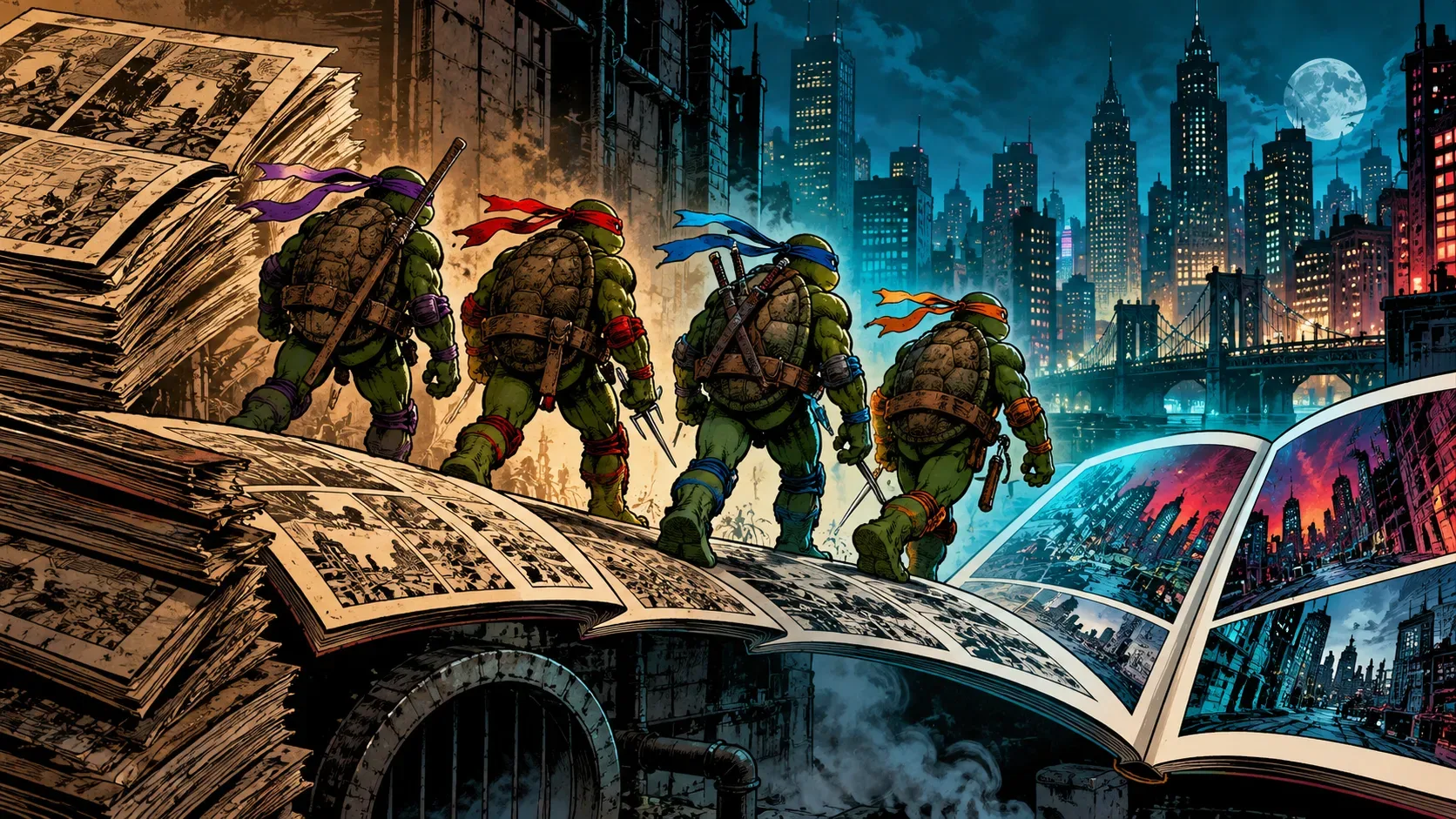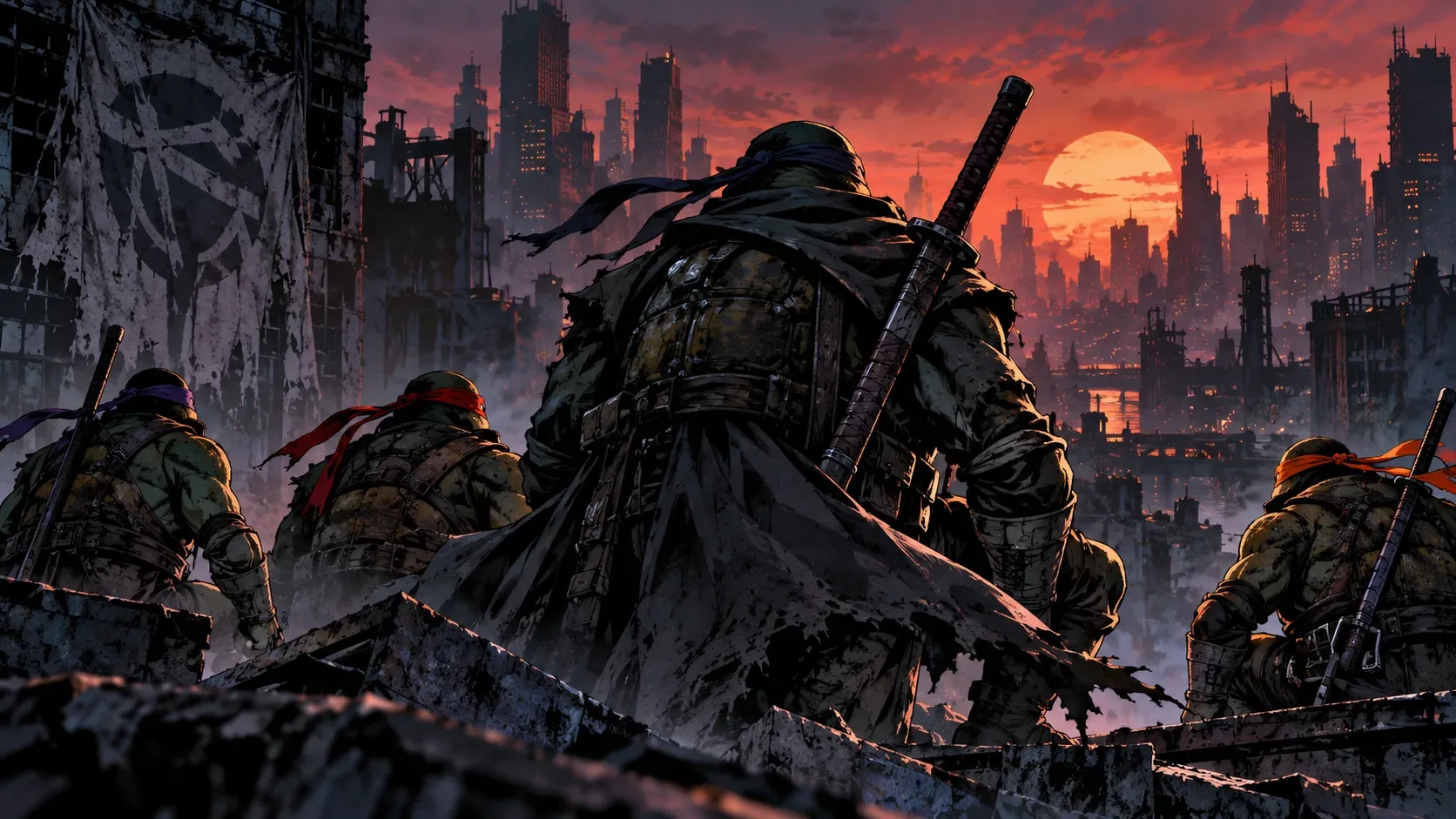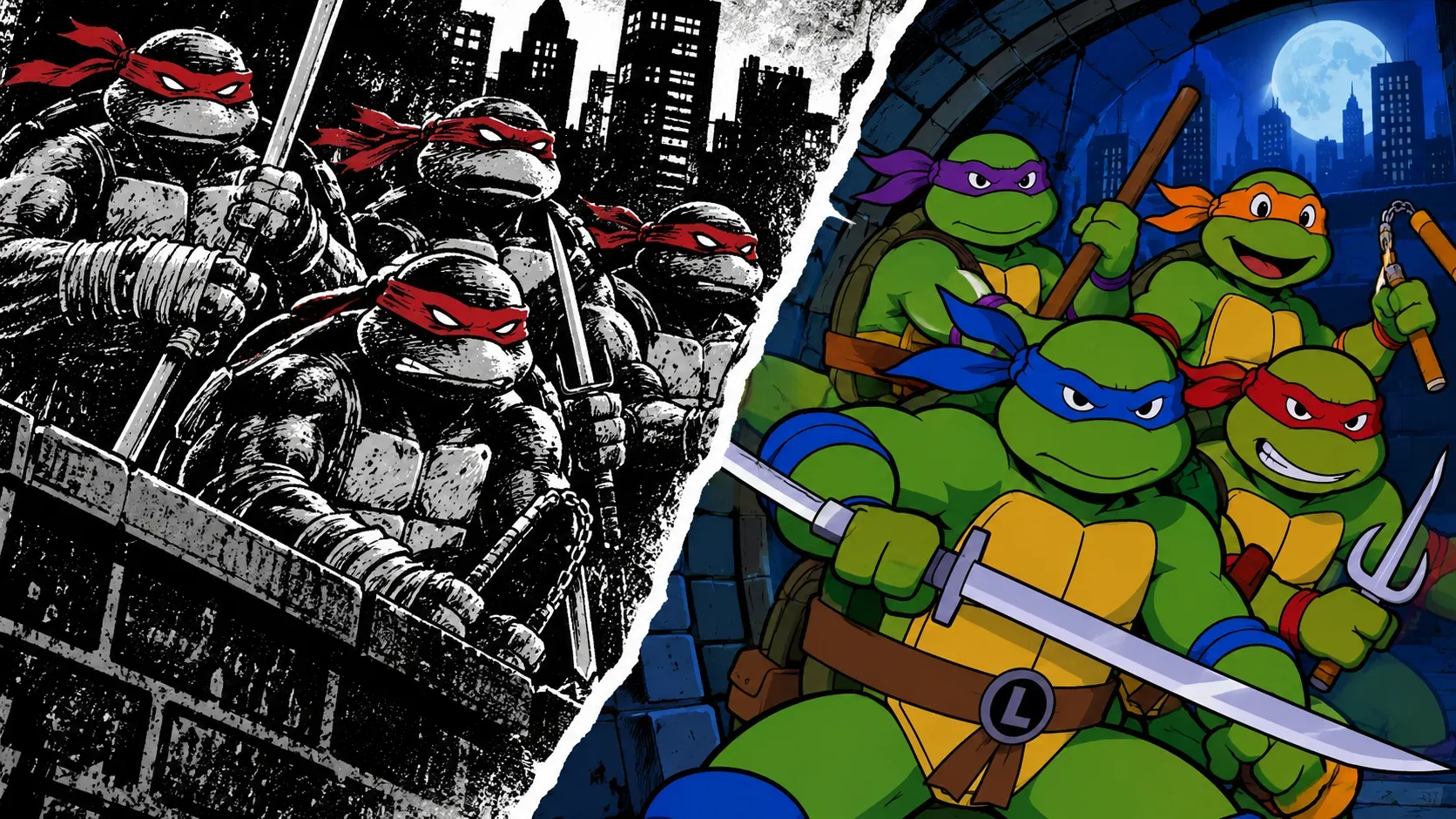
All four Teenage Mutant Ninja Turtles wore red bandanas in the color artwork of Kevin Eastman and Peter Laird’s original comics, which began in 1984. Individual colors became familiar through the 1987 animated series: blue for Leonardo, purple for Donatello, red for Raphael, and orange for Michelangelo. The documented reason for the change was to make each Turtle easier to identify on television and as a toy, not to assign a proven psychological meaning to each color.
What did the bandanas look like in the 1984 comics?
Mirage Studios published Teenage Mutant Ninja Turtles #1 in May 1984. Its interior pages were black and white, while the cover used red. In early color depictions, all four bandanas were red. Saying the original masks were red does not mean every page of the comic was printed in color.
In Kevin Eastman’s interview with Gary Groth, originally published by The Comics Journal in 1998, the cocreator recalled that even the series’ first fully colored cover, for issue #5, showed red bandanas, green skin, and yellow chest plates. Mirage’s catalog dates that issue to October 1985. Readers primarily distinguished the brothers through their weapons, dialogue, and actions: Leonardo’s swords, Donatello’s staff, Raphael’s sai, and Michelangelo’s nunchaku.
Peter Laird explained on his blog that the black-and-white format reflected both a limited budget and the creators’ appreciation of black-and-white comics. Nothing in the statements reviewed establishes that red was originally selected to symbolize anger, unity, or a shared psychological trait.
What changed when Playmates and animation entered the picture?
As the toy line and cartoon were developed in 1986 and 1987, Playmates Toys wanted characters that children could recognize instantly. The comics had been aimed at older readers; the adaptation softened the violence and adjusted the look for younger viewers. The toy company was involved alongside the two creators and the animation operation associated with Fred Wolf.
Distinct bandana colors addressed a practical problem: when all four Turtles appeared together, viewers and buyers should not need to recognize their weapons to tell them apart. Initials on the belts reinforced those distinctions. Eastman also recalled a suggestion to use different shades of green, an approach he considered impractical for toys and animation.
The timing clears up a frequent misunderstanding. According to Eastman’s 2022 interview, the cartoon’s first five episodes aired at the end of 1987, while the initial toys reached stores in June 1988. The multicolored designs were therefore developed for the joint animation-and-merchandising project, rather than appearing in a 1987 comic that retroactively replaced the original red bandanas.
Who proposed the colors? Eastman and Laird remember it differently
In his 1998 Comics Journal interview, Eastman said the commercial team asked how to make the Turtles easier to distinguish, and he credited Peter Laird with proposing differently colored bandanas and lettered belt buckles. Eastman repeated that account in an interview with Brian Howe for INDY Week in March 2018.
Laird, however, wrote in August 2012 that the idea of giving the Turtles different colors came from either Playmates or the animation studio. When a reader pointed out Eastman’s earlier statement, Laird acknowledged that his partner’s memory might be right, while clarifying what he remembered most clearly: the need to distinguish the characters had never arisen while they were drawing the comics. It emerged during discussions with Playmates.
These accounts do not establish a single indisputable author of every part of the change. Together, they support a commercial need for greater visual distinction and a particular solution that Eastman attributes to Laird, although Laird could not firmly recall proposing it. Giving sole credit to Fred Wolf, Playmates, or either cocreator would overlook that distinction.
Why blue for Leonardo, and why did Raphael keep red?
The 1987 cartoon established the familiar arrangement: Leonardo in blue, Donatello in purple, Michelangelo in orange, and Raphael in red. Raphael’s retention of the original red is visible in the adaptation, but the specific reason behind that assignment is not demonstrated by the statements examined.
In February 2012, Laird said he did not remember any discussion matching colors to the Turtles’ personalities. He allowed that Playmates or Fred Wolf’s studio might have discussed it without his recollection. In August, he again said he could not recall a decisive rationale for assigning individual colors. Claims such as red representing Raphael’s anger, blue representing Leonardo’s leadership, or orange representing Michelangelo’s sense of humor may be interpretations of the finished designs, but they are not confirmed original intentions.
What does the change tell us about the two versions of TMNT?
The difference between 1984 and 1987 reflects a shift in medium and audience. In the independent comics, the creators could distinguish the brothers through art and storytelling; in animation and toys, colors and initials offered immediate recognition. Eastman and Laird participated in the adaptation discussions while the original comic line retained its red-bandana identity. A design solution for the cartoon became the franchise’s best-known look without erasing the one it started with.
Sources and references
- Mirage Studios: Teenage Mutant Ninja Turtles #1 (1984)
- Mirage Studios: Teenage Mutant Ninja Turtles, Volume 1
- The Comics Journal: Gary Groth interviews Kevin Eastman (1998; online 2012)
- INDY Week: Brian Howe interviews Kevin Eastman (2018)
- Peter Laird: Ask PL #7 (February 2012)
- Peter Laird: Ask PL #10 and comments (August 2012)
- The Comics Journal: Jason Bergman interviews Kevin Eastman (2022)