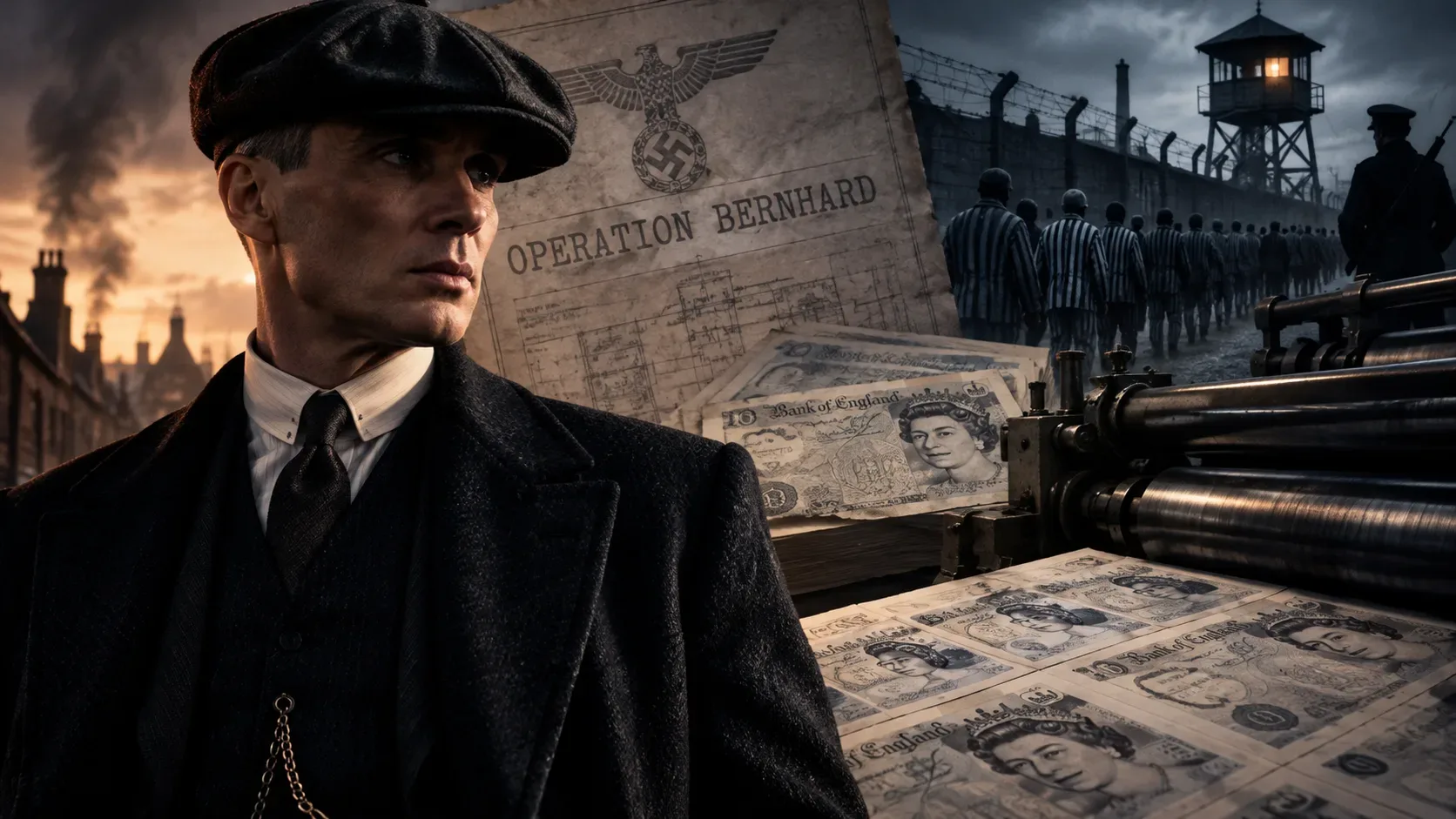
Operation Bernhard was real. During the Second World War, Nazi Germany used the forced labour of Jewish prisoners to counterfeit British pound notes, seeking both to undermine the British economy and to finance intelligence activities. In Peaky Blinders: The Immortal Man (2026), that historical operation provides the basis for a fictional plot involving Tommy Shelby. Tommy Shelby did not exist, and the Shelby family's involvement in the operation is fictional.
Minor spoiler warning: the following sections identify the antagonist's scheme and Duke's involvement, but do not reveal any character's fate or the film's ending.
Andreas came before Bernhard: the timeline the film compresses
The Bank of England Museum separates the project into distinct phases. The idea of flooding Britain with counterfeit money emerged in 1939; the initial plan, known as Operation Andreas, began taking shape around 1940. According to a transcript of a museum presentation, trials took place in 1941, including notes submitted to Swiss banks. The initiative subsequently lost support before it was revived in 1942 under SS officer Bernhard Krüger, this time as Operation Bernhard.
That distinction matters because Netflix's official synopsis places the film in Birmingham in 1940. By connecting that setting to counterfeiting at Sachsenhausen and the fully developed scheme, the story brings the early Andreas phase closer to the Bernhard phase documented from 1942 onward. It would be misleading to describe all of these stages as one fully established operation in 1940.
The forced labour at Sachsenhausen was real
The counterfeiting centre under Krüger operated at Sachsenhausen concentration camp near Berlin, not at a secret enterprise run by British gangsters. The Bank of England Museum documents a group of 142 Jewish prisoners selected for their skills in printing, engraving, graphic design and banking. They were captives compelled to work for the regime that persecuted them.
To reproduce £5, £10, £20 and £50 banknotes, the prisoners examined security features, engraved the Britannia image, replicated the paper and watermarks, and artificially aged the finished notes. The museum says they identified around 150 security marks. Technical success must not be mistaken for voluntary participation: the work was carried out under threat, and the prisoners themselves attempted to delay production, according to the museum's historical talk.
One of the survivors was Adolf Burger, a Slovak Jewish printer who later described his experience in a book. His account restores the victims to a story that an action film might otherwise frame primarily as a suspenseful question of who will distribute the money.
Was the goal to destroy the pound or to fund espionage?
Both aims existed, but at different stages. The original scheme envisaged scattering vast quantities of fake banknotes across Britain, including from aircraft, to undermine confidence in sterling. That mass distribution never happened as planned. In the Bernhard phase, the Bank of England's documentation highlights a more immediate use: paying intelligence agents and purchasing gold and other supplies with counterfeit currency.
The film revives the threat of flooding the British economy with forged notes and turns their distribution into a mission involving fictional characters. Netflix describes John Beckett, played by Tim Roth, as a Nazi sympathiser seeking to circulate fake pounds; Duke Shelby, portrayed by Barry Keoghan, becomes involved. Their connection to the Peaky Blinders network is a screenplay device, not a finding from historical records.
What actually happened to the counterfeit notes?
In 1943, a forgery that had passed through a British bank in Morocco was detected because it reused the serial number of a note already withdrawn from circulation. The Bank of England explains that the counterfeiters reproduced the paper and printing convincingly but never cracked its numbering system. In response, the bank withdrew notes with denominations above £5 from circulation.
In the final months of the war, the prisoners were transferred to Austria and freed by US forces on 6 May 1945. The museum records accounts of banknotes and printing plates being discarded in Lake Toplitz, while distinguishing those reports from uncertain estimates of the overall sums involved. The operation created a serious banknote-security problem and prompted banking measures; it did not bring about the collapse of Britain's economy envisioned by Nazi planners.
What does The Immortal Man invent?
The historical facts are the counterfeiting programme, its use of forced labour, the covert circulation of notes and the Bank of England's response. The dramatic invention lies in making Tommy, Duke and Beckett key players in the distribution and the struggle over the money. Steven Knight told Radio Times that he used this historical episode as a starting point to imagine the involvement of criminal organisations. Guy Walters's reporting in The Independent likewise separates the genuine scheme from the film's fictional resolution.
The more useful question, then, is not whether Peaky Blinders literally reconstructs Operation Bernhard, but which real mechanisms the script relocates into the Shelbys' invented story. The forged currency and its victims are documented history. The Shelby family's role is fiction, and the merging of 1940 and 1942 is best understood as dramatic compression rather than a historical timeline.
Sources and references
- Bank of England Museum: Operation Bernhard (Alison Cook, 26 January 2024)
- Bank of England Museum: transcript of the historical talk
- Netflix Tudum: film information (20 March 2026)
- Netflix Tudum: plot discussion and Operation Bernhard (20 March 2026)
- Netflix Tudum: character guide (20 March 2026)
- Radio Times: Patrick Cremona, historical inspiration (6 March 2026)
- The Independent: Guy Walters, historical investigation (16 March 2026)