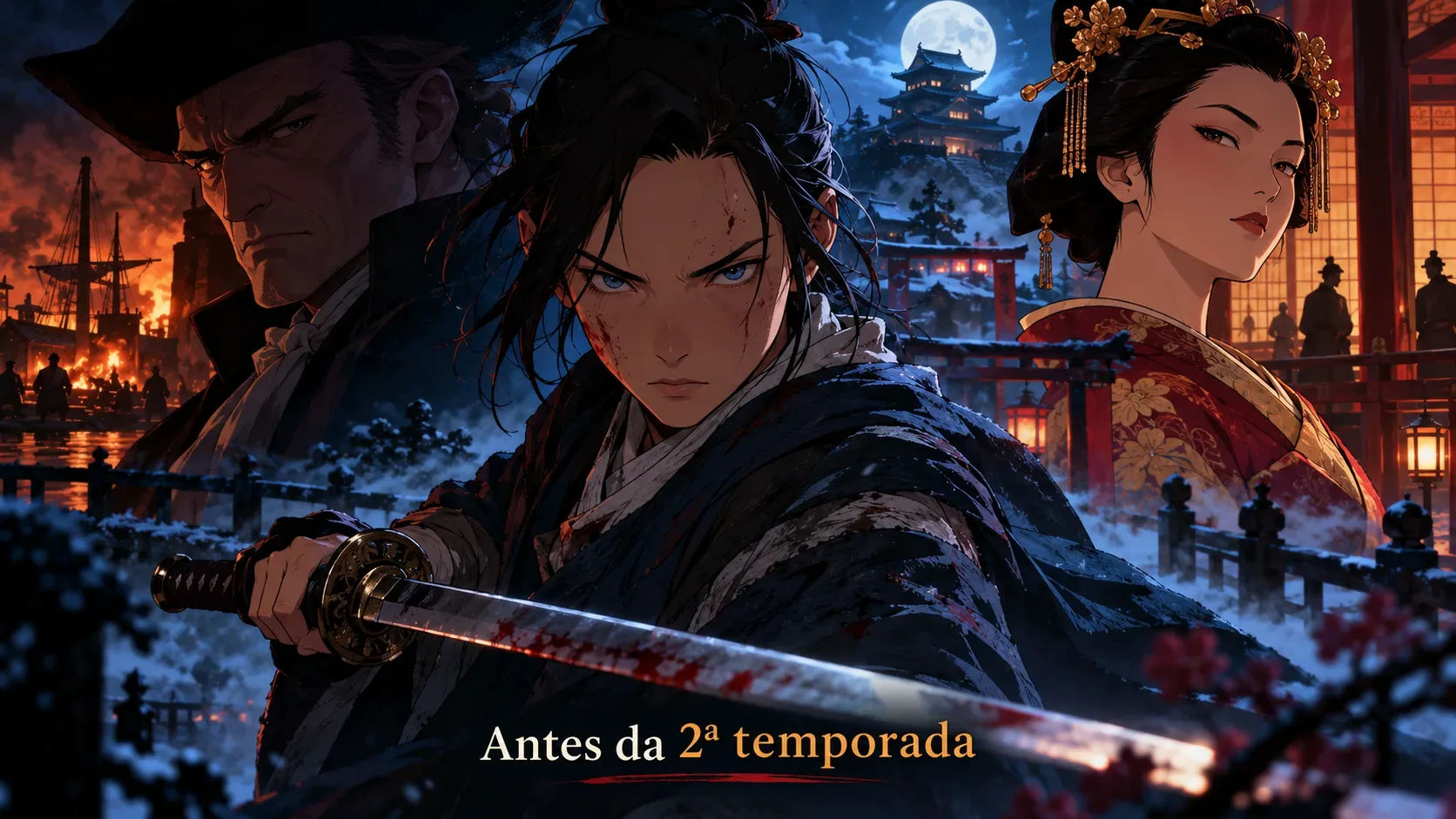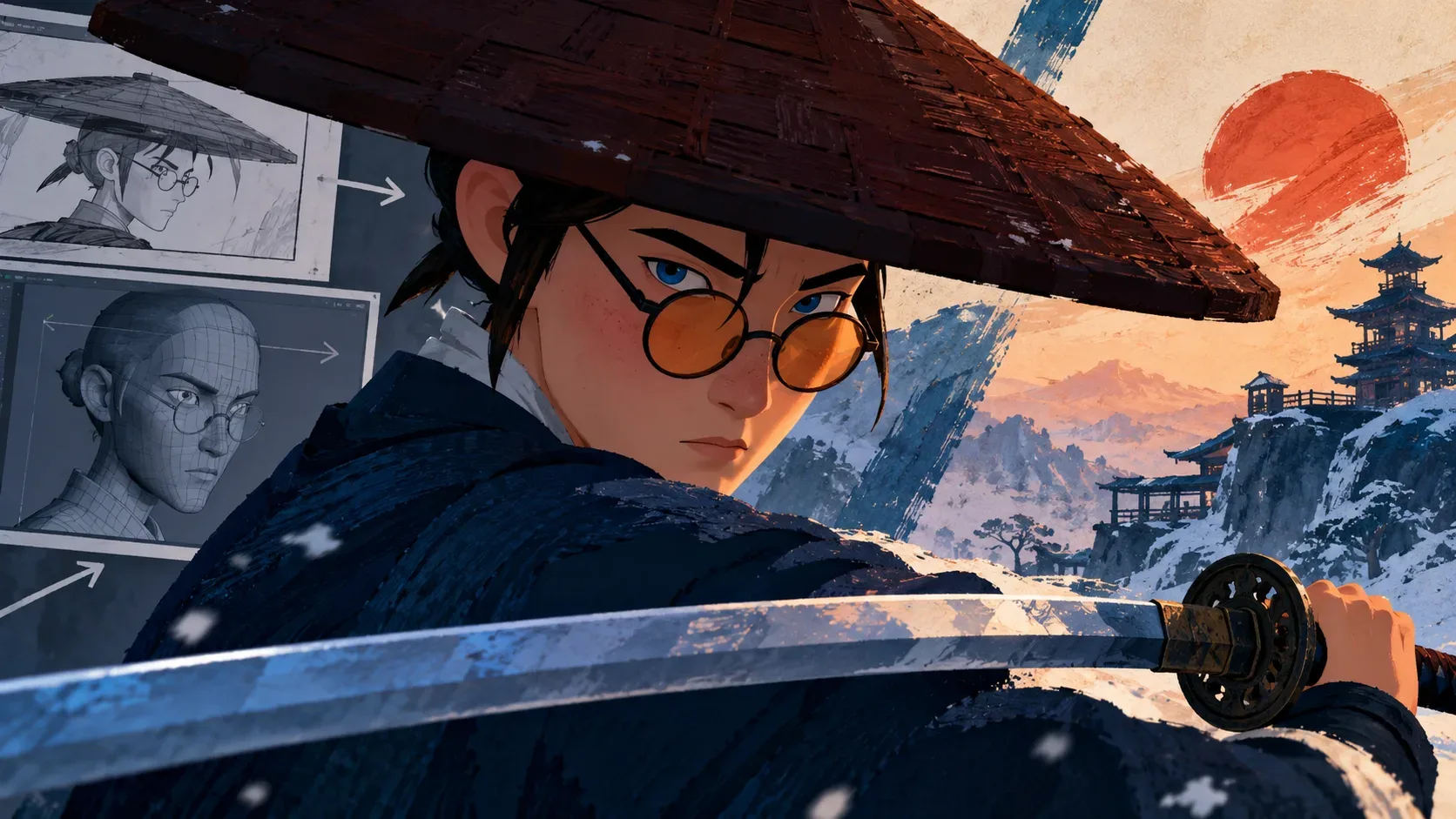
Blue Eye Samurai achieves a hand-drawn 2D appearance without abandoning a three-dimensional foundation. French-Canadian studio Blue Spirit built and animated the production using 3D tools and a proprietary visual treatment designed to give the resulting images a 2D aesthetic. This made it possible to stage environments, cameras, and movement in space while retaining the impression of artist-made illustrations. Blue Spirit executive Olivier Lelardoux outlined that approach in an interview published by France’s CNC on July 24, 2024.
The visual direction did not originate with the animation studio alone. The Netflix series was created by Amber Noizumi and Michael Green, with Jane Wu serving as supervising director and producer, while Blue Spirit handled the animation production. Separating the people who shaped the visual language from those who brought it to the screen is essential: the finished look was not simply a filter placed on standard 3D images.
What does hybrid 2D and 3D animation mean here?
The key difference is between how a shot is built and how it ultimately looks. In an account of a team presentation published by DNEG Animation on May 28, 2024, supervising director Jane Wu and production designer Toby Wilson explained that the environments were built in 3D during pre-production but presented with a 2D look in the finished series. Wilson emphasized the freedom to move a camera through a three-dimensional space, much like shooting live action.
That does not mean every frame was hand-drawn, or that the studio merely flattened completed models. The 3D environment supplied volume, positioning, and depth for staging; the two-dimensional impression came from the design, performance, and rendering choices. In Netflix’s account, Michael Green described the approach as a hybrid of 2D and 3D technologies intended to feel handcrafted even when the underlying process used 3D.
Previsualization, camera work, and fights before the final image
Netflix reports that the production used previsualization, stunt visualization, and wardrobe departments, tools also associated with live-action filmmaking. The three-dimensional stage helped the team explore framing and the placement of characters within environments before the final stylized presentation. A camera free to move through a virtual set helps explain the cinematic staging, but it does not by itself disclose the exact programs or settings behind individual shots.
The fights also connected live performance with animation. According to a Netflix Tudum report dated November 10, 2023, stunt choreographer Sunny Sun planned the action, filmed stunt performers carrying it out, and cut that footage into the storyboard. Animators could then follow the timing and connections between movements. This documents filmed reference and planning, not proof that the entire series was made with motion capture.
Lelardoux’s CNC interview adds another step: the studio studied samurai movement, weapon handling, fighting gestures, and the way kimonos deform during combat. Members of the American teams even brought swords and kimonos to Angoulême to demonstrate details to animators. Those observations informed how the characters were performed within the animation workflow.
How did the 3D work acquire an illustrated finish?
Lelardoux said Blue Spirit developed a specific 3D process to deliver 2D-style renderings. The studio had already explored a related look in productions such as The Mysterious Cities of Gold and episodes of What If...?, but pushed the quality further for Blue Eye Samurai. The CNC confirms the broad technical approach without publishing a shot-by-shot breakdown of materials, shaders, rendering passes, or any painting interventions.
The artistic intention is more clearly documented. Jane Wu told Netflix she did not want to simply reproduce the look of conventional anime, video games, or the familiar computer-animated style of major family-animation studios. She pointed to Japanese bunraku theater puppets as an influence on the character designs. At the DNEG presentation, Wu also spoke about wanting the artist’s hand to remain visible in every shot.
So saying that 3D was made to look 2D describes the intended effect, not a single software filter. Interviews support the connection between digital volume, staging, movement, and graphic finishing; assigning a named custom shader, an exact application, or manual paintovers on every frame would go beyond the evidence available.
How was production divided across France, Canada, and the United States?
According to the CNC, Blue Spirit was responsible for part of pre-production and the entire animation production, from layout through delivery of finished shots prepared for color grading in Los Angeles. Management and part of pre-production were based in Paris. Most animation, modeling, and texturing took place in Angoulême, supported by the Montreal studio. This describes the production organization discussed in 2024, not an exhaustive task list for each shot.
The place where animation is produced should not be confused with cultural authorship. The creators and supervising direction shaped the narrative and visual language of a story set in Edo-period Japan; Blue Spirit teams in France and Canada helped turn that vision into animated images. Drawing on Japanese animation and art does not automatically make it a Japanese studio production, just as French production work does not override the creators’ decisions.
Why does the result feel drawn even though it was built in 3D?
Because the team used the spatial advantages of 3D without aiming for the standard look of computer-generated animation. Three-dimensional environments supported staging and camera movement; physical movement studies provided performance references; Japanese art influences and stylized rendering gave the images their painterly character. The documented point is how these production stages and teams worked together. The exact technical recipe for every shot has not been fully disclosed in the sources consulted.