Spoiler warning: the following summary reveals the entire story and ending of Scary Movie (2000).
At the end of Scary Movie (2000), Doofy is revealed to be the real masked killer. Bobby and Ray also plot an attack on Cindy, but admit they are imitating a murderer who is already active. This revelation comes after a concealed hit-and-run, a string of pursuits, and a confrontation in which the heroine believes she has defeated her attacker.
Directed by Keenen Ivory Wayans, the film turns the structure of a teen slasher mystery into a parody. This recap covers the 2000 movie, not its sequels. Events are reconstructed from published narrative accounts; it does not claim firsthand verification of every edit, alternate cut, or streaming version.
The earlier accident and Cindy's secret
One year before the main story, Cindy Campbell and her friends are involved in a hit-and-run during a drive after drinking. Instead of calling for help and clarifying what happened, the group decides to conceal the incident and throws the injured man into the water. He is later identified as David Keegan. This cover-up, rather than any proven act of revenge, establishes the initial suspicion.
When Cindy receives a threatening note indicating that someone knows what happened last Halloween, she links it to the death of Drew Decker, attacked by a hooded murderer at the beginning of the movie. Remembering the accident leads the friends to believe someone is punishing those involved for keeping it secret.
The killings and chases before the party
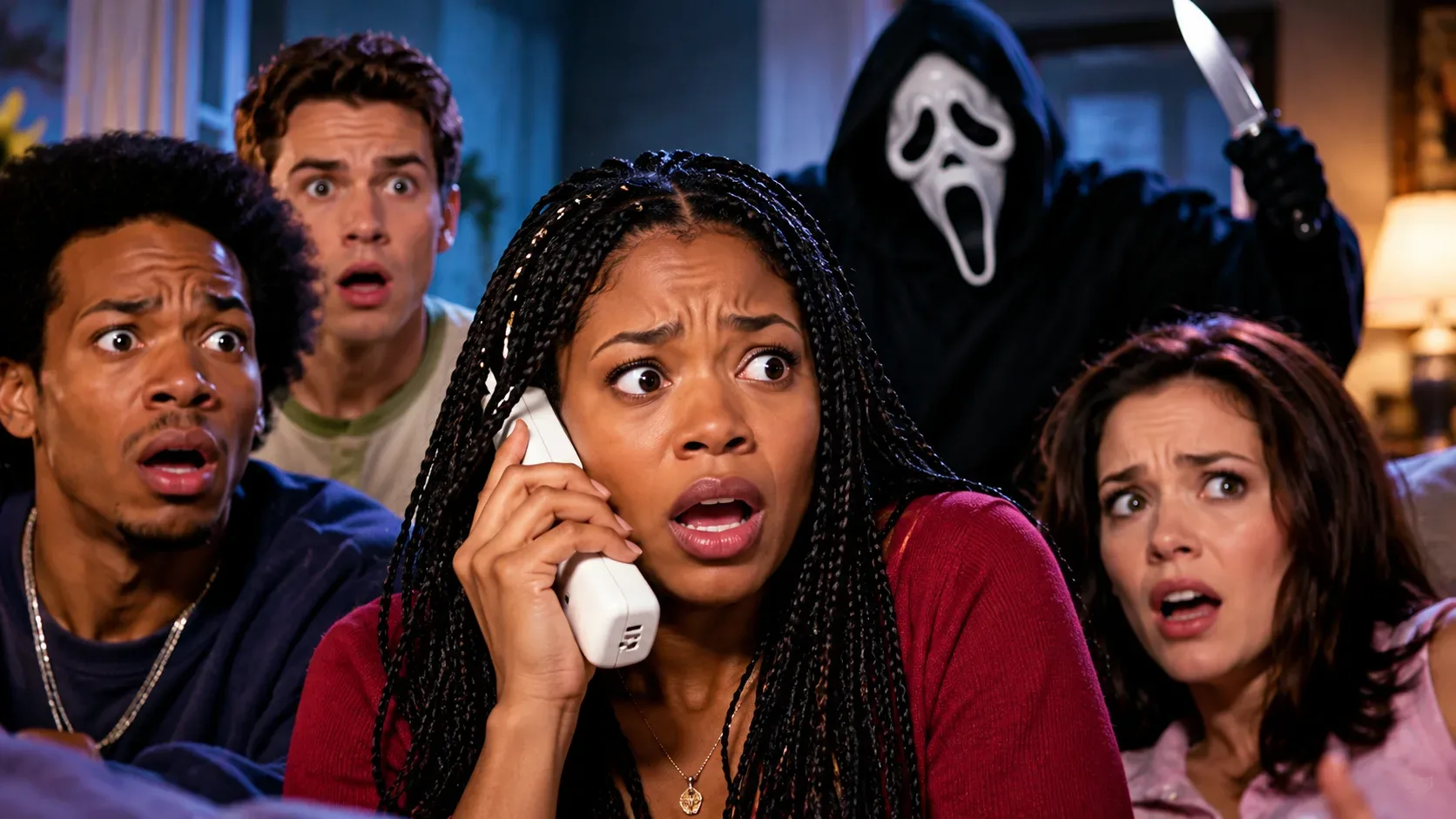
The killer uses a mask, a dark robe, and threatening phone calls, but the comedy changes the consequences of every encounter. Cindy's investigation is interrupted by suspicion, misleading clues, and people treating absurd events as perfectly ordinary.
- Drew Decker: receives a threatening call, runs from a masked figure, and is killed after a chase that establishes the parody of Scream.
- Greg: is attacked during a beauty pageant. Buffy sees the murder, but the audience mistakes her screams for part of her performance.
- Cindy and Bobby: Cindy fights off the attacker at home. Bobby arrives under suspicious circumstances, is taken into custody, and is no longer treated as the culprit when the threat continues.
- Buffy: is killed in the school locker room, in a sequence that exaggerates her dialogue and reaction even as she faces danger.
- Gail and Kenny: the reporter hunts for a sensational story; her cameraman Kenny dies after they approach the killer.
- Ray and Brenda: at the movie theater, Ray appears to be attacked in the bathroom. Brenda is killed by fellow moviegoers, irritated by her talking during the screening, rather than by the masked murderer.
The party at Cindy's house and the fake killers
Afraid to be alone, Cindy gathers classmates at her house. The killer blends into the chaos, even smoking with Shorty and his friends in the basement, while the party becomes a sequence of deaths and jokes. Cindy and Bobby go upstairs; when the chase resumes, Bobby appears to have been stabbed.
Shorty comes up to warn that people have been killed inside the house. Bobby, however, takes Cindy's gun and shoots him. Ray reappears alive, undoing the impression that he died at the theater. The apparent knife wound, Ray's return, and the gun expose a staged attack organized by the two young men.
Why aren't Bobby and Ray the real Ghostface?
Bobby and Ray tell Cindy that they are copying another murderer's crimes. Their plan involves attacking Cindy and her father and constructing a version of events that benefits them. Bobby combines his resentment over Cindy's reluctance to be intimate with a revelation about his involvement with Ray, who responds by denying the relationship.
Their alliance collapses when Ray repeatedly stabs Bobby. The comically petty reason he cites is the cancellation of The Wayans Bros., a joke about exaggerated explanations for violence in horror movies. Then the real masked killer appears and attacks Ray, making the distinction between the imitators and the earlier murderer unmistakable.
Cindy fights the attacker using moves borrowed from The Matrix and kicks him through a window. Because the body disappears before the police arrive, her apparent victory does not solve the mystery.
Who is Doofy, and how is he unmasked?
At the police station, Cindy and the sheriff reconsider who knew about the hit-and-run and could move around unnoticed. Suspicion falls on Doofy, Buffy's brother and a member of the local police. He had pretended to have cognitive impairments in order to seem harmless, and the twist identifies him as the person behind the masked attacks.
The sequence references the ending of The Usual Suspects: previously dismissed details suddenly come together as Doofy abandons his rehearsed mannerisms. He leaves with reporter Gail Hailstorm, and Cindy finds evidence of his discarded disguise too late to stop him. Gail's departure with Doofy is shown, but the film does not spell out exactly how much she knew about each crime.
David Keegan, therefore, is the misleading answer associated with the group's past; Bobby and Ray are the copycats; Doofy is the revealed identity of the principal killer. The story does not provide a complete psychological explanation for every choice Doofy makes.
Cindy's fate and the joke during the credits
After discovering the deception, Cindy screams in despair in the street and is struck by a car. It is one last reversal of expectations: solving the case does not earn her a heroic send-off. The movie plays the impact as a gag, without providing a definitive medical explanation of her condition at that instant.
During the credits, Shorty delivers what sound like rules for surviving a dangerous situation; the joke turns out to be a plan to grab goods from a store and run away. This scene extends the satire of horror-movie survival rules, but does not change the killer's identity revealed earlier.
Which movie parodies actually drive the plot?
The anonymous calls, the killer's costume, the teenage suspects, and the two false culprits mainly parody Scream (1996). The hidden hit-and-run and shared guilt recall I Know What You Did Last Summer (1997). The final fight borrows the visual language of The Matrix (1999), while Doofy's exposure follows the logic of The Usual Suspects (1995).
These references explain how the comedy works, but should not be confused with events from other films. In Scary Movie's own story, the answers remain clear: the secret is the hit-and-run, Bobby and Ray pretend to be the murderer, and Doofy escapes after his true identity comes to light.