Spoiler warning: this article reveals the ending of The Substance (2024).
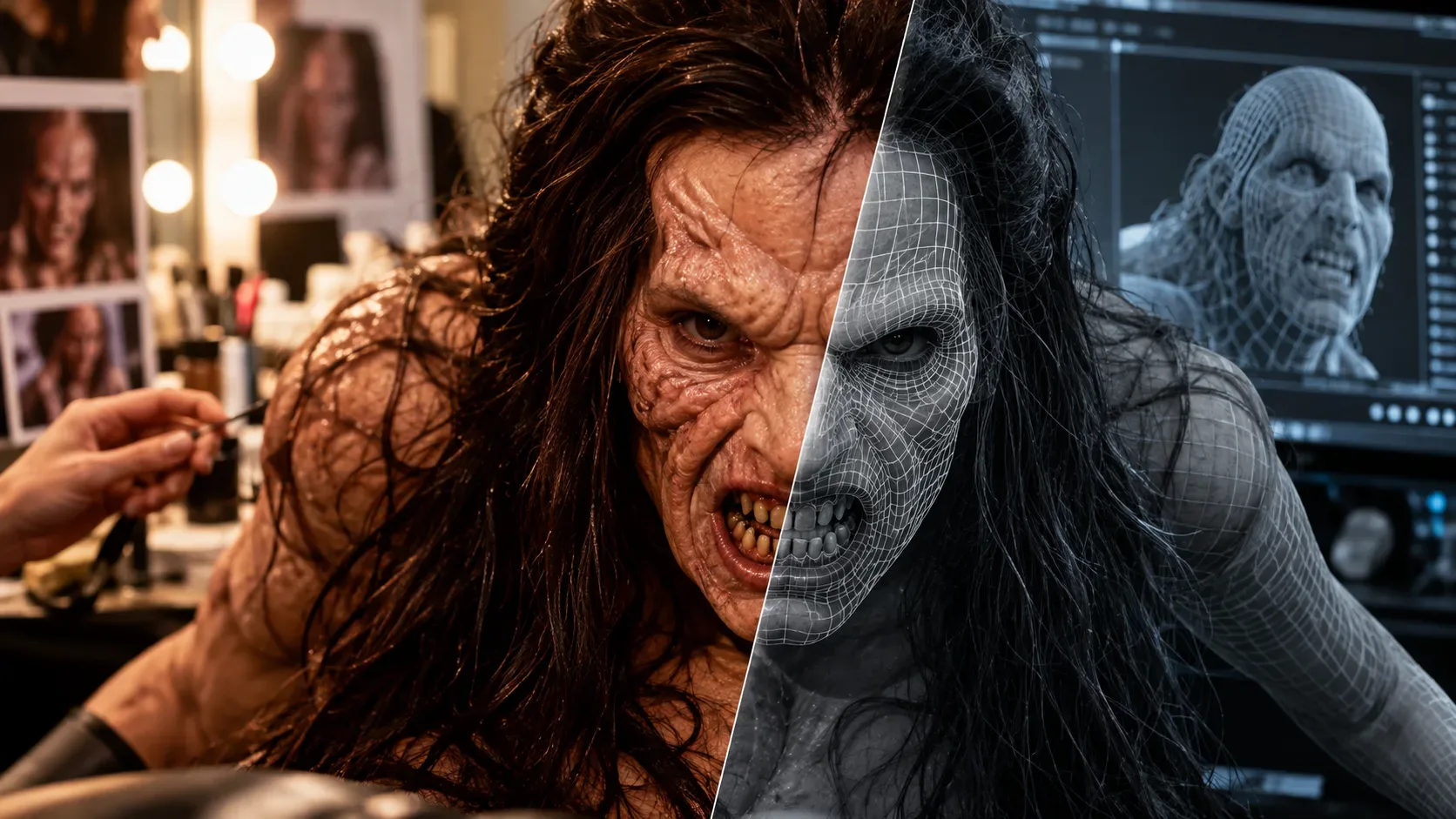
Monstro Elisasue in The Substance was neither an entirely practical makeup creation nor an all-CGI creature. Its distorted body, prosthetics, movements and much of the blood-soaked climax were physically made and performed. But Elisabeth Sparkle's face, played by Demi Moore, on the creature's back was created digitally using the actor's performance. The crawling mass seen at the very end likewise involved both an on-set puppet and substantial digital animation and compositing. The distinction comes directly from the filmmakers' accounts of their work.
Monstro's body existed in front of the camera
To turn the fusion of Elisabeth and Sue (Margaret Qualley) into something tangible, director Coralie Fargeat worked with Pierre-Olivier Persin, the film's prosthetic makeup effects designer. In interviews with Backstage and The Credits, he explains that Monstro's bulky suit was made from foam latex, whereas many other prosthetics in the film relied primarily on silicone. The awkwardly positioned limbs, additional breasts, fleshy shapes and asymmetric outline were parts of a physical build.
Someone had to wear and operate that creation. Persin says Margaret Qualley performed Monstro's close-ups, while stunt doubles handled wider shots. He even climbed inside the suit to manually move a protruding latex feature for one effect. The unstable movement of flesh was therefore not necessarily computer simulation: some of it came from people manipulating real materials on set.
The weight created genuine difficulties. During the bloody corridor sequence, a stunt performer had wheeled support underneath the dress because the suit and the force of the blood rig made walking difficult. Persin also explained that foam latex absorbed the liquid, requiring waterproofing, drying and repairs between takes. This was not simply a virtual creature inserted later.
Where CGI takes over: Elisabeth's face on the back
The most important exception is the face embedded in Monstro's back. The screenplay already called for Elisabeth's terrified face there, but a silicone head could not reproduce the subtle performance Fargeat wanted. According to Persin's interviews with CHAOS, The Credits and AwardsWatch, the eyes, mouth and expressions were handled through visual effects based on footage of Demi Moore.
Persin described photogrammetry using approximately 200 cameras to photograph Moore's face from multiple angles for a digital reconstruction. CGI was not there to replace the whole monster. Its job was to make a human performance appear trapped within a prosthetic surface. The physical build and digitally animated face share the same shot.
In a report by Scott Roxborough, originally published by The Hollywood Reporter and consulted through its Yahoo republication, visual effects supervisor Chervin Shafaghi describes another challenge: the virtual face needed to look as wet and thick as the real latex. His team at Noid studied the appearance of glycerine applied to the prosthetics and reworked the digital surface until it blended with the physical creature. Here, CGI had to reproduce the imperfections of a practical effect rather than smooth them away.
Blood and shot composition used both techniques
The climactic blood spray involved physical rigs and real liquid on set, but the finished shots also required digital intervention. Persin told AwardsWatch that green elements had to be removed in post-production. In The Credits, he described a stunt performer's actual arm positioned against a green VFX surface so that the shot could be treated later. Calling the blood entirely CGI would be wrong; claiming the final images needed no digital compositing would also overstate the practical approach.
An earlier scene, in which Sue emerges through Elisabeth's back, illustrates the same team's methods. Two silicone bodies were operated with cables and by hand from below a raised set to create the splitting-skin effect. Persin documented this puppetry. It should not be confused with the separate CGI work on Monstro's face, but it shows the production's preference for filming real materials wherever feasible.
What about the crawling face in the final scene?
The last mass, known to the crew as the Blob or Blub, is where digital work becomes more extensive. Persin told The Credits that his team built a silicone puppet, operated it using ropes and filmed a physical reference. Demi Moore's performance then had to be incorporated to convey crying, screaming and facial expressions that a puppet alone could not reproduce.
Shafaghi explained that the visual effects team scanned the puppet, developed digital movement, including keyframe animation, and worked with volumetric capture of Moore's performance. His account stresses that much of the Blob's final screen image was made on a computer, although its design and tactile reference came from the physical piece. These interviews describe different stages of a shared process, rather than contradictory versions of how the effect was made.
Practical or digital? A breakdown of the climax
| Element | Physical foundation | Documented digital work |
|---|---|---|
| Monstro's body | Foam-latex suit, prosthetics, performers and hand-operated movement | Adjustments and compositing in particular shots, with no evidence of wholesale body replacement |
| Elisabeth's face on the back | Prosthetic structure supporting the facial effect | Reconstruction and animation of Moore's performance, matched to the prosthetic texture |
| Blood and arm in the corridor | Blood rig, stunt performer and physical suit | Green-element removal and compositing |
| The final Blob | Silicone puppet built and operated on set | Extensive animation and compositing incorporating Moore's acting |
Speaking to CHAOS, Persin estimated that roughly 80% of the movie's effects were practical. That was a professional's approximation, not an audited shot-by-shot calculation for Monstro. The supported conclusion is more precise: The Substance used physical materials to give its horror volume, weight and texture, while crucial digital effects supplied Elisabeth's expressiveness and integrated elements that could not be completed in front of the camera alone.
Sources and references
- CHAOS: Gérard Delorme interview with Pierre-Olivier Persin, Nov. 9, 2024
- The Credits: Hugh Hart interview with Pierre-Olivier Persin, Feb. 19, 2025
- Backstage: Emma Fraser interview with Pierre-Olivier Persin, Feb. 5, 2025
- AwardsWatch: Daniel Bayer interview with Pierre-Olivier Persin, Nov. 20, 2024
- The Hollywood Reporter (via Yahoo): Scott Roxborough report featuring Chervin Shafaghi, Jan. 14, 2025