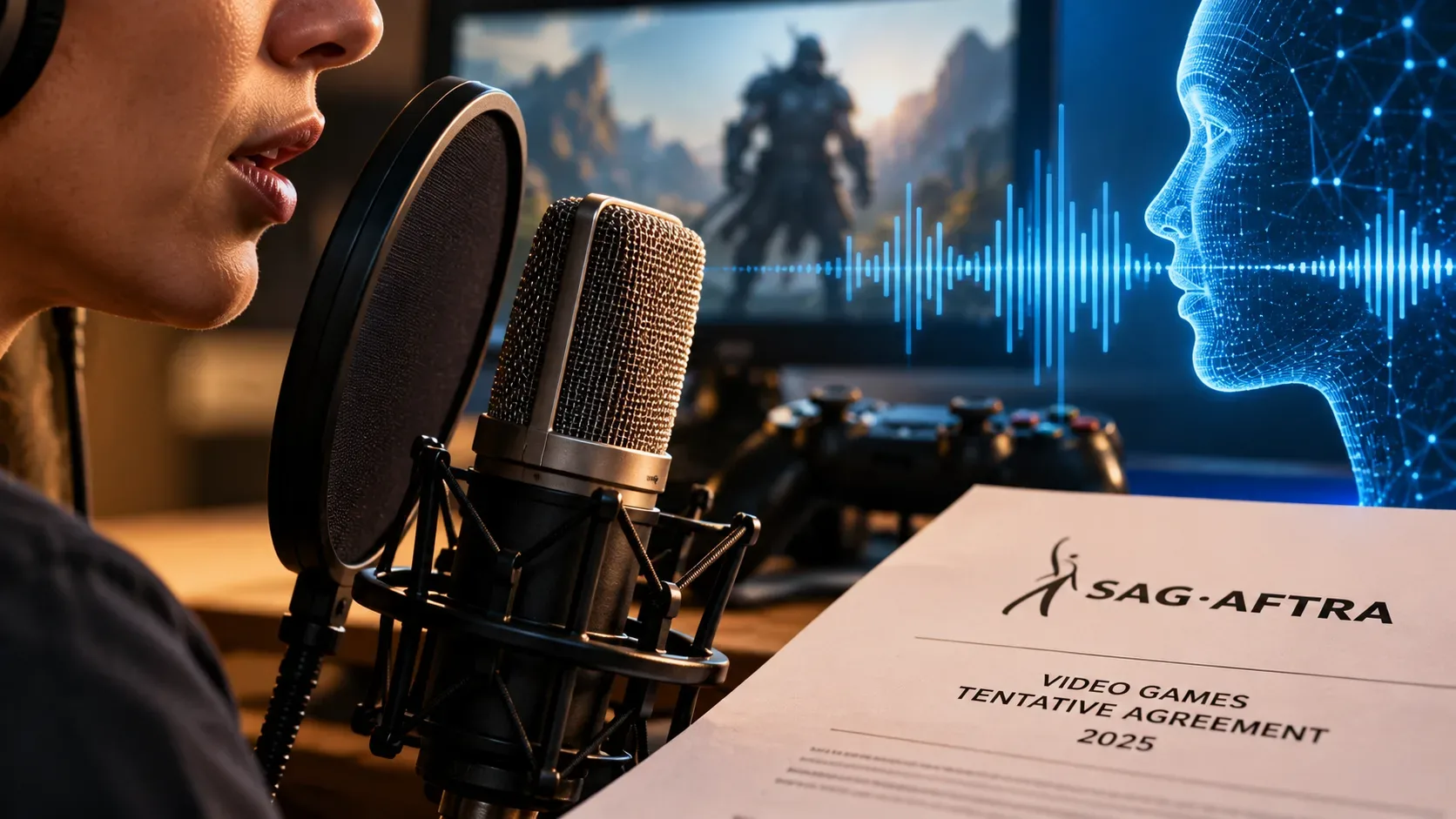
The strike by video game voice and performance-capture actors formally ended on July 9, 2025, when SAG-AFTRA members ratified a new agreement with game producers. Its main safeguard against AI-generated copies of performers' voices is a requirement for documented consent, disclosure of intended uses and compensation when a digital replica covered by the contract creates a new performance. That includes lines the actor never recorded.
There are boundaries: the deal distinguishes replicas built from contract-covered work from independently created replicas, contains explicit exceptions and applies to productions covered by the US collective bargaining agreement. It is not a worldwide law against voice cloning, nor does it automatically prohibit every synthetic voice in a video game.
How the strike ended and which work the deal covers
The strike was suspended on June 11, 2025. Ratification on July 9, with 95.04% voting in favor and 4.96% against, formally brought it to a close. The deal is the Interactive Media Agreement (IMA), negotiated with a group including Activision Productions, Electronic Arts Productions, Disney Character Voices, Formosa Interactive, Insomniac Games, Take 2 Productions and WB Games, alongside other companies identified by SAG-AFTRA.
The referendum materials place the agreement's term between November 8, 2022, and October 31, 2028. The new AI provisions apply prospectively from the first Sunday at least 90 days after employers receive formal notice of ratification. That timetable matters: the provisions should not be presented as an immediate, retroactive obligation covering every earlier recording.
Not every union gaming contract was replaced. Separate agreements for tiered-budget independent titles, independent localization, students and game jams retain their own terms. The interim agreement adopts the new IMA conditions for future work, without retroactively applying them to performances already completed.
Comparison: voice, likeness and real-time generation
Under the union text, a digital replica is not simply any computer-generated game character. The source material, objective identifiability as a particular performer and the purpose of the new performance all matter. Voice and visual uses are treated differently.
| Scenario | How the agreement defines it | Safeguard and limit |
|---|---|---|
| Employment-based vocal replica | A newly generated, identifiable voice of a specific performer, including in character, primarily built from recordings covered by the IMA. | Consent for creation and use, a reasonably specific description and a minimum payment linked to generated lines. Covers gameplay dialogue and cinematics. |
| Employment-based visual replica | A newly generated, identifiable visual performance derived from work covered by the IMA. | The visual-replica clause focuses on scripted cinematics. Reuse of visual work in gameplay may fall under separate secondary performance payments; those payments do not cover voiceover. |
| Independently created digital replica (ICDR) | A recognizable voice or likeness of a performer meeting the agreement's criteria, based on non-IMA material or an AI prompt using the performer's name. | Written consent is the rule, with compensation negotiated; exceptions cover supply by an authorized third party and certain uses protected by the US First Amendment. |
| Real-time dialogue generation | Dialogue dynamically produced by a vocal replica or ICDR in a public release of the game, rather than prerecorded lines. | The intended use must be disclosed. A minimum of 750% of applicable scale per replica per game applies, plus the specified bonus. Strike suspension is restricted once the replica is embedded. |
| Ordinary audio editing | Noise reduction, timing, speed, pitch, tone and similar adjustments. | These processing practices are excluded from the new digital-replica rules. Not every technological modification of a voice is a replica. |
| Temporary pre-production material | Reference voice or visuals used solely in scratch tracks or previsualization for a franchise game that has already employed the performer. | This narrow exception allows creation and use without fresh consent, but requires at least one minimum-scale payment per game. |
What studios must disclose to obtain consent
For a digital replica based on IMA-covered work, consent to create and use it must be clearly and conspicuously written, with a separate signature or initials. The intended use must be described with reasonable specificity. SAG-AFTRA's FAQ says this could include the character, context, dialogue or gameplay; mandatory information also includes:
- the project's code name, game genre and whether it is based on existing intellectual property;
- whether the actor is reprising a role, the role's scope and any sexual, violent or offensive-language content;
- whether the replica will produce real-time generated dialogue.
Permission is not an unlimited license to produce any future line. Using the replica in another game generally requires further consent before that use, rather than at initial hiring. There is a franchise exception: consent may be secured up front for identified franchise installments, provided the proposed uses are specifically described and compensation is agreed for each game.
If a use no longer fits the description given to the actor, the union explains that consent no longer authorizes that use. For deceased performers, the contractual summary also provides for valid lifetime consent (unless restricted), consent from an authorized representative or, if none can be found, from the union.
How payment works for an AI voice in a game
For an employment-based vocal replica, the stated minimum is a session fee for every 300 generated lines. Each line averages ten spoken words, or one distinct sound such as an effort or creature vocalization. Time spent providing covered services to create the replica is also paid as working time.
If a game contains a system that generates dialogue dynamically during play, the real-time provision requires at least 750% of the applicable minimum scale per digital replica per game, plus the maximum additional compensation bonus specified by the IMA. That does not mean 750% for every individual utterance; nor can the percentage be translated into a fixed dollar figure without the applicable rate schedule.
Employers must also provide a usage report within 90 days of a game's public release, identifying relevant characters and the compensation calculation or negotiated payment. For ordinary ICDR uses, pay is freely negotiated, so the 300-line calculation should not automatically be applied to them.
Can actors withdraw consent during another strike?
For a production subject to a strike, consent to generate new material with an employment-based digital replica is automatically suspended for the strike's duration. For other productions, and certain pre-production and ICDR uses, suspension requires written notice to the employer.
One important exception concerns real-time AI: once a replica has been incorporated into the game for dynamic dialogue generation, the performer cannot suspend that particular use because of a strike. Outside strike-related provisions or separately negotiated conditions, the union FAQ does not establish a general right to revoke valid consent at will. Challenging a use that exceeds the original description is a separate matter.
Exceptions and the agreement's actual reach
An ICDR is not just any soundalike voice. Among its conditions, the contractual definition requires a principal performer who worked under a SAG-AFTRA collective bargaining agreement within the preceding three years, an objectively identifiable performance, and material not covered by the IMA or an AI prompt including the performer's name. If more than a minimal amount of IMA-covered material is used, the replica is instead treated as an ordinary digital replica.
The ICDR clause waives consent and bargaining requirements under the IMA when an authorized third party supplies the replica, or for certain uses protected by the First Amendment to the US Constitution, such as criticism, commentary, satire and parody. The FAQ also warns that prompts built only around a character, an image or elements other than the actor's name may fall outside these definitions. That does not, by itself, decide whether a use is lawful under other rules.
The contract does not broadly outlaw routine AI-assisted audio processing, and it does not guarantee that a synthetic voice unidentifiable as any particular performer counts as that person's protected replica. According to the FAQ, whether some motion-capture work is covered also remains an area of differing positions between the union and employers.
In practice, enforcement relies on documentation, reports from performers and union procedures. The IMA provides for arbitration of AI-related disputes, with arbitral remedies limited to monetary damages; it does not guarantee technical blocking of the software. For readers outside the US, the key distinction is between contractual rights on productions subject to this American collective agreement and the separate laws and contracts that may apply in other countries.