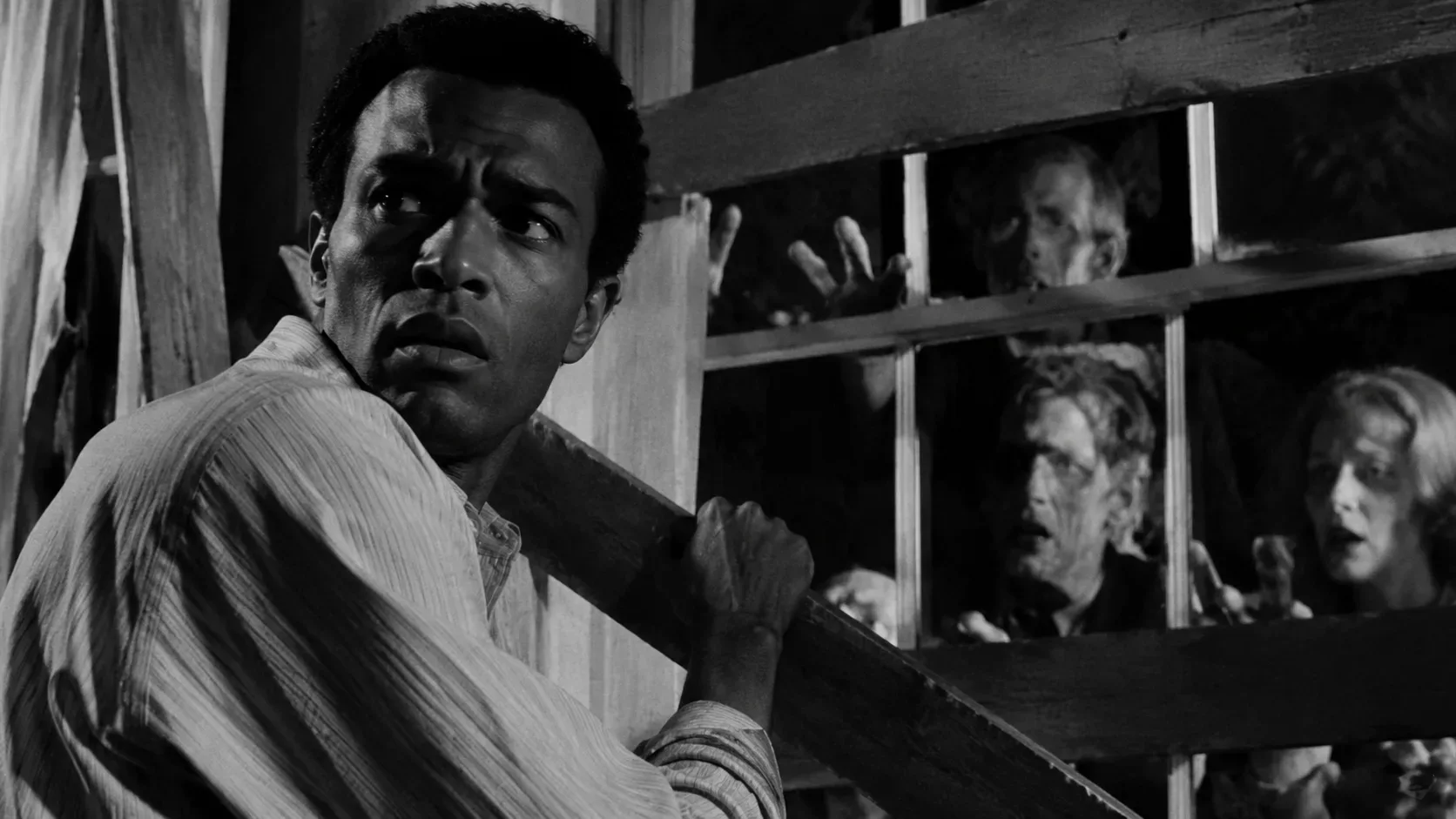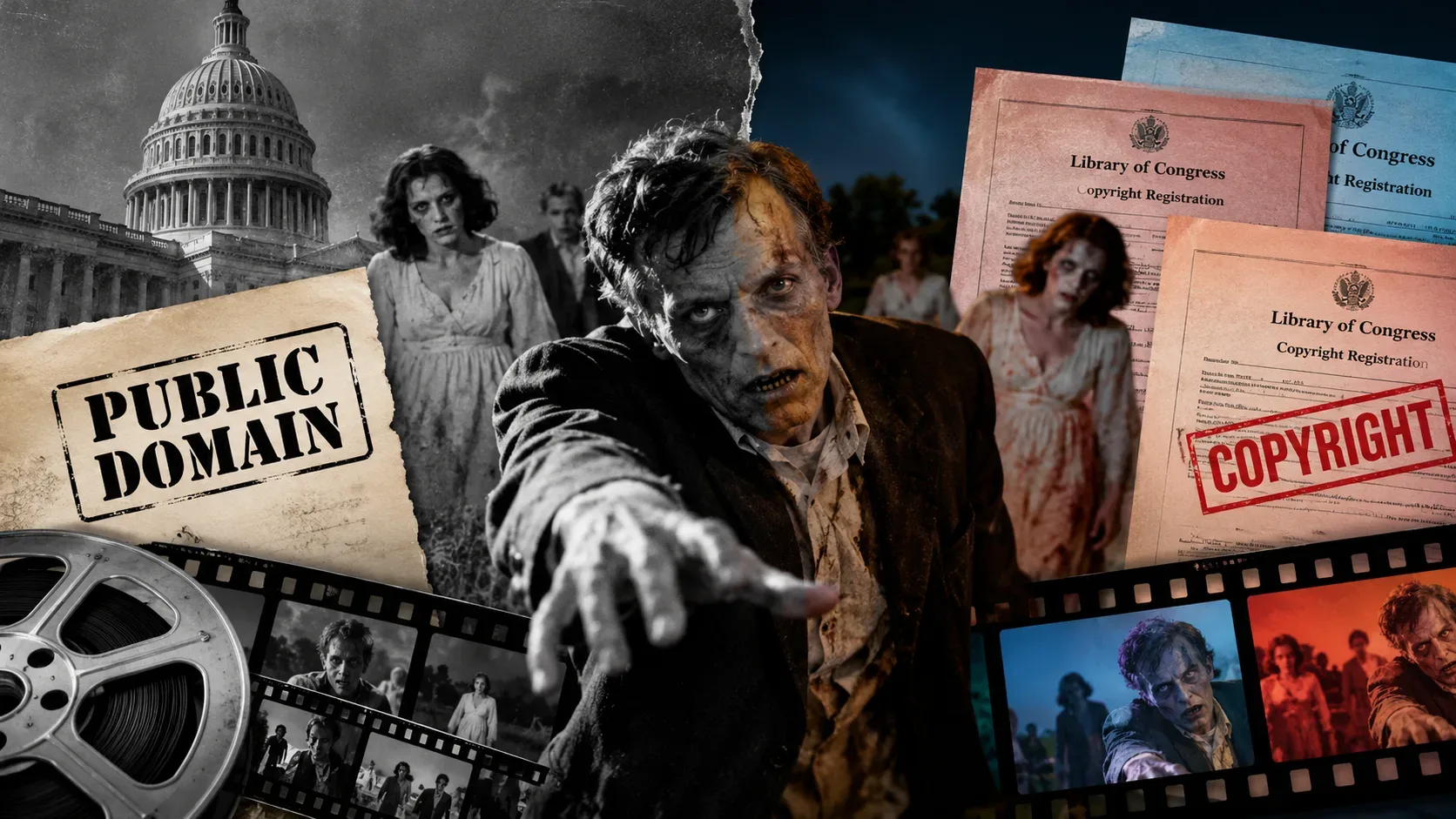
George A. Romero’s Night of the Living Dead (1968) is in the public domain in the United States because its release lacked the copyright notice required by the law then in force. That status does not automatically free creative material added in later editions. The Library of Congress documents the cancellation of the original film’s registration and lists two separate registrations for colorized versions. Those claims concern new coloring choices, not ownership of the original black-and-white film.
How a title change put the film in the public domain
The production had used the title Night of the Flesh Eaters. When it was changed to Night of the Living Dead, the opening title card was replaced, but the distributor failed to carry over the copyright notice. The U.S. Copyright Office recounts the mistake in its historical article Copyright Horror Stories.
That omission mattered in 1968. The 1909 U.S. Copyright Act imposed notice formalities on published works. Regulation 37 CFR 202.2 further explains that a pre-January 1, 1978 publication without the required notice could lose copyright protection upon publication, and adding a notice to later copies could not repair the loss. This historical rule should not be projected onto films first released today.
The Library of Congress catalog says registration PA46-101 for the original black-and-white version was canceled specifically because the film had been published before 1978 without a copyright notice. The entry reports no valid registration for that original version. This record, rather than the film’s age alone, supports the conclusion about its U.S. public-domain status.
Three different entries in the Library of Congress record
| Work or version | Dates stated in the record | Registration / claimant | Documented scope |
|---|---|---|---|
| Original black-and-white film | 1968 | PA46-101, canceled | Published without the required notice; original film in the U.S. public domain. |
| Colorized version no. 1 | Created in 1986; published Oct. 9, 1986; registered June 14, 1991 | PA542-023; RHI Entertainment, Inc.; stated authorship: Hal Roach Studios, Inc. | Claim to all added color work, not to the original film. |
| Colorized version no. 2 | Created in 1993; published Aug. 18, 1993; registered March 4, 1994 | PA687-953; CST Entertainment Imaging, Inc. | Claim to colorization of the preexisting motion picture. |
Creation, publication, and registration dates describe different events. The catalog also identifies surviving copies held by the Library, but neither custody nor a registration entry means that the Library owns the rights or has granted a license to reuse the material.
What colorization can protect, and what it cannot
Sections 101 and 103 of U.S. copyright law address derivative works. When a new edition incorporates enough original expression, copyright covers the new contribution alone and does not expand the rights in the underlying material. A copyrighted colorized version and a public-domain original can therefore coexist.
In a decision published on June 22, 1987, the Copyright Office recognized that certain computer-colorized films could qualify for registration. The criteria included numerous human color selections, more than trivial variation, and a material change in overall appearance. The Office also ruled out protection merely for changing a few colors, coloring a handful of frames, or removing color. Where registration was warranted, the protection covered the new selections of color only.
As a result, using an original black-and-white copy does not require permission from the owner of a later colorization just because that derivative version exists. Reproducing a particular colorized edition, however, may also reproduce its protected new contribution. Another creator may make an independent color version from the public-domain film, provided they do not copy the new elements of someone else’s edition.
Restorations, soundtracks, and national boundaries
Colorizing a movie is not the same as restoring it. Removing scratches, stabilizing footage, or making a faithful digital transfer does not automatically generate new copyright merely because the work was costly. The question is whether protectable original expression was actually added. New music, commentary, narration, or other creative additions may carry separate rights. A label such as restored or 4K does not by itself establish new rights over the original images.
Two limits are essential: the film’s public-domain status under U.S. copyright law does not establish public-domain status worldwide, and the colorization registrations do not confer a monopoly over every version of the movie. Anyone planning to use a particular release should identify the material it contains and the laws of the territory where it will be used. This article addresses U.S. copyright only and is not individual legal advice.
Sources and references
- Library of Congress: catalog record for the film and both colorized versions
- U.S. Copyright Office: Copyright Horror Stories (the missing notice)
- U.S. Copyright Office: 37 CFR 202.2 (notice for pre-1978 works)
- U.S. Copyright Office: Title 17, sections 101 and 103 (derivative works)
- U.S. Copyright Office: 1987 decision on registration of colorized films