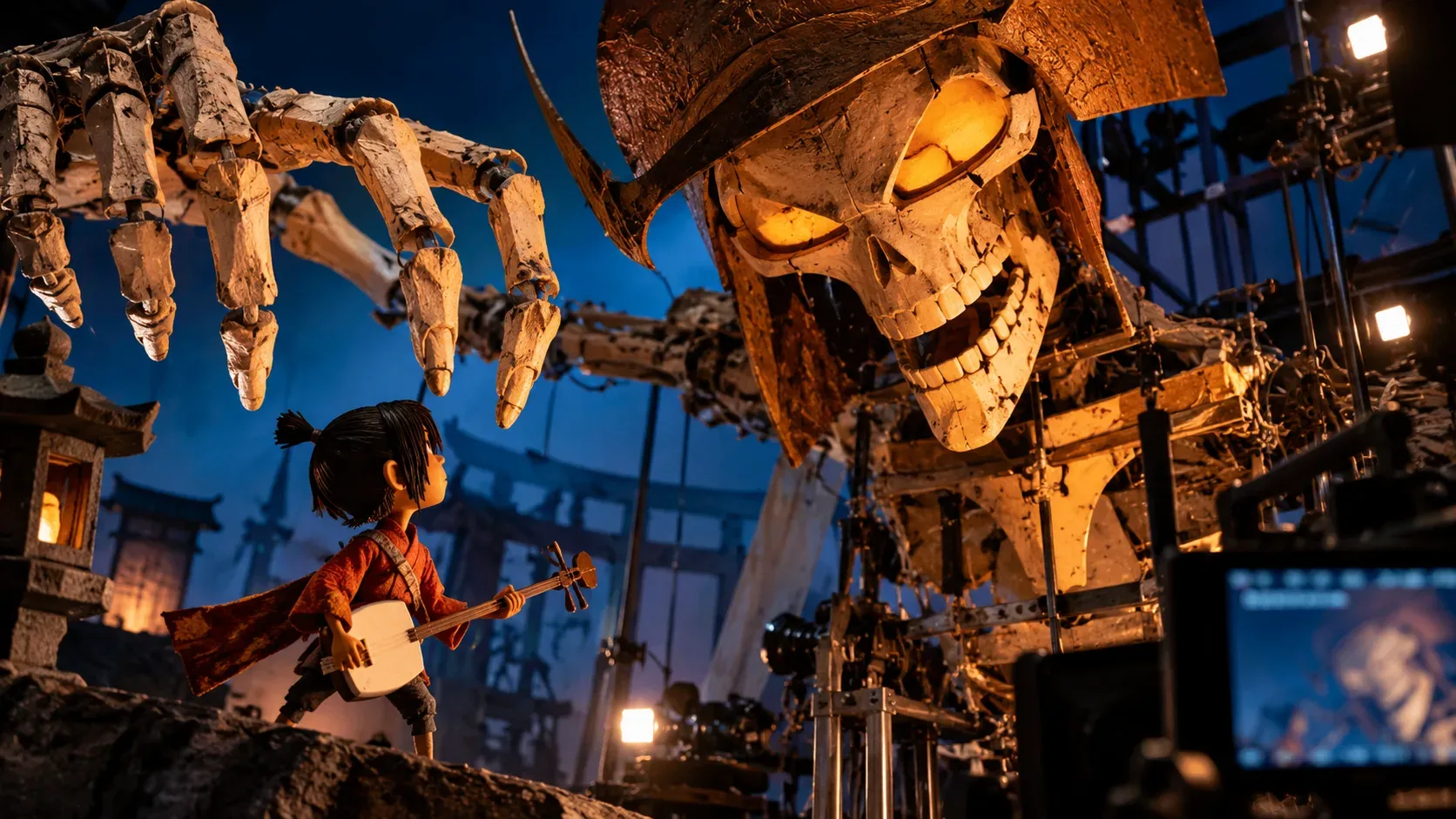
The Giant Skeleton in Kubo and the Two Strings (2016) was animated using a real puppet roughly 16 feet (4.9 metres) tall, rather than a monster built entirely in CGI. LAIKA mounted its torso on a six-axis mechanical platform, supported its arms with overhead cables and photographed tiny adjustments one frame at a time. Digital effects then removed the support equipment and extended the set.
The 16-foot measurement comes from Hidden Worlds, an exhibition organised with LAIKA, which also lists the puppet at about 400 pounds (181 kg). Sources do not all use the same height: visual effects supervisor Steve Emerson described the skeleton as 18 feet tall when fully assembled. Attributing those figures is more accurate than presenting them as one identical measurement.
Why build a skeleton almost as tall as a building?
It began as a scale problem. The characters in Kubo were generally made at approximately one-sixth human scale. A much smaller skeleton would also have required miniature versions of the heroes to photograph their interactions. As reported by Cartoon Brew, engineer Steve Switaj explained that those tiny puppets would have had little internal structure and been difficult to pose precisely.
The team therefore chose to keep the main characters at their usual scale and build a monster large enough for direct physical interaction. Smaller models were still part of the process: a second skeleton, just over 2.5 feet (about 76 centimetres) tall, was used for certain shots. LAIKA's documentation also says that the large puppet's upper and lower halves were photographed separately, with most footage featuring its torso.
Foam, magnets and joints that had to hold their position
The size made simply enlarging a conventional stop-motion armature impractical. The rigging team used high-density industrial foam that could be cut and hollowed out to reduce weight, alongside other finishing techniques, including papier-mâché-like elements. The figure was divided into sections so that it could be handled.
Instead of relying solely on the small ball-and-socket joints common in stop-motion puppets, clusters of magnets attached the arms and head to the torso. Its elbows used locks made from automobile brake pads to hold each pose between photographs. According to LAIKA's exhibition, each hand weighed around 6 pounds (2.7 kg). More than 1,000 bone-shaped pieces and 70 individually made swords decorated the figure.
How did the arms, hands and jaw move frame by frame?
At the heart of the system was a hexapod, a motion platform able to position the torso across three translation axes and three rotation axes. LAIKA says it took 27 days to build. The animator used a dedicated input controller connected to the motion and camera systems to make adjustments and steady the puppet before each exposure. Computers operated the machinery, but the animator still determined the poses.
The arms were too large to hold themselves up. Above the set, cables, counterweights, pulleys and stepper motors supported and repositioned sections of the limbs, much like the strings of a marionette. Animator Charles Greenfield moved around platforms and scaffolding to work with the system. Hands and fingers required dedicated adjustments; the eyes and jaw were manipulated by hand, following the timing sheets familiar from traditional animation.
After each movement, the machinery had to lock in place so the camera could expose a frame. That distinction matters: using robotics and electronic controls did not turn the skeleton into a computer-animated character. The real object was posed and photographed in sequence, one frame at a time.
What was physical, and what was added digitally?
The monster itself was physical, as were the set surfaces touched by the characters. But the Hall of Bones was not built in its entirety: a floor area and part of a wall were filmed, and the architecture was extended digitally. Computer Graphics World describes a stage area of about 360 square feet and a virtual wall rising to roughly 22 feet (6.7 metres).
Visual effects artists also removed visible cables and supports, repaired surfaces frame by frame and combined the photographed puppets with computer-generated environments. Supervisor Steve Emerson explained that the team aimed to preserve real puppets and physical contact points, using CGI when a scene needed to extend beyond them. The final image is therefore a blend of photographed puppetry and post-production, even though the main creature was a practical effect.
How much work went into just a few seconds?
According to Ian Failes's Cartoon Brew report, the larger skeleton took around six months to build and was filmed over approximately a year. That version produced 49.2 seconds of footage. This figure refers to material shot with the giant puppet, not the complete duration of the Hall of Bones sequence, which also used the smaller version and digital compositing.
The result required the team to solve separate problems in sequence: weight and structure to hold the body, locking mechanisms to preserve poses, fine controls to move it, and digital compositing to conceal the engineering. Its size is the most obvious achievement; making something that large move with stop-motion precision was the real technical breakthrough.