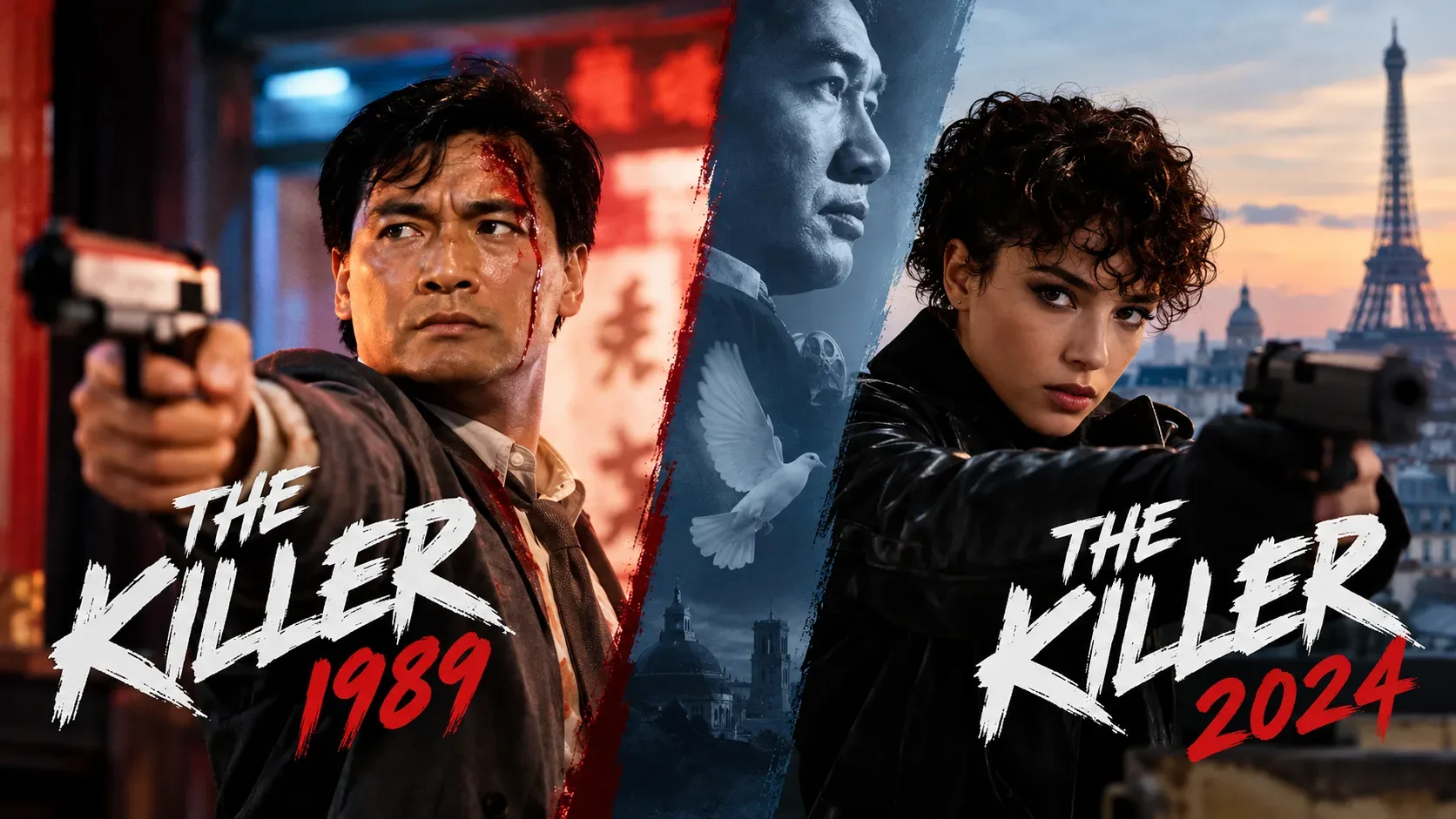
John Woo regards The Killer (2024) as another version of his 1989 story because it changes the lead character, reshapes the reason for protecting a singer, rebuilds the relationship with the detective, and chooses a different ending. That does not mean it is no longer a remake: the new production deliberately revisits the premise and dramatic roles of the Hong Kong film. The distinction is between the project’s place in the film industry and the director’s decision to reinterpret it.
A remake for the studio, another version for John Woo
Universal describes the 2024 film as a radical reimagining of its 1989 predecessor. Its US debut took place on Peacock on August 23, 2024, as announced by the streaming service. In an interview with TheWrap, however, Woo said he preferred to call the production another version of The Killer. The descriptions are not necessarily contradictory: remake defines the connection between the films, while another version expresses the artistic intention to change the story rather than simply reproduce its events.
The director said he had been reluctant to remake one of his own films. He became interested when screenwriters Josh Campbell and Matt Stuecken suggested changing the central character from a man to a woman. Brian Helgeland later reworked the screenplay, expanding the detective’s role and introducing changes in humor and the ending. Woo said the approach retained what he considered the spirit of the original.
What changed between Hong Kong and Paris?
Both stories retain the clash between a contract killer, an injured singer, and a police officer who recognizes the humanity of the person being pursued. The causes and consequences, however, differ. In the 1989 film, Ah Jong, played by Chow Yun-fat, accidentally injures the eyes of singer Jennie, played by Sally Yeh. Guilt and the attempt to restore her sight drive his decisions. Inspector Li Ying, played by Danny Lee, gradually becomes his ally.
In the Paris-set production, Zee, played by Nathalie Emmanuel, spares Jenn, portrayed by Diana Silvers, despite an order to kill her. That choice puts Zee at odds with her handler and under scrutiny from Sey, the detective played by Omar Sy. The singer remains central, but the drama now starts with a refusal to obey, followed by a criminal conspiracy.
| Element | The Killer (1989) | The Killer (2024) |
|---|---|---|
| Setting | Hong Kong | Paris |
| Contract killer | Ah Jong, played by Chow Yun-fat | Zee, played by Nathalie Emmanuel |
| Singer | Jennie, played by Sally Yeh; accidentally injured | Jenn, played by Diana Silvers; spared after the nightclub operation |
| Detective | Li Ying, played by Danny Lee | Sey, played by Omar Sy |
| Central conflict | Guilt, loyalty, and a growing bond between adversaries | Disobedience, pursuit, and broken alliances |
| Narrative approach | Tragic melodrama and bonds of honor | More room for humor and a different fate for the lead |
Changing the lead also reshapes the relationships
In the original, Ah Jong and Jennie develop a romantic connection, while the unlikely friendship between the killer and Li Ying anchors a conflict between professional duty and a personal moral code. The Guardian’s comparison notes that the 2024 film keeps the basic outline of those relationships but does not reproduce their emotional tensions in the same way. The revised screenplay gives more attention to Sey and his growing connection with Zee.
Changing the lead character’s gender therefore has consequences beyond casting. It affects how the story handles care for the singer and solidarity with the police officer. That is a change in dramatic construction, not a claim that the new film abandons Woo’s recurring concerns. Writing for Folha de S.Paulo, critic Sérgio Alpendre highlights the way the assassin and the detective mirror each other, as well as the blurred moral identities.
Why did the remake take so long?
According to Drew Taylor’s report for TheWrap, attempts to develop an American version began in the decades following the 1989 release. Several people were involved over the years, but no adaptation moved forward. Woo cited the difficulty of finding a convincing combination of director, cast, and screenplay. The version with a female lead ultimately persuaded him to direct it himself.
Lupita Nyong’o had been attached to the central role at an earlier stage. According to Woo’s account to TheWrap, she left amid changes to the script and other opportunities, with Nathalie Emmanuel eventually taking over. During the same period, the film shifted from a planned Universal theatrical release to a Peacock debut in the United States. That historical US release information should not be mistaken for a claim that streaming availability was identical in Brazil.
Woo’s Paris still bears the marks of Hong Kong action cinema
The change of city had a personal significance for the director. Speaking to TheWrap, Woo connected his wish to shoot in France with his admiration for Jean-Pierre Melville, particularly stories about solitary criminals such as Le Samouraï. Paris is therefore a cinematic reference, not merely a replacement setting.
The film retains stylistic touches associated with Woo, including dual-wielded guns, choreographed movement, and doves during action scenes. Critics did not assess those choices in the same way. At Folha, Sérgio Alpendre praised the staging and the relationship between Zee and Sey. In The Guardian, Jesse Hassenger found the 2024 story lighter and less romantic than the 1989 original while still acknowledging Woo’s action direction. These are two attributed critical perspectives, not a measured consensus.
Spoiler warning: the next section reveals the outcomes of both films. Stop here if you want to see either ending without knowing what happens.
Why does the 2024 ending change the meaning of the story?
The 1989 film ends tragically, with Ah Jong dying after violence destroys the possibility of a future with Jennie. His attempt to make amends and the bond between the characters end in loss, a defining feature of the film’s fatalistic tone.
In 2024, Woo accepted Brian Helgeland’s decision to give the new protagonist a less tragic way out. Zee survives and the ending suggests the possibility of leaving contract killing behind, while her partnership with Sey reaches a different resolution. Instead of repeating the original sacrifice, the new conclusion emphasizes the possibility of change. Woo’s interview with TheWrap confirms that the happier ending was a deliberate screenplay choice.
That is why calling The Killer (2024) a remake remains accurate in industry and critical terminology. Woo’s preference for another version helps explain his priority: keeping the idea of a killer with a conscience while rebuilding that person’s journey, relationships, and fate for a story set in Paris.